

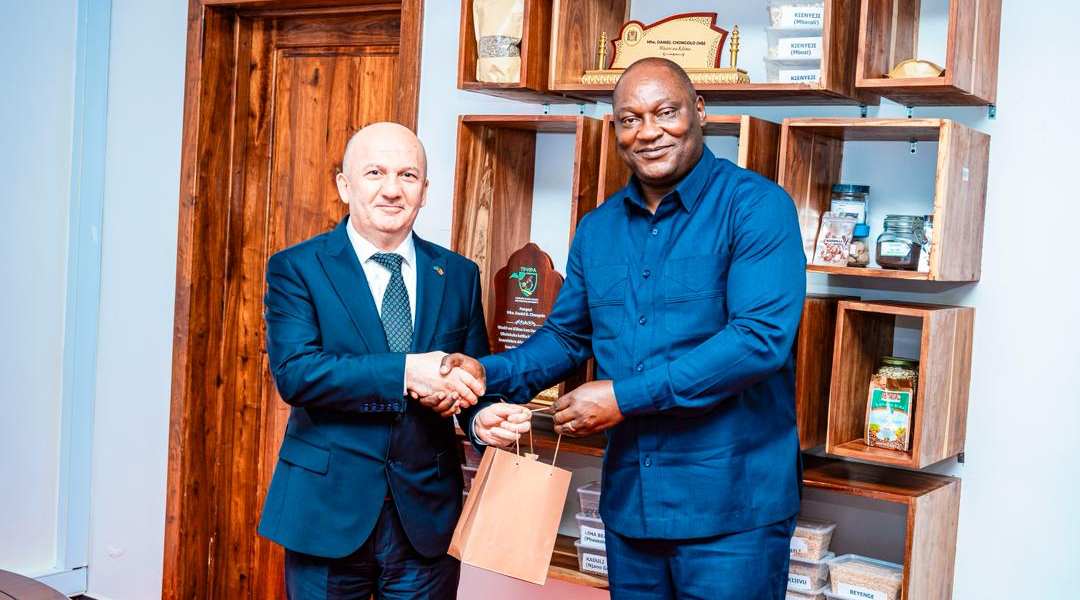
A decade after their first agricultural accord expired, Dodoma and Ankara are back at the table — this time eyeing irrigation, machinery, cold chains and the skills to run them
Feature story by Sifa Lubasi
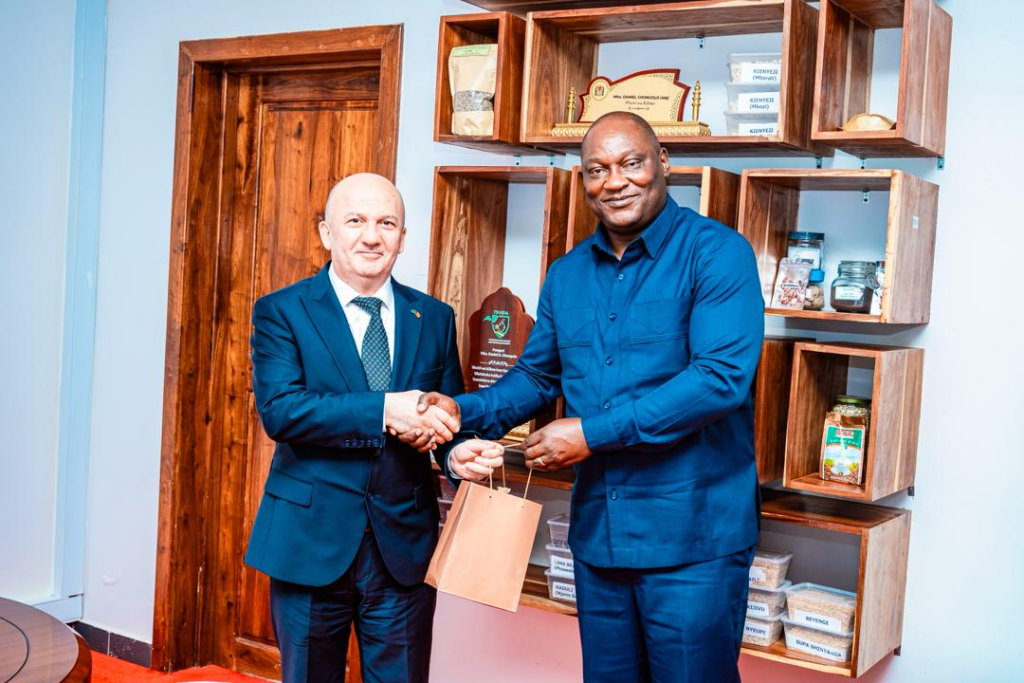
DODOMA — When Tanzania’s Minister for Agriculture, Hon. Daniel Chongolo (MP), sat down with Türkiye’s Ambassador, H.E. Bekir Gezer, on 17 June 2026, the conversation was less a first introduction than a reunion. The two countries had walked this road before, under a Memorandum of Understanding (MoU) on agricultural cooperation that ran from 2009 to 2014 and then quietly lapsed. A decade on, both governments signalled they are ready to pick it up again — and to make the second attempt more ambitious than the first.
The meeting reaffirmed a commitment to a strategic partnership in agriculture, deliberately framed around Tanzania’s Agriculture Master Plan 2050 (ADP 2050) and Agenda 10/30 — the twin frameworks that aim to transform farming from a subsistence livelihood into a productive, commercially viable industry growing at up to 10 percent a year by 2030. Agriculture remains the engine of the Tanzanian economy, employing the majority of citizens and underpinning rural incomes, food security and export earnings. For a sector of that weight, a partner with capital, technology and a track record on the ground is no small prize.
Four pillars of cooperation
The discussions reinforced the longstanding ties between the two countries and zeroed in on four priority areas — each chosen because it targets a stubborn bottleneck in Tanzanian agriculture.
Irrigation infrastructure sits at the top of the list. Tanzanian farming is still overwhelmingly rain-fed, leaving harvests hostage to increasingly erratic weather. Expanding irrigation is one of the clearest routes to higher, more predictable yields and to a second or even third planting season.
Mechanisation comes next. Low levels of tractor use and modern equipment keep productivity per worker far below potential. Turkish manufacturers — already significant exporters of machinery and agricultural equipment to the region — are well placed to supply both hardware and the maintenance know-how that too often goes missing.
Cold storage and post-harvest management may be the single most consequential pillar. Tanzania, like much of the continent, loses a painful share of what it grows to spoilage between farm and market. A follow-up statement from the Minister underscored that curbing those post-harvest losses is a central aim of the proposed MoU — a quiet but powerful lever, since reducing waste raises farmer incomes without a single extra acre being planted.
Technical support and capacity building ties the package together. Equipment and infrastructure deliver little without the skills and institutions to run them, and both sides flagged training and knowledge transfer as essential to making the partnership stick.
“A timely visit”
For Ambassador Gezer, the meeting was an occasion to celebrate the broader trajectory of relations. He praised the growing economic diplomacy between the two nations, pointing to the expanding presence of Turkish projects across health, education, fisheries, energy and trade. Agricultural collaboration, he stressed, is crucial both for farmers’ welfare and for Tanzania’s wider development.
Minister Chongolo, for his part, read the Ambassador’s outreach as a statement of intent.
“Your timely visit shows the commitment of your country in the renewal of a Memorandum of Understanding to enhance agricultural cooperation. Notably, our countries had a previous MoU from 2009 to 2014, so I commend your readiness to strengthen our economic ties,” he said.
The Minister went further, sketching the investment opportunities the two countries could pursue together: lifting agricultural productivity, and — crucially — moving up the value chain through value addition, agribusiness and agro-processing. The emphasis on processing is deliberate. Tanzania’s farm exports to Türkiye remain concentrated in raw commodities, and capturing more value at home is central to the Agenda 10/30 vision.
The TİKA factor
Much of the conversation turned on the Turkish Cooperation and Coordination Agency (TİKA), Ankara’s development arm and the institution most likely to translate goodwill into projects on the ground. Ambassador Gezer urged the Tanzanian government to make full use of TİKA’s programmes so that their benefits reach farmers directly — through technology transfer, training and infrastructure.
That encouragement rests on a real track record. TİKA has run a programme coordination office in Dar es Salaam for years and has delivered across exactly the sectors the Ambassador cited. In health, it has supported Muhimbili — Tanzania’s largest referral hospital — with everything from physiotherapy training to a renovated children’s emergency room, and brought Tanzanian medics to Türkiye for advanced surgical training. As recently as mid-2025 it ran a free medical campaign in Dodoma offering examinations and treatment across paediatrics, ophthalmology, dentistry and women’s health. In education, it has equipped science and computer laboratories at schools in Dar es Salaam, and it has long-running health and social programmes in Zanzibar.
Agriculture is where the next chapter would be written — and the regional template already exists. In neighbouring Kenya, TİKA recently completed a drought-resistant agriculture project in Wajir County, building a model farm with a solar-powered well, drip irrigation, a greenhouse and a nursery of climate-adapted tree species. The agency has also run beekeeping and women’s livelihood programmes across several countries. A Tanzanian equivalent, tuned to local crops and conditions, is precisely the kind of demand-driven project both sides were gesturing toward.
Trade on a steep upward curve
The agricultural push lands against a backdrop of fast-deepening commercial ties. Bilateral trade between Tanzania and Türkiye has grown roughly fivefold over the past decade — from about USD 60 million in 2011/12 to around USD 300 million by 2022/23 — with the Tanzanian Ministry of Finance putting the figure at USD 281.68 million. More than 900 Turkish companies now export to Tanzania, and the two governments have set their sights on a USD 1 billion bilateral investment target.
The architecture to support that ambition is falling into place. A Bilateral Investment Treaty has been in force since 2011, and in early 2026 the two countries signed a Double Taxation Agreement — Tanzania’s thirteenth — explicitly designed to give Turkish investors confidence that income will not be taxed twice across the two jurisdictions.
There is, however, an imbalance worth naming. Türkiye runs a surplus, exporting machinery, iron and steel, vehicles, plastics, textiles and processed foods, while Tanzania’s exports skew toward raw agricultural commodities — sesame, cashew nuts, tobacco, cotton, pulses, oilseeds and hides — alongside minerals. That asymmetry is exactly why the agro-processing and value-addition agenda matters: it is the most credible path to rebalancing trade in Tanzania’s favour, by selling finished goods rather than unprocessed raw materials.
Part of a wider diplomatic drive
The Türkiye talks are not happening in isolation. Tanzania’s Ministry of Agriculture has been on an assertive run of agricultural diplomacy in 2026 — deepening cooperation with the World Bank, agreeing with Belarus to collaborate on mechanisation and value addition, and courting partners around export crops from coffee to cashew. Domestically, the National Agricultural Extension Services Agency (NAESA) is scheduled to begin operations in July 2026, and the annual Nane Nane agricultural exhibition offers a ready stage to showcase the very technologies a renewed Türkiye partnership could bring.
In that context, the Dodoma meeting reads as one move in a coordinated strategy: assemble a coalition of partners — multilateral lenders, traditional allies and rising powers like Türkiye — each plugged into a different gap in the ADP 2050 roadmap.
Around the table
The meeting drew senior figures from across the agriculture establishment. In attendance were Prof. Peter L. M. Msoffe, Deputy Permanent Secretary (Crops Development and Food Security); Dr. Yasinta Nzogela, Director of Crop Development; Ms. Happy Pascal, Acting Director of Marketing and Food Security; and Ms. Tagie Daisy, Head of the Government Communication Unit in the Ministry of Agriculture. They were joined by representatives of the Embassy of the Republic of Türkiye in Tanzania and the Ministry of Foreign Affairs and East African Cooperation.
What comes next
The substance of the renewed partnership will be judged not by the warmth of a single meeting but by what follows it: a signed MoU, named projects, budgets and beneficiaries. The early signals are promising — a clear menu of priorities, an institution in TİKA with a proven delivery record in Tanzania, a trade relationship climbing steeply, and a national strategy hungry for exactly this kind of investment.
If the second attempt at a Tanzania–Türkiye agricultural pact can convert ambition into irrigation canals, working tractors, cold rooms and trained extension officers, it will do more than revive a lapsed agreement. It will move Tanzanian agriculture a measurable step closer to the productive, commercial, 10-percent-growth future that Agenda 10/30 promises.
Reporting draws on statements from the Ministry of Agriculture and contemporaneous coverage by The Citizen, The Guardian, Daily News and TanzaniaInvest, together with TİKA’s published project records.