

By Kilimokwanza Reporter | Nairobi • Dar es Salaam • Kampala
For generations, an East African beekeeper’s wealth was counted in honey and, occasionally, wax. That calculus is being rewritten across Kenya, Tanzania and Uganda, not by abandoning honey, but by recognising that a single colony is in fact a small factory producing a ladder of products, each worth far more than the last. At the top of that ladder sits a substance farmers once dreaded: the venom of the sting itself.
The clearest signal of the shift came in February 2026, when the Kenyan firm Savannah Honey launched in Utawala, Nairobi, what it describes as Africa’s first structured bee venom marketplace, with Co-operatives and MSMEs Cabinet Secretary Wycliffe Oparanya presiding. But the venom story only makes sense inside the larger picture, a regional industry that supports millions of livelihoods, underpins food production through pollination, and is straining to modernise fast enough to capture the value now on offer.
“Simply producing a hive product is no longer enough. The money is in meeting the exact grade, purity and traceability that high-value buyers demand.”
1. The big picture: a sector running below its potential
East Africa sits on some of the most favourable beekeeping country on the continent, yet harvests a fraction of what it could. Tanzania is the standout: with roughly 9.2 million honeybee colonies and forests and woodlands covering more than half its land area, it is the second-largest honey producer in Africa after Ethiopia and ranks around tenth globally. The sector supports an estimated two million livelihoods and contributes about US$77.5 million a year, close to one per cent of national GDP, yet the country produces about 31,000 tonnes of honey against an estimated potential nearer 138,000 tonnes. Only about a fifth of the opportunity is being realised.
Kenya tells a similar story from the demand side. A 2024 survey put national output at roughly 19,000 tonnes against demand of more than 43,000 tonnes, leaving a structural deficit filled by imports, even as the national hive count climbed from about 1.2 million in 2019 to 1.6 million in 2023. Officials and researchers warn that bee populations are under pressure from pesticide misuse, deforestation and a flood of adulterated honey, and that Kenya risks slipping into permanent net-importer status. Apiculture accounts for only about two per cent of livestock GDP, but its indirect value, through pollination, is far larger.
Uganda has strong production but has been locked out of the lucrative European market for the best part of two decades over standards and compliance, a reminder that production volume means little without the certification to sell into premium markets. Across all three countries, the same gap recurs: abundant natural potential, thin realisation.
| Indicator | Kenya | Tanzania | Uganda |
| Honey output | ~19,000 MT/yr (2024 survey) against ~43,000–47,000 MT demand | ~31,000 MT/yr; 2nd in Africa, ~10th globally | Sizeable producer; honey shut out of the EU for nearly two decades |
| Potential vs realised | Potential ~100,000 MT; only ~20% realised | Potential ~138,000 MT honey; only ~22% realised | Strong potential, constrained by market access and standards |
| Livelihoods | ~91,000 directly employed; apiculture ~2% of livestock GDP | ~2 million livelihoods; sector ~US$77.5m/yr (~1% GDP) | Widespread smallholder participation |
| Venom signal | Africa’s first structured venom marketplace (Nairobi, Feb 2026) | Venom recognised in 2005 apiary rules; detailed regulation lacking | Affordable local collector (~USh 600,000 vs ~US$2,000 imported) |
Figures drawn from ITC, FAO, KIPPRA, Kenyan government surveys and 2025–26 sector reporting; volumes are indicative and vary year to year.
2. Mapping the chain: from forager to finished product
A modern apiculture value chain runs through five broad stages, and East Africa loses value at almost every one.
Production: the hive itself
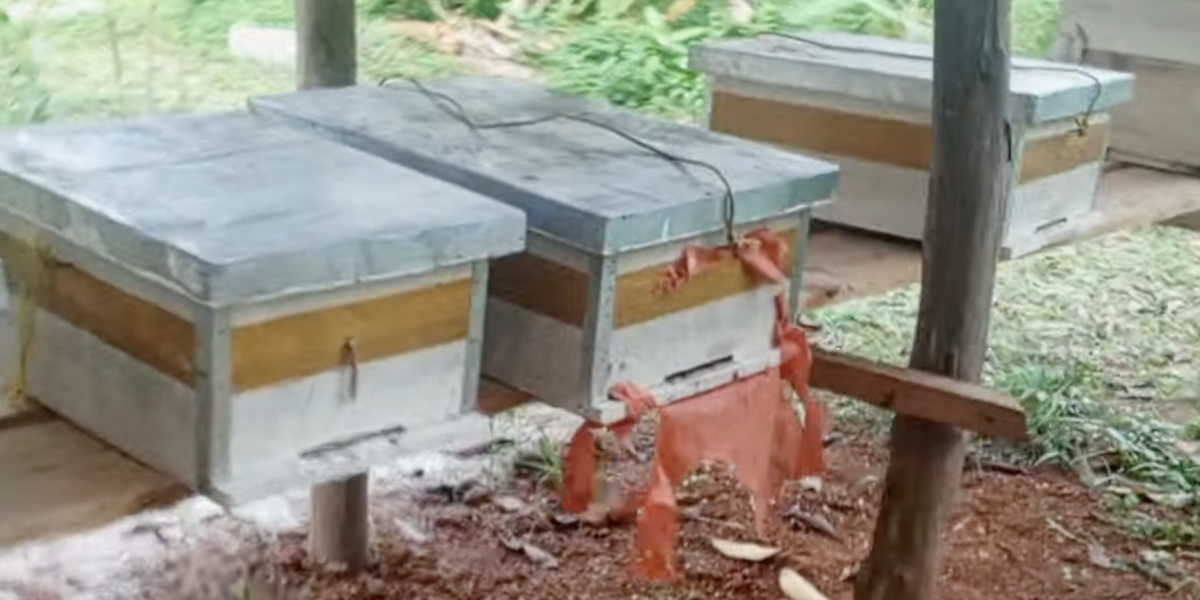
The foundation is the hive, and here technology is decisive. Traditional fixed-comb log hives still dominate (in Kenya they account for roughly 80 per cent of honey produced) but they yield little and make it hard to harvest clean, gradeable product. Field evidence is stark: in one Tanzanian study, movable-comb top-bar hives achieved about 85 per cent colony occupancy and some 22 kilos of honey per hive, against roughly 65 per cent occupancy and barely 8 kilos for log hives. Kenya Top Bar (KTB) and Langstroth systems, and innovations such as durable hives moulded from recycled plastic, are the entry point to everything above honey on the value ladder.
Aggregation and handling
Because most beekeepers are smallholders with a handful of hives, volumes are small and scattered. Without aggregation, farmers have weak bargaining power and buyers cannot assemble consistent, traceable lots, the precise thing pharmaceutical and cosmetic buyers require. Hygienic harvesting (centrifugal extractors rather than crushed comb), correct drying and proper storage determine whether a product reaches food or pharmaceutical grade.
Processing and value addition
This is where the largest margins are captured, and where the region is weakest. Raw honey sells for a few hundred shillings a kilo; refined, branded, certified and diversified product earns multiples of that. Tanzania is building five modern honey processing factories partly to open the Chinese market, while Kenyan firms such as Savannah Honey run KEBS-certified processing lines turning out honey, wax, propolis, pollen, royal jelly and venom-infused products.
Marketing, certification and export
The final stage is where standards bite. A Kenyan labelling study found that all 24 domestic honey samples examined failed to meet front-of-pack labelling requirements, leaning on vague claims of “natural” and “pure”, while imported brands fared somewhat better. For export, EU and other sanitary requirements are exacting; for venom, pharmaceutical and cosmetic buyers want 95–99 per cent purity with full traceability. Certification, geographical branding and market intelligence are the levers that convert volume into premium revenue.
3. The product ladder: seven income streams from one hive
The strategic insight reshaping the region’s thinking is that a hive is not a honey machine but a portfolio. Each rung up the ladder carries higher value, higher skill and higher returns, culminating in venom and, above even that, the invisible value of pollination.
| Hive product | Indicative value (East African market) | Primary uses |
| Honey | ~KSh 400–500 a kilo farm-gate; higher retail and for monofloral grades | Food, beverages, nutraceuticals, traditional medicine |
| Beeswax | Worth more per kilo than honey; routinely discarded in the region | Cosmetics (~40%), pharma (~30%), candles (~20%), comb foundation |
| Propolis | Around KSh 1,900 a kilo raw; far more as tinctures and capsules | Antimicrobial tinctures, throat and immune supplements |
| Bee pollen | Around KSh 6,800 a kilo | Protein-rich superfood, supplements |
| Royal jelly | Premium; only 200–300 g per hive a year, refrigerated handling | High-end supplements, cosmetics |
| Bee venom (apitoxin) | ~KSh 4,000 a gram locally (~KSh 4m/kg, ~US$30,000); up to US$100/g abroad | Pharmaceuticals, anti-ageing cosmetics, apitherapy |
| Pollination services | Largely uncosted, yet the single largest economic contribution | Crop yields, fodder, biodiversity, food security |
Prices are indicative local figures from producer interviews and traders, and vary with grade, purity and season.
Beeswax is the most under-exploited near-term opportunity: it fetches more per kilo than honey, splits globally between cosmetics, pharmaceuticals and candle-making, and yet is routinely thrown away in African honey houses. Because African beekeepers tend to use few or no chemical treatments, the region is well placed to supply the residue-free, organic-grade wax that is genuinely scarce on world markets.
Propolis, pollen and royal jelly climb steeply in value but demand technical skill: royal jelly, secreted only for queen larvae, must be harvested through queen-rearing and kept refrigerated, while propolis and pollen need clean collection and careful storage. Each already sells in Nairobi as tinctures, capsules and supplements, evidence that domestic value-addition is viable, not theoretical.
4. Bee venom: the apex product
Venom is where the economics become spectacular. It trades locally at around KSh 4,000 a gram (roughly KSh 4 million, or about US$30,000, a kilogram), with international prices quoted far higher. A well-managed hive can yield around 10 grams a year, so 50 hives could earn some KSh 2 million annually from venom alone, before any honey, wax or propolis. Crucially, venom can be collected regularly rather than seasonally, in sessions of under an hour, smoothing a beekeeper’s income through the year.
The demand is real. The global bee venom extract market is valued at about US$438 million in 2026 and is projected to reach roughly US$726 million by 2036, growing around five per cent a year, with pharmaceutical applications the largest segment and Asia-Pacific the fastest-growing region. Venom’s active peptides, chiefly melittin and apamin, underpin anti-inflammatory, analgesic and neuroprotective research, while in cosmetics it is marketed as a natural alternative to botulinum toxin.
Home-grown technology levels the field
What makes the venom story authentically East African is that the region is building the tools, not just supplying raw material. In Kenya, Patvention, founded by Patrice Murugi Wachira, has patented an ethical collection device that uses gentle stimulation to draw venom onto glass plates without killing bees. Assessments credit it with lifting extraction efficiency by around 30 per cent while cutting colony stress sharply, and the company also builds hives from recycled plastic. In Uganda, a locally manufactured collector retails near USh 600,000, against roughly US$2,000 for imported units, putting the technology within smallholders’ reach.
A marketplace, not just a product
Savannah Honey’s February 2026 platform is significant less for the price it quotes than for the architecture it imposes: standardised collection, handling and storage protocols, a guaranteed buying price, and a traceability system tracking venom from hive to export. The company, which says it works with close to 16,000 contracted farmers, announced plans to contract and manage 10,000 hives within months to meet existing export orders. That is the missing institutional layer, aggregation plus standards plus a route to market, that the rest of the value chain still lacks.
5. The invisible value: pollination
Above every priced product sits one that rarely appears on any invoice. Bees pollinate an estimated three-quarters of crop species, directly shaping yields, quality and farm productivity. In Kenya, where agriculture contributes between a fifth and a third of GDP and the country meets only about 40 per cent of its livestock feed requirement, healthier pollination would lift fodder and food crops alike. Viewed this way, beekeeping is not a rural side-hustle but strategic agricultural infrastructure: protecting bees protects the wider food system.
“The biggest contribution a bee makes is not honey, and not even venom: it is the crop it pollinates on the farm next door.”
6. The bottlenecks
For all the momentum, the chain is built on thin ground. Five constraints recur across the region:
- Regulatory gaps. There is no harmonised legislation or quality standard for high-value products such as venom. Tanzania’s 2005 rules name venom as an apiary product but stop short of detailed regulation; Uganda’s venom and apitherapy trade is largely unregulated; and Kenya’s attempts to formalise apiculture through successive Livestock Bills, with mandatory registration and stiff penalties, have repeatedly stalled amid fears they would crush smallholders, with an earlier version withdrawn for consultation.
- Quality and market access. Poor hygiene, weak grading and labelling non-compliance lock producers out of premium markets, while venom buyers demand 95–99 per cent purity and cold-chain handling that few can yet meet.
- Production inefficiency. Heavy reliance on low-yield traditional hives, limited modern equipment and patchy training keep volumes and quality down.
- Bee-health threats. Pesticide misuse, deforestation and pests and diseases such as Varroa mites and Nosema erode colony health, though integrated pest management in East Africa has shown a benefit-cost ratio of about 8:1 and a net present value near US$500 million, supporting food security for hundreds of thousands of people.
- Fragmentation and finance. Scattered, unorganised producers have weak bargaining power and little access to the credit needed to invest in modern hives and processing.
7. A road map for the next harvest
The path forward is less about discovery than discipline, building the rules, facilities and institutions that let the region keep the value at home.
- Modernise the hive base. Subsidise and locally manufacture KTB, Langstroth and recycled-plastic hives, and the affordable collectors that unlock venom, propolis and pollen.
- Legislate clearly. Enact harmonised, smallholder-friendly standards for each product, including venom quality and apitherapy safety, developed with beekeepers rather than imposed on them.
- Invest in processing and cold chain. Back hygienic, certified facilities for extraction, purification and storage, the layer where margins are captured.
- Aggregate and finance. Strengthen cooperatives and inclusive contracts, and provide tailored micro-finance so farmers can invest and bargain collectively.
- Certify, brand and chase intelligence. Pursue regional certification and geographical branding, fix labelling, and equip farmers with live market data, including the traceability premium buyers will pay.
- Anchor research and inclusion. Partner with icipe, KALRO’s apiculture institutes, Tanzania’s beekeeping institutes and donor programmes (ITC–ENABEL, FAO, AfDB, UNDP), and deliberately bring women and youth, already leading ventures like Patvention, into the core of the chain.
The pieces are now on the board: a working venom marketplace in Nairobi, patented collection technology, affordable Ugandan hardware, Tanzanian processing capacity aimed at Asia, and a regional resource base that remains four-fifths unrealised. The question for Kenya, Uganda and Tanzania is no longer whether the bee economy can be worth far more than honey. It is whether they can build the standards, laboratories and trust fast enough to keep the value, the liquid gold and everything beneath it, inside East Africa.
Reporting notes and sources
This feature draws on: ITC/ENABEL and FAO data on the Tanzanian and regional beekeeping value chain; a 2025 peer-reviewed review of Tanzania’s beekeeping sector (PMC); KIPPRA and Kenyan government (2024–26) honey-deficit and employment figures; The Star, Mwakilishi, Ecofin Agency and Radio 47 coverage of the February 2026 Savannah Honey venom marketplace; the African Development Bank, Vital Voices and GoGettaz on Patvention and Patrice Murugi Wachira; Daily Monitor on Uganda’s locally made venom collector; Daily Nation (Seeds of Gold) on multi-product beekeeping and pollination; a 2025 MDPI study on Kenyan honey labelling; Kenyan parliamentary and legal commentary on the Livestock Bill; and Future Market Insights’ 2026 bee venom extract market analysis. Prices are indicative and vary by grade, purity and season.
Prepared for Kilimokwanza.org