

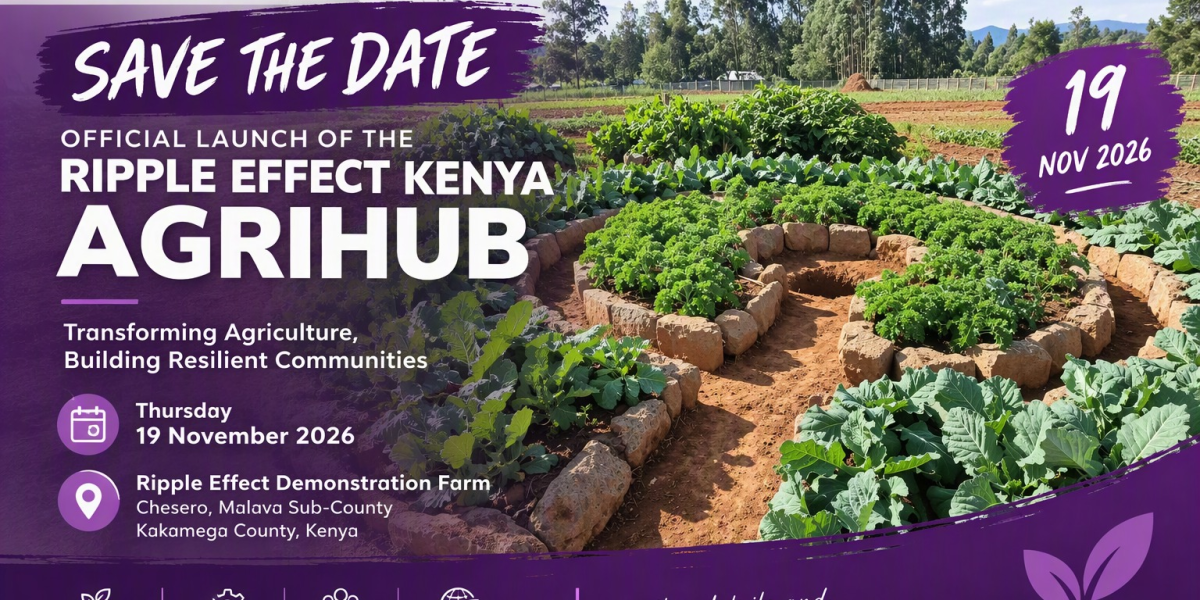
A five-acre demonstration and learning site backed by Riverford aims to connect sustainable farming, livestock development and rural enterprise in western Kenya.
By Kilimokwanza.org Team
KAKAMEGA, Kenya, 19 November 2026 — Ripple Effect Kenya is scheduled to launch a five-acre Agroecology Hub in Chesero, Malava Sub-County, today, creating a practical learning space for farmers seeking to improve production, protect their soils and develop rural businesses.
According to a press release issued ahead of the launch, the hub has been developed with funding from Riverford. It is intended to bring farmers, technical experts and partners together to demonstrate sustainable farming methods and explore opportunities for stronger, more resilient livelihoods.
The organisation said the site would combine agroecology, farmer learning, livestock-related demonstrations and market-oriented agricultural development. Further infrastructure and facilities remain under development.
Five acres of practical learning
The hub is divided into five functional zones and already features fruit trees, cereals, indigenous vegetables, horticultural crops and forage grasses, according to Ripple Effect.
Its demonstration gardens include keyhole, mandala, double-dug and sunken-bed designs. These different layouts will give farmers and partners a setting in which to explore farming approaches through observation and practical learning.
The longer-term aim is to support techniques that improve soil health, diversify production and strengthen resilience to changing weather patterns. The site is being developed as a place to demonstrate and share knowledge rather than simply present farming ideas in a classroom.
Connecting farming with rural enterprise
Alongside its learning role, the hub is intended to explore income-generating opportunities through seedlings, planting materials and other agricultural products.
Ripple Effect said these activities would help build a sustainable model for continued learning and engagement. The emphasis on market-oriented development connects the environmental aims of the project with the practical need for farming families to earn an income.
The scheduled launch is expected to bring together representatives of county government, farmer organisations, development partners, research institutions, private-sector actors and local communities. It will introduce the hub’s vision and the demonstrations already in place.
A space for locally relevant solutions
Alfred Juma, Programme Manager at Ripple Effect Kenya, said the hub was intended to respond to the realities faced by farming communities.
“The Agroecology Hub is an opportunity to bring farmers, technical experts and partners together around practical solutions that respond to the realities of farming in our communities. We want this space to become a place where knowledge is demonstrated, shared and translated into stronger, more resilient livelihoods,” Juma said in the release.
The initiative builds on Ripple Effect’s wider work with rural farming families in Kenya, combining sustainable agriculture, gender and social inclusion, and enterprise development to support locally led change.
Ripple Effect is an international development organisation working with farming families in eastern and southern Africa. Its work emphasises practical learning and farmer-to-farmer knowledge sharing, alongside efforts to help households grow more food, earn sustainable incomes and protect the natural environment.
This story is based on Ripple Effect Kenya’s pre-launch press release, dated 13 November 2026. The launch was scheduled for 19 November; completion of the event had not been independently confirmed at publication.
More information: Ripple Effect.
Related reading

Do you have a story or press release for African agriculture? Send it to kilimokwanza.africa@gmail.com or read how to submit.