

Twenty Years of Structured Trade: How the Warehouse Receipt System Rewrote Tanzania’s Crop Markets, and Where It Goes Next
Over two decades, the Warehouse Receipts Regulatory Board has moved more than 5.2 billion kilogrammes of produce worth above TSh 11.3 trillion through licensed warehouses, created over 30,000 jobs across 23 regions, and turned a sack of crops into a bankable asset. As the Board marked its 20th anniversary in Dodoma, day two looked outward, to the EAC, SADC and AfCFTA, while a flagship panel chaired by the AGCOT Centre tied the system to Tanzania’s Vision 2050, and Prime Minister Dr Mwigulu Nchemba used the closing keynote to set an ambitious new agenda.
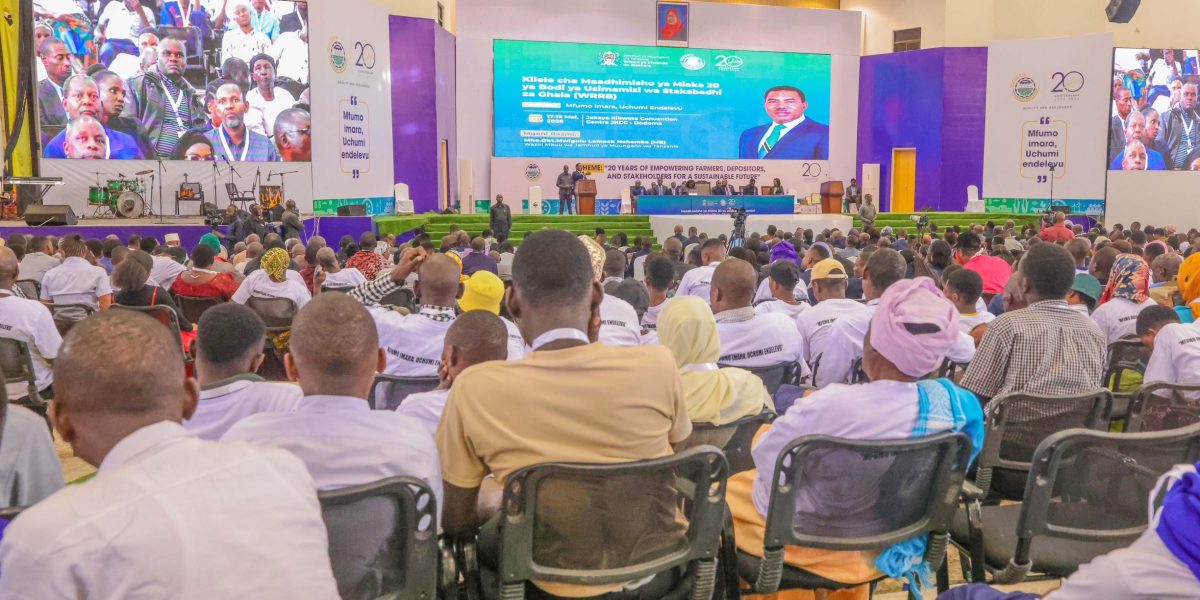
For most of Tanzania’s post-independence history, the smallholder farmer harvested in hope and sold in haste. Without secure storage or a guaranteed buyer, peak-season gluts pushed prices to the floor, and the financial reward of a year’s labour drained away from the village to urban middlemen and speculators. It was to break that cycle that the Government created the Warehouse Receipt System (WRS) two decades ago. This week, at the Jakaya Kikwete Convention Centre in Dodoma, the institution that regulates it, the Warehouse Receipts Regulatory Board (WRRB), celebrated 20 years of doing exactly that, under the theme “Mfumo Imara, Uchumi Endelevu” (A Strong System, a Sustainable Economy).
The three-day commemoration (17 to 19 May 2026) was deliberately structured as a progression: from the physical infrastructure of the system, to its place in the regional and continental economy, to a national keynote that set the terms of its third decade. This report follows that arc.
Day OneFrom the Warehouse Floor to the Exhibition Hall
The anniversary did not begin with speeches. It began on the ground. Ahead of the main programme, on 16 and 17 May, stakeholders were taken on structured tours of modern, licensed warehouses across the Dodoma region, an opportunity to inspect, first-hand, the physical storage infrastructure on which the entire system depends. It was a fitting opening for an institution whose credibility rests on grading, weighing, secure storage and quality control rather than rhetoric.
The formal celebrations had in fact been set in motion months earlier, with an official media launch on 27 January 2026 led by the Deputy Minister for Industry and Trade, Hon. Denis Londo, who traced the Board’s two-decade journey and used the occasion to press a point that would recur throughout the anniversary: that the system’s single greatest vulnerability is delay in paying farmers once their produce is sold. When settlement drags on for weeks, Mr Londo warned, a farmer is effectively extending an interest-free loan to a cooperative or the wider system, and that erosion of trust is what pushes producers back into the arms of unregulated cash buyers.
On the evening of 17 May, Deputy Minister Londo formally opened the main exhibition at the Jakaya Kikwete Convention Centre, followed by opening remarks from WRRB Executive Director Asangye Bangu. The exhibition floor itself told the story of how far the system has travelled: stands showcasing agricultural finance products, commodity-trading platforms, logistics and storage technologies, certified weighing and “smart scale” equipment, and value-chain services, a marketplace of the very tools that have professionalised Tanzanian crop trade.
Day TwoLooking Outward to EAC, SADC and AfCFTA
If day one was about infrastructure, day two was about ambition. The second day, with the Minister for Industry and Trade, Hon. Judith Kapinga, as guest of honour, was given over to a series of technical panel discussions, and the dominant theme was regional and continental market integration.
Stakeholders debated how Tanzanian producers and institutions can position themselves competitively within the markets of the East African Community (EAC), the Southern African Development Community (SADC) and the African Continental Free Trade Area (AfCFTA). The consensus was that regional cooperation offers a substantial opportunity for traders and institutions to widen the market for their goods and services while growing the national economy. But opportunity, delegates stressed, is conditional: to compete in international markets, Tanzania must keep raising product quality and adopt robust, modern trading systems. The warehouse receipt model, with its certified weights, enforced grades, electronic receipts and transparent auctions, was presented as precisely the kind of infrastructure that makes regional and global competitiveness credible rather than aspirational.
This outward-looking framing was reinforced by the pan-African composition of the forum. Sessions over the celebration drew commodity-exchange and warehouse-receipt leaders from across the continent, including Kenya, Rwanda, Malawi, Zambia and South Africa, alongside the Eastern Africa Grain Council, underscoring that buyers can now bid in real time for Tanzanian cashew, sesame and pulses from anywhere in the world through digital auctions. Tanzania’s two-decade experience was repeatedly held up as a reference model for structured commodity trade in Africa.
The AGCOT-Led Flagship Panel: Tying the WRS to Vision 2050
The intellectual centrepiece of day two was a high-level panel moderated by Geoffrey Kirenga, Chief Executive Officer of the Agricultural Growth Corridors of Tanzania (AGCOT) Centre, the body that grew out of, and now scales nationally, the Southern Agricultural Growth Corridor of Tanzania (SAGCOT). The choice of moderator was deliberate and significant. AGCOT is the institution charged with building a USD 100 billion agricultural economy by 2050, and Kirenga is also a member of the President’s advisory council on agriculture and food systems, chaired by the retired Prime Minister, Hon. Mizengo Pinda, placing him at the centre of national agricultural strategy. Opening the session, Kirenga set its terms plainly: a short, sharp discussion to assess the WRRB’s contribution to Vision 2050 and its role in growing national GDP, with each panellist given no more than five minutes. By the close, he said he was beginning to see every indication that Vision 2050 was being implemented with greater force and certainty.
The panel brought together a deliberately broad cast, each speaking to a different link in the chain:
- Asangye Bangu, Director General of the WRRB, framed the system as a major, formalising solution for crop trade and pointed to three observable effects of putting a commodity through the WRS. First, production rises for every crop drawn into the system, cashew and sesame among them, with the country now trading on the order of a million tonnes a year, which he called a major revolution. Second, quality improves, because producers learn, delivery by delivery, that the grade they arrived with is not the grade they could achieve. Third, incomes rise, as larger, better-organised volumes attract buyers and the money becomes visible in farmers’ everyday lives. He also offered a plain-language definition for the audience: a stakabadhi is a receipt; a ghala is a place of safekeeping, which may be a building, a livestock pen or even a farm, and the document handed over when a commodity is deposited for storage is the warehouse receipt itself.
- Dr Crispin Kitimbo, Deputy Executive Secretary for Trade and Innovation, National Planning Commission, located the discussion firmly within Vision 2050, noting that trade, innovation and industry are difficult to separate and that the industrial sector is both a significant contributor to GDP and a connector across other sectors. Trade, he argued, is a catalyst: by tapping the opportunities in regional economic blocs such as the East African Community (EAC) and the African Continental Free Trade Area (AfCFTA), as well as global trade, Tanzania can reach far larger markets, build economies of scale, and expose its producers to the kind of competition that forces continuous upgrading of product quality. Innovation, he added, is not only about high technology but about how investment and business are executed, moving beyond “business as usual” to cut costs, improve quality and unlock new streams of income.
- Raymond Urassa, of the National Bank of Commerce (NBC), connected the system to the Vision 2050 targets of a USD 1 trillion economy and roughly USD 7,000 in per-capita income, and explained how the WRRB’s framework has unlocked commercial lending to farmers and value-chain actors. Because the system raises and records farmers’ incomes, and links to data from the TMX, COPRA and the cooperative authorities, banks can assess creditworthiness and serve clients they previously could not reach. He stressed that finance is moving away from traditional, tangible collateral: the system itself now suffices, allowing cooperatives to borrow for vehicles, warehouses and inputs, and farmers to receive advance payments rather than turning to private lenders at punishing interest. Citing the 2023 FinScope survey, he noted that only around 15 per cent of Tanzanians hold the kind of property documents banks traditionally demand as security, and that the warehouse receipt system is precisely how the financial sector can reach the large majority who do not. His ambition, echoing a point raised earlier by the Registrar of Cooperative Societies, is full system integration, so that the moment a farmer’s produce is weighed, the data flows into the financial system and an advance payment can be released instantly.
- Abdul Karim Masudi, Chairman of the warehouse operators, spoke for the businesses at the physical heart of the system. The operator’s core task, he explained, is to receive a depositor’s consignment and certify its quality, accepting only produce that meets national and international sale standards, and either rejecting substandard goods or working to improve them. That guarantee is what allows a buyer purchasing from a warehouse to trust that quality and quantity are exactly as stated, rather than haggling a farmer down on spurious grounds at the farm gate. Operators are now investing in modern warehouses to replace ageing facilities, and for sesame and copra are installing cleaning machinery so that the purity of a stored consignment is assured, in his words, certainty that what was promised is what was delivered.
- Roda Ezekiel, of the Tanzania Pastoralists Association (Umoja wa Wafugaji Tanzania) and a livestock keeper herself, made the case for the system’s most ambitious frontier: extending it to livestock. The model, she said, would resolve the chronic market-access problem that has long forced pastoralists to sell cheaply or transport animals over vast distances in search of a buyer. Under the design, a keeper’s grazing land becomes the ghala, with two tiers: large holding facilities equipped with water, feeding and fattening infrastructure, and smaller community ranches set aside by government and local authorities for smallholder keepers. Auctions would take place close to home, building fairer price formation for keeper and buyer alike and cutting out exploitative middlemen. Her message to fellow pastoralists, delivered to camera, was to prepare for opportunities in fattening, in the fodder business, and in qualifying their land as registered holding facilities. She has toured Katavi, Ruvuma, Lindi and Morogoro with Mr Bangu to ready the sector.
Returning to the livestock question, Mr Bangu gave the most concrete glimpse yet of how the frontier will work. Having visited Liwale, Katavi and Sumbawanga himself, he described the urgent need for a formal selling system, noting that livestock at auction is currently not weighed but sold by visual estimate, with the price hinging on whoever bargains hardest. The journey, begun with NBC four years ago, is now close: the Ministry of Livestock is finalising the arrangements. Crucially, President Samia Suluhu Hassan’s directive to ear-tag the national herd becomes the mechanism: the ear-tag number will function as the warehouse receipt. Once an animal enters a registered holding facility, he said, NBC has agreed to advance up to 70 per cent of its value, with the animal weighed weekly; a receipt might read one million shillings today and, with good feeding, one-and-a-half million later. To sell, the keeper need not move the animal at all: paper is exchanged for cash while the beast keeps feeding inside the facility.
The day’s technical programme also featured presentations and supportive messages from a wide span of institutional partners: the Registrar of Cooperative Societies, the Director General of the Cashewnut Board of Tanzania, the Chief Executive of the Tanzania Mercantile Exchange (TMX), the Director General of the Cereals and Other Produce Regulatory Authority (COPRA), the Permanent Secretary of the President’s Office, Regional Administration and Local Government (TAMISEMI), and the Ministry of Agriculture. WRRB Board Chairperson Prof. Geraldine Arbogast Rasheli delivered greetings on behalf of the newly constituted Board of Directors, which held its inaugural meeting on 14 February 2026 at the Tanzania Investment Centre in Dar es Salaam, and which has framed the WRS as a tool that lowers credit risk for lenders while raising market transparency for farmers.
Crucially, day two also saw Minister Judith Kapinga launch the first edition of the Warehouse Receipt Journal (Jarida la Stakabadhi za Ghala), establishing, for the first time, a regular publication dedicated to academic and operational research on structured trade in Tanzania. For a system that has matured from pilot to national instrument, the Journal signals a new phase of evidence-led policy. In her remarks, the Minister returned to a theme she has pressed consistently: that the single most important thing the system delivers is market certainty, and that competitive, transparent markets, which produce better, fairer prices, must be defended by farmers and stakeholders alike.
The LedgerTwo Decades in Numbers
The figures presented during the anniversary give the achievement its scale. Official performance reports show that, from the 2007/08 fiscal year up to December 2025, the cumulative volume of trade handled through the WRS exceeded 5.2 billion kilogrammes across 18 major commodities, translating into a cumulative market value of more than TSh 11.3 trillion. The system has formally generated over 30,000 structured jobs and now operates across 23 of mainland Tanzania’s 26 administrative regions.
The momentum has accelerated sharply in recent seasons. The 2025/2026 trading season alone recorded sales of more than 1.1 million tonnes of produce, a 43 per cent jump on the previous year, earning farmers some TSh 2.4 trillion, led by cashew nuts, pigeon peas and sesame. Over the same period the system expanded from 65 to 114 districts; the number of depositors surged from 224 to 788; local-government levy collections climbed to TSh 65 billion; licensed warehouses rose to 286; and the activity supported an additional 11,430 formal and informal jobs. Cashew remains the flagship crop, with cumulative trade exceeding 400,000 tonnes, while sesame alone earned roughly TSh 300 billion from about 150,000 tonnes exported in 2024, with Asia and Europe as the leading markets.
MechanismHow the System Works and Why It Matters
The mechanism is elegantly simple. A farmer or cooperative delivers harvested crops to a licensed warehouse, where the produce is graded, weighed on certified scales and stored in secure, standardised conditions. In return, the depositor receives a legally recognised warehouse receipt certifying the ownership, quantity, type and quality of the stored commodity. That receipt is a tradeable asset: it can be sold through competitive auction, and it can serve as collateral for short-term bank credit while the farmer waits for a better price.
The effect is threefold. It gives farmers a guaranteed, transparent market and frees them from the pressure to dump produce at harvest. It pulls them into the formal financial economy, where recorded transactions make loans, debt repayment and forward planning possible. And it rewards quality: because price now follows grade, farmers are incentivised to dry, clean and handle their crops to standard, rather than bulking up weight with sand, stones or water. The replacement of buckets and uncalibrated bags with certified weighing equipment, described by senior WRRB officer Dominic Dionis as one of the milestones of the past two decades, ended a long-running mechanism by which producers were quietly cheated at the point of sale.
OriginsFrom Pilot to Maturity
The legal foundation was laid by the Warehouse Receipts Act No. 10 of 2005, with the regulatory board and its regulations established in 2006; research into the model had begun in the early 2000s. The system launched modestly, with coffee and cotton as pilot crops, before broadening into the basket of staples, legumes, oilseeds and cash crops it covers today.
Its decisive leap came in 2015. The amendment of the Warehouse Receipts Act, aligned with the licensing of the Tanzania Mercantile Exchange (TMX) under the Commodity Exchanges Act of 2015, resolved the system’s missing link: a centralised, transparent platform for price discovery. By converting physical receipts into tradeable digital contracts cleared through the TMX, the WRRB transformed fragmented physical trade into a competitive electronic marketplace, where domestic and international buyers submit bids through a transparent bidding portal, and the local intermediary, for so long the bottleneck, is bypassed. WRRB officials like to describe the system’s growth as that of a child learning first to stand, then to walk, then to run; at 20, they say, it has come of age.
Day ThreeThe Prime Minister’s Keynote, and the Most Vital Agenda of All
If day two looked outward, the closing day, Tuesday 19 May, looked forward, and it was here that the anniversary delivered its most consequential moment. The Prime Minister of the United Republic of Tanzania, Dr Mwigulu Lameck Nchemba, appointed to the premiership by President Samia Suluhu Hassan in late 2025, delivered the keynote address and used it to set a markedly ambitious agenda for the system’s next decade.
His central message was one of reform over retreat. The warehouse receipt system, he argued, has improved transparency and competition in crop trade and protected farmers from exploitation, and where problems arise, the answer is not to abandon structure for disorder.
“As challenges emerge, the solution is not to return to disorderly trade systems, but to improve the existing system for the benefit of farmers.”Dr Mwigulu Nchemba, Prime Minister
He told delegates that the era of “trust-based” informal dealing has been overtaken by time, and that those who have prospered are overwhelmingly those who used proper systems rather than shortcuts. He then made news on several fronts.
The Prime Minister formally launched the Warehouse Receipt System Awareness Strategy (Mkakati wa Uhamasishaji Matumizi ya Mfumo wa Stakabadhi za Ghala), a national campaign to raise understanding and participation among smallholders, cooperative unions, financial institutions and private traders. For a system whose reach is still uneven across regions, the strategy is an explicit bid to convert two decades of proof into mass adoption.
In his most striking proposal, Dr Nchemba called for 20 per cent of agricultural crop-marketing revenues to be channelled into building modern, decentralised warehouses closer to farming communities. The logic is self-funding expansion: rather than depending on external aid or development loans, the sector would systematically finance its own storage capacity, shortening the distances farmers must travel, cutting transport costs and reducing post-harvest losses.
The Prime Minister pressed the Governor of the Bank of Tanzania to establish a credit window that allows movable assets, including stored-crop receipts, agricultural machinery and even students’ academic certificates, to be used as loan security.
“We want a warehouse receipt to be collateral that can enable a farmer to access money while waiting for a good price for their produce.”Dr Mwigulu Nchemba
In remarks that drew wide attention, Dr Nchemba criticised commercial banks for foreclosing on borrowers’ entire assets without regard to how much of a loan had already been repaid. He cited the case of a borrower who took a TSh 37 million loan against a tractor, repaid all but TSh 10 million, and still had the whole tractor seized and sold.
“This is injustice.”Dr Mwigulu Nchemba
He urged the central bank to design a fairer, more balanced framework that protects a borrower’s equity in partially repaid loans. He also condemned the burden of identical, voluminous paperwork imposed on large and small borrowers alike, a system, he noted, that pushes the frustrated towards punishing informal lenders.
The Prime Minister reserved some of his sharpest language for the persistence of lumbesa, the over-filled, non-standard packaging used to extract extra produce from farmers without paying for it.
“Lumbesa is a thing of the past. It is a way of robbing the producer right before their own eyes. Let us abandon it.”Dr Mwigulu Nchemba
He insisted that certified weights, measures and standard packaging are non-negotiable in a modern crop economy.
Taken together, the Prime Minister’s keynote did more than close a celebration. It reframed the warehouse receipt system as a pillar of Tanzania’s broader push towards self-reliance and a structured, transparent, financially inclusive agricultural economy, and it handed the WRRB, the Bank of Tanzania and Parliament a concrete to-do list.
Open QuestionsThe Friction Points That Remain
The anniversary was candid about what still does not work. Four challenges recurred across the three days.
The most urgent is payment delay. Even with electronic auctions clearing through the TMX, the settlement chain through banks and cooperatives can stall, leaving farmers, who need immediate cash for inputs and labour, squeezed at precisely the wrong moment, and tempted back to informal buyers.
The second is rigid collateral enforcement, the practice the Prime Minister attacked directly: foreclosure that ignores partial repayment and discourages farmers from using formal credit at all.
The third is logistics and connectivity. Licensed, well-conditioned warehouses are still unevenly distributed, often far from production zones, forcing costly transport and risking spoilage in transit. And the shift to digital trading depends on rural telecommunications that remain patchy; as Head of Procurement David Wilson noted, stable connectivity in key production areas is essential, and requires sustained collaboration with telecom providers.
The fourth is regulatory overlap. Multiple bodies (crop boards, cooperative agencies, local authorities, trade ministries) hold intersecting mandates, generating conflicting directives, compliance delays and added cost that ultimately shaves farmers’ net returns. Removing this duplication, the Government has signalled, is now an explicit efficiency priority.
AheadThe Third Decade: Diversification and Digitalisation
The forward agenda set out at the anniversary is expansive. Beyond traditional crops, the WRRB intends to bring livestock, hides and skins, fisheries, forestry products and even minerals into the structured-trade fold. The livestock plan is the most developed: in partnership with national ranches, owners would deposit cattle into registered holding facilities to be recorded, graded and auctioned electronically via the TMX, giving pastoralists the same protection from middlemen that crop farmers now enjoy. Bringing fisheries, timber and small-scale mining into the system would, in turn, formalise large informal sectors and widen the tax base.
On finance, the Board is piloting advance-payment schemes that give farmers a partial payout on delivery, immediate liquidity while the crop awaits final auction, and advocating regulatory protection for borrowers’ equity. On technology, it is deepening the use of ICT (TEHAMA) across all operations: real-time electronic receipts, market-trend analytics, and improved rural connectivity, all aimed at shortening transaction cycles and putting live price data in farmers’ hands. And it is courting private investment in modern, mobile warehouses to extend the system’s reach.
In ClosingThe Bigger Picture
Twenty years on, the story of the Warehouse Receipt System is the story of a single, stubborn idea: that a farmer’s harvest should be a recognised asset, traded fairly in a transparent market, not a perishable liability sold at a loss under duress. The anniversary in Dodoma showed how far that idea has travelled: from two pilot crops to 18 commodities, from buckets to certified scales, from village middlemen to global digital auctions, from TSh figures in the billions to a cumulative TSh 11.3 trillion.
It also showed where the idea must now go: outward, into the EAC, SADC and AfCFTA markets that day two’s panels mapped; upward, into the USD 100 billion Vision 2050 economy that the AGCOT-chaired flagship session tied it to; and inward, into the homes of millions of farmers the Prime Minister’s awareness strategy is meant to reach. The promise at the heart of the system remains the one it set out to keep two decades ago: certainty of market, fairness of price, and a receipt that turns a sack of crops into money in the bank. The next decade will be judged on whether that promise reaches every farmer, in every region, on time.
KilimoKwanza.org · Agriculture First. Reporting on the policies, institutions and innovations shaping East Africa’s food and farming economy.