

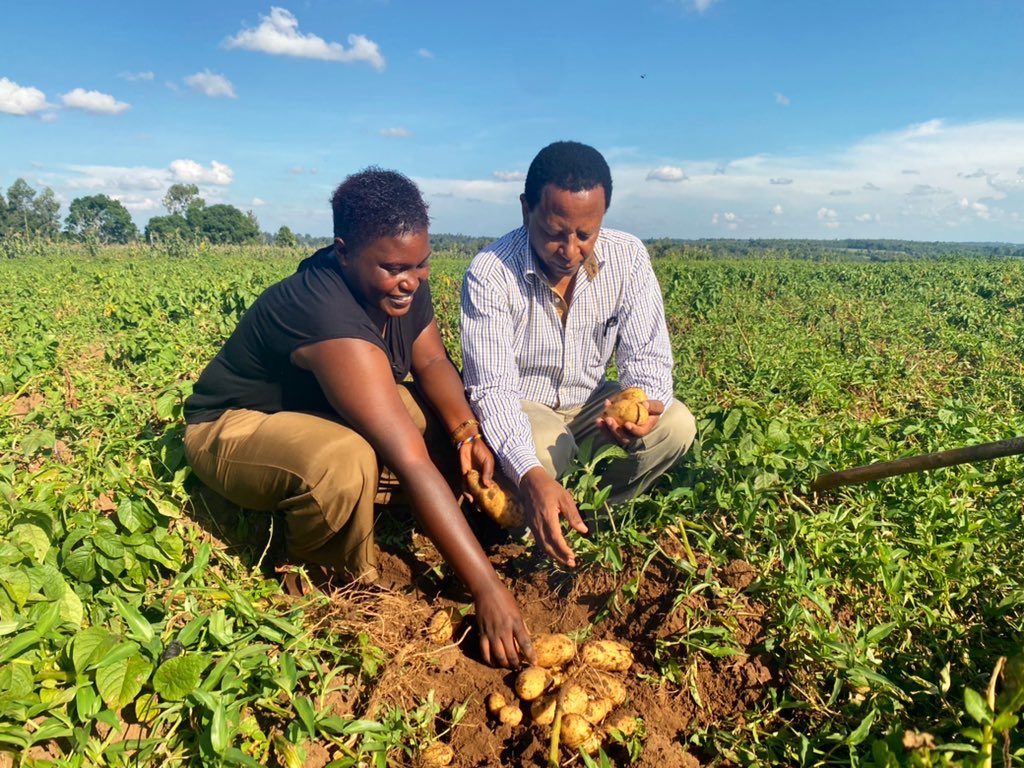
Tanzania’s Potato Surge: Institutional Architecture, Regional Integration, and a Moment on the Global Stage
**The Minister’s Roadmap — Daniel Chongolo’s April 2026 announcement: from 2.96 million to 3 million tonnes by 2026/27
**The Institutional Catalyst — The Potato Council of Tanzania and AGCOT: how governance structures make the target credible
**From Fragmentation to Commercial Scale — The 89% production surge as institutional evidence (2023/24)
The Architecture That Holds It Together — Seed systems, varieties, finance mechanisms, and regional integration October 2026:
The Threshold Moment — What Tanzania presents at the World Potato Congress, and whether execution matches ambition
The 13th World Potato Congress will convene in Naivasha, Kenya, in October 2026. Over 1,000 global potato leaders, researchers, and farmers will assemble for five days of scientific presentations, policy discussions, and innovation showcases. For the first time, Tanzania arrives at a global forum with coherent institutional infrastructure to back its ambitions.
This is not a modest claim. Tanzania is the sixth-largest potato producer in Africa. What distinguishes the nation’s entrance to the global stage is not production volume alone, but the institutional machinery that now underpins it-a transformation from fragmented smallholder systems to coordinated commercial value chains. This represents the kind of systemic change in agricultural governance that the global development community has long pursued but rarely achieved at scale in East Africa.
The Catalyst: The Potato Council of Tanzania
In June 2024, the Potato Council of Tanzania (PCT) was formally registered under the Tanzania Business Registrations and Licensing Agency (BRELA). Chaired by Beno Mgaya, the council represents an unprecedented institutional convergence: farmer cooperatives, commercial seed multipliers, input suppliers, research institutions, and financial institutions working through a single governance body.
This institutional architecture operates within the broader framework of the Agricultural Growth Corridors of Tanzania (AGCOT), launched by Prime Minister Kassim Majaliwa in Dodoma on 27 April 2025. This transition from SAGCOT (the Southern Agricultural Growth Corridor) to a nationwide framework represents the institutional foundation that renders the National Potato Development Strategy implementable, not merely aspirational.
The evidence is tangible. Between the 2023/24 and 2024/25 seasons, Tanzanian potato production surged 89.1%-from 1.47 million to 2.78 million tonnes. This was not the product of favourable weather or commodity price spikes. It was directed institutional intervention, led by Geoffrey Kirenga, AGCOT’s Chief Executive Officer.
The Baseline Problem: A Fragmented Sector Transformed
To understand what this transformation means, one must grasp what preceded it. Historically, Tanzania’s potato sector was fundamentally fractured:
In 2017, production stood at 1.75 million tonnes across roughly 700,000 smallholder households. Average yield languished at 8.43 tonnes per hectare-barely half the attainable potential of 15–25 tonnes per hectare when using certified seed. Post-harvest losses ranged from 15% to 45% between field and consumer. Middlemen captured a 42.6% price gap. Farmers recycled diseased seeds across seasons, perpetuating low yields. Storage infrastructure was absent. The lumbesa system-oversized, non-standard bags-allowed traders to systematically extract more volume than they had purchased.
This was not poverty; it was a system design that prevented agronomic gain from translating into farmer income.
Institutional Architecture: Three Operating Nodes
1. Seed Systems & Research Infrastructure
The transformation began with seed. The AGRA-funded Scaling Seeds and Technologies Partnership brought smallholders in Njombe district from degenerate, recycled seeds to certified varieties through the Tanzania Official Seed Certification Institute (TOSCI). Within two seasons, yields leaped from 7 to 31 tonnes per hectare.
Isowelo AMCOS, a farmer cooperative in Njombe, exemplifies this trajectory. The cooperative grew from 208 to 630 members (nearly half women) by adopting the Sagitta certified variety. Yields surged from 50 to 200 bags per acre. This performance unlocked institutional financing: TZS 590 million in input loans from microfinance institutions, followed by TZS 1 billion from CRDB Bank, Tanzania’s largest listed lender. This is not subsidised smallholding; it is formal commercial agricultural financing at scale, contingent upon organisational discipline and demonstrated productivity.
Two new seed storage facilities are under construction at Igeri Research Station (Njombe) and Uyole Research Station (Mbeya), with rehabilitation of TARI Tengeru (Arusha). These use low-cost diffused-light storage technology, enabling smallholders to preserve seed viability between growing cycles without purchasing new commercial seed every season.
2. Varietal Diversity & Market Responsiveness
Tanzania now operates the most diverse formal potato variety catalogue in East Africa: 16 registered varieties through the Tanzania Potato Variety Catalog. This diversity is deliberately structured around distinct market segments and agroecological contexts:
- Markies (Netherlands origin; late maturity; >40 t/ha): Industry standard for frozen French fries and crisps.
- Sagitta (Netherlands; 100-day maturity; up to 50 t/ha): Premium processing cultivar for frozen chips; currently driving commercial cooperative success.
- Asante (CIP-Peru; 3–4 month cycle; >40 t/ha): Fresh retail market; highly resistant to late blight.
- Tengeru (TARI-developed; late maturity; 35–45 t/ha): Multipurpose; resistant to late blight; white-cream skin preferred in regional markets.
- Unica (CIP-Peru; medium maturity; up to 40 t/ha): Fresh market and processing; drought-tolerant; enriched zinc and iron content.
- Rumba and Sifra (European cultivars): Emerging resistance to Potato Cyst Nematodes (PCN).
- Costanera, Roko, Saviola (European; under advanced trials): Climate-resilient cultivars optimised for bimodal rainfall zones and rising temperatures.
This variety matrix is not experimental; it is production-deployed across Tanzania’s growing zones. Varieties are matched to altitude, microclimate, pest pressure, and end-market destination (fresh retail, processing, cold storage, export).
3. Institutional Governance & Cross-Border Integration
The Jumuiya Potato Platform, launched in Kampala in June 2022, harmonises seed potato regulations across East African Community member states, establishes mutual phytosanitary recognition, and streamlines border procedures. This shift transformed cross-border potato trade from informal barter to structured commercial exchange.
Tanzanian potato exports from the Ihemi Cluster-a designated production hub-now reach supermarkets in Kenya (Namanga and Holili borders), Zanzibar’s tourism sector, the Comoros, and, following September 2024 bilateral trade negotiations, Zambia. This is value-chain regionalisation, not subsistence food movement.
Spatial Organisation & Production Cycles
The Southern Corridor-spanning Mbeya, Njombe, Iringa, Songwe, Rukwa, Ruvuma, and Morogoro-is deliberately organised into six operational clusters: Ihemi, Mbarali, Kilombero, Ludewa, Rufiji, and Sumbawanga. This spatial granularity is intentional. Each cluster operates as a production hub with dedicated seed zones, research linkages, and established market channels.
The Southern Highlands account for 70–80% of national potato output and 65% of all food production nationally. Crucially, the region operates two growing seasons annually (September–January/February and February–June/July), creating a bimodal production rhythm that contrasts sharply with the single-cycle patterns of Eastern and Northern zones. This climatic advantage positions Tanzania as a reliable year-round supplier to East African urban markets-a competitive advantage few African nations possess.
Production Trajectory: The Institutional Evidence
The yield progression from 2017 to 2026 maps institutional stabilisation, not linear growth:
- 2017: 1.75 million tonnes; 700,000 smallholder households; average yield 8.43 t/ha.
- 2022: 1.01 million tonnes; yield 8.43 t/ha (nadir; temporary contraction post-2020).
- 2023/24: 2.78 million tonnes; yield improvements to 18–20 t/ha within AGCOT clusters.
- 2026/27 Target: 3.0 million tonnes; consistent 18–20 t/ha baseline with elite demonstration blocks at 30+ t/ha.
The Potato Council of Tanzania, operating through regional hubs and the Jumuiya Platform, anchors production systems that previously fragmented across informal farmer networks. Private-sector engagement-HZPC, Yara, Syngenta, Mtanga Foods-provides input access, technical backstopping, and market offtake certainty.
The Financial Architecture: Capital Mechanisms for Scale
Ambitious production targets are only credible if financing mechanisms exist to translate ambition into action. Tanzania’s potato sector now operates within a comprehensive financial architecture specifically designed for agricultural value-chain support.
Development Finance Institutions
The Tanzania Agricultural Development Bank (TADB), a state-owned development finance institution, has disbursed over $203 million in cumulative loans to the agricultural sector. It is backed by a $66 million sovereign loan from the African Development Bank and an $81 million credit line from the French Development Agency. TADB explicitly reserves 20% of its lending portfolio for women and youth-led agricultural enterprises, making it a gender-intentional lender at scale.
The Cooperative Bank of Tanzania (CBT) was formally launched on 28 April 2025, officiated by President Samia Suluhu Hassan. The bank provides TZS 55 billion in starting capital and serves 6,500 registered cooperatives holding TZS 5.1 trillion in aggregate assets. Critically, the CBT creates a direct financial channel for rural enterprises and cooperative structures-a systemic advantage for the farmer-cooperative model that anchors the potato sector.
Commercial Bank Agricultural Lending
CRDB Bank, Tanzania’s largest listed lender by asset expansion, has structured agricultural lending specifically for smallholder and cooperative farmer blocks. Its Fahari Kilimo product suite targets smallholder farmers, cooperatives, farmer associations, and farmer groups in rural areas. CRDB’s offerings include:
- Seed and fertiliser financing: Loans covering certified seed and input costs.
- Farm equipment loans: Financing for irrigation systems, tractors, and mechanised equipment.
- Working capital loans: Credit facilities for seasonal farming operations.
Isowelo AMCOS’s TZS 1 billion loan from CRDB Bank demonstrates this mechanism in operation: a 630-member cooperative secured formal commercial financing based on demonstrated organisational capacity and yield discipline-not subsidised lending, but credit structured on commercial principles.
NMB Bank (National Microfinance Bank), Tanzania’s other Tier-1 lender, operates an Emerging and Commercial Farmers Finance programme designed for farmers managing 50 to 1,250 acres of land who meet good agricultural practice standards and have established banking relationships. NMB has launched agricultural equipment financing with flexible repayment schedules aligned to seasonal harvest cycles-addressing a critical mechanisation constraint. The bank’s agricultural portfolio includes crop financing, livestock loans, and equipment leasing tailored to agricultural seasonal patterns.
Both CRDB and NMB have issued blended-finance instruments: CRDB’s $300 million green bond (with International Finance Corporation anchor investment) and NMB’s $159 million sustainability bond and $17.4 million gender bond, with proceeds directed to agriculture and related sectors. Both banks benefit from European Investment Bank backing (€150 million to CRDB, €100 million to NMB) specifically designed to improve access to finance for smallholder and women-led businesses. KCB Bank Tanzania, the regional subsidiary of Kenya’s Kenya Commercial Bank, operates within the same EIB framework (€20 million credit line) and provides agricultural finance with emphasis on smallholder and women-owned enterprise segments.
The Cooperative Bridge
This institutional layering is crucial: potato farmers increasingly organise into producer cooperatives, which then access bulk financing through CRDB, NMB, and TADB. A 630-member cooperative can secure TZS 1 billion in financing; individual smallholders cannot. The Cooperative Bank of Tanzania serves as the institutional backbone enabling this transition from individual subsistence to organised commercial blocks.
This is not charity; it is commercial risk reduction through organisational discipline. Banks lend because cooperatives reduce credit risk through collective accountability and documented production capacity.
Implementation Mechanisms: Scaling Adoption
Farmer adoption accelerates when tangible proof surrounds farmers. The Mkulima kwa Mkulima demonstration plots in Songea and Tajirika na Lusitu in Ruvuma prove the efficacy of this principle: when neighbouring farmers witness 200 bags per acre generating TZS 16 million in return, adoption rates surpass extension messaging by orders of magnitude.
The STAWISHA Potato Centre of Excellence, operating over 30 hectares, demonstrates mechanised land preparation, planting, and harvesting achieving 59 tonnes per hectare. This is not a subsidised showpiece; it is a neighbouring proof-of-concept demonstrating that commercial-scale yields are attainable under Tanzania’s agroecological conditions.
Institutional autonomy is equally crucial. AGCOT’s regional structure (offices in Morogoro, Iringa, and Mbeya) operates independent of central government disbursement delays. Each regional office manages cluster-level stakeholder coordination, input supplier linkages, and farmer cooperative federations. The Potato Council of Tanzania, as a registered non-partisan institution, can move faster than ministry budget cycles.
Climate Adaptation: Embedded in System Design
AGCOT’s Green Reference Group, partnering with The Nature Conservancy, Wildlife Conservation Society, and World Wildlife Fund, applies scenario-based planning to prevent agricultural expansion from degrading critical watersheds (Rufiji and Little Ruaha basins). Climate projections show temperature rises of up to 3°C and 3.4% rainfall decline by 2050 in potato production zones-formidable challenges requiring adaptive system redesign.
Irrigation expansion through drip systems and precision soil-moisture testing is projected to increase yields 8% whilst reducing water consumption 14% by 2030. This is not climate doom; it is climate-adapted production system design already embedded in corridor planning. The climate-resilient varieties (Costanera, Roko, Saviola) under advanced trial in Tanzania’s agroecological zones reflect this forward-looking institutional strategy.
The Regional Opportunity: East Africa’s Production Advantage
East Africa possesses a unique agricultural advantage: equatorial and near-equatorial climates that enable two growing seasons annually. Kenya leverages this advantage through planting cycles in March and October, ensuring continuous food security and climate resilience. Tanzania’s Southern Highlands operate on similar bimodal rainfall patterns, creating dynamic production cycles that position the region as a reliable supplier to East African urban markets, the broader Indian Ocean region, and increasingly, continental trade networks.
A fully realised Potato Development Strategy positions Tanzania as:
- A reliable seed production hub for the East African region.
- A dependable source of quality potato for urban markets across East Africa.
- A platform for climate-resilient agricultural innovation and adaptive research.
- A replicable model for smallholder commercialisation across the continent.
October 2026: The Global Moment
The 13th World Potato Congress in Naivasha emphasises sustainable farming practices, climate-resilient solutions, seed production systems, post-harvest value addition, mechanisation, and inclusive smallholder models. Tanzania’s strategy aligns directly with these global priorities.
At Naivasha in October, Tanzanian delegations will not present abstract ambitions. They will present:
- The Potato Council of Tanzania: A registered, multi-stakeholder governance body with representation across farmer cooperatives, seed multipliers, input suppliers, research institutions, and financial networks.
- Documented yield progression: From 8.43 t/ha baseline (2017–2022) to 18–20 t/ha in AGCOT clusters, with elite blocks demonstrating 30+ t/ha.
- Cooperative case studies: Isowelo AMCOS (630 members, TZS 1 billion CRDB Bank loan); Mkulima kwa Mkulima demonstration plots (200 bags/acre, TZS 16 million return); STAWISHA Centre of Excellence (59 t/ha mechanised production).
- Varietal repository: Tanzania Potato Variety Catalog with 16 registered varieties responding to distinct market segments, pest pressures, and agroecological zones.
- Regional trade integration: Jumuiya Potato Platform harmonising EAC seed regulations, enabling cross-border export to Kenya, Zambia, Comoros, and Zanzibar.
- Financial architecture: Cooperative Bank of Tanzania, Tanzania Agricultural Development Bank, CRDB Bank, NMB Bank, and blended finance models channelling capital to smallholder blocks.
This is institutional depth. Tanzania is not requesting a seat at the global potato conversation; it is entering with documented evidence of systemic transformation.
The Challenge Ahead: Execution Under Pressure
Implementation remains the fundamental test. Parliamentary concerns about government fund disbursement persist; only 55% of planned development expenditure had landed by February 2026. Regional hubs must operate with genuine autonomy, not become administrative appendages of Dar es Salaam bureaucracy. Climate impacts-rising temperatures, declining rainfall-will pressure even improved varieties and expanded irrigation. Cross-border trade integration requires sustained regulatory harmonisation and consistency at border-level coordination points.
But for the first time, Tanzania enters these challenges with institutional machinery specifically designed to navigate them. The Potato Council is not a ministry department; it is a registered platform with multi-stakeholder governance. AGCOT’s decentralised cluster structure is not a government hierarchy; it is a spatial coordination framework enabling local responsiveness. The Jumuiya Platform is not national policy; it is regional regulatory architecture enabling cross-border standardisation. The banking ecosystem-from TADB to CRDB to CBT-operates on commercial principles that will persist regardless of government budget cycles.
Conclusion: The Threshold Moment
The 13th World Potato Congress represents a threshold moment. Global attention will focus on African potato production precisely as Tanzania consolidates institutional frameworks to deliver scale. The nation will enter neither as a subsistence producer requesting development aid nor as a theoretical giant with no infrastructure. It will arrive as a coordinated system demonstrating that smallholder potato farming can transition to commercial reliability through deliberately designed institutions, not through market optimism alone.
Implementation will determine whether this becomes a replicable model for African agricultural transformation, or another promising strategy outpaced by execution gaps and institutional fragmentation.
The framework is ready. The institutions are in place. The regional architecture is operational. The financial mechanisms exist. Now comes the harder work: sustaining disbursement discipline, maintaining farmer engagement, adapting to climate shocks, and ensuring that regional clusters operate with sufficient autonomy to respond to their distinct contexts whilst remaining coordinated through the Potato Council framework.
Tanzania has built the institutional scaffolding. October will reveal whether it can hold.
Kilimokwanza.org covers agricultural policy, market intelligence, and development narratives across East Africa. This article examines Tanzania’s agricultural governance as global attention focuses on Kenya’s hosting of the 13th World Potato Congress.