

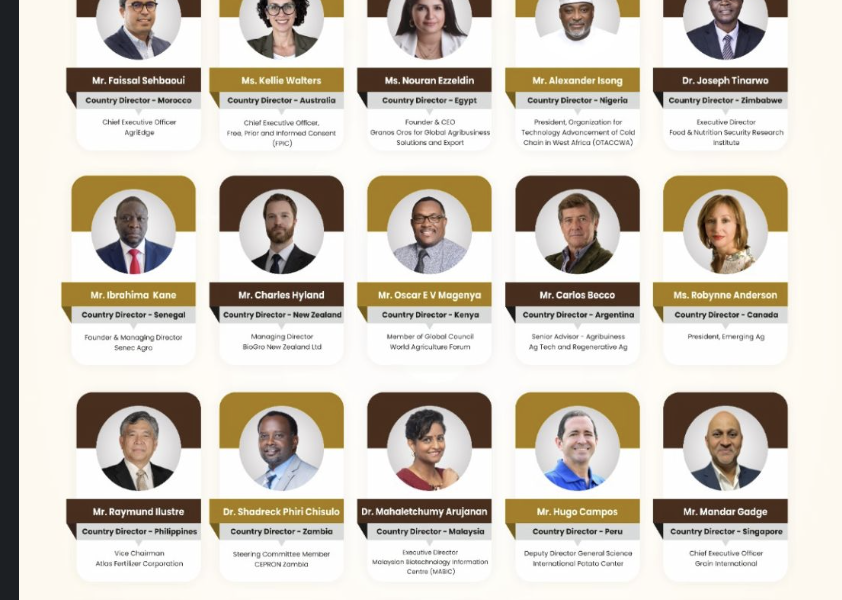
The Netherlands-headquartered World Agriculture Forum has named twenty Country Directors across Africa, Asia, the Gulf, Europe and the Americas. The appointments mark the operational launch of its national Country Council model — and put nine African leaders at the centre of a rising global platform on food, policy and agri-innovation.
By Kilimokwanza.org Newsroom
A forum reborn, now turning global vision into national muscle
The World Agriculture Forum (WAF) has formally unveiled the first cohort of twenty Country Directors who will anchor its national Country Councils — a move the organisation describes as a decisive step toward building stronger national and global agricultural ecosystems.
The announcement is significant on two levels. It is, first, a roster of names — twenty senior professionals drawn from governments, industry, research institutions, civil society, agritech and trade. It is, second, the operational launch of a governance architecture that WAF has been designing for more than a year: a system of national Country Councils, each led by a Country Director drawn from WAF’s global Council, acting as what the Forum itself calls the living link between global vision and local transformation.
WAF, headquartered in the Netherlands, is a reconstituted version of a Forum that was originally founded in 1997 and dissolved in 2018. Its present-day iteration is chaired by Prof. Rudy Rabbinge, emeritus research professor of sustainable development and food security at Wageningen University and a former director of the Alliance for a Green Revolution for Africa (AGRA). Its Secretary General is Dr. Jacqueline Hughes, the former Director-General of ICRISAT, whose appointment in late 2024 signalled WAF’s clear pivot toward Africa and Asia.
The Forum positions itself as a policy-neutral, science-based platform convening governments, farmers, agribusinesses, experts and development institutions — roughly analogous in ambition to the World Economic Forum, but dedicated entirely to agriculture, food systems and rural prosperity.
With the Country Director appointments now public, the scaffolding becomes skeleton.
What the Country Directors are being asked to do
According to WAF’s own governance framework, Country Directors are appointed from the WAF Council and act as the primary bridge between WAF’s global strategies and national execution. Their mandate, as set out by the Forum, covers five interlocking responsibilities:
Establishing and expanding WAF’s national presence through inclusive Country Councils and stakeholder networks. Advocating for sustainable agriculture aligned with global goals and sharing global success models locally. Coordinating with regional and global councils to implement strategies tailored to national contexts. Collaborating with governments and industries to promote reforms, investment, trade and technology adoption. Hosting events, policy dialogues and workshops that connect national challenges to global solutions.
The Country Councils they chair are conceived as interpretive bodies — translating WAF’s vision into actionable local programs while feeding ground-level insights on emerging challenges, opportunities and innovations back into the global strategy. The deliverables WAF expects from them include National Agriculture Agenda Reports, whitepapers, investment and innovation facilitation, annual impact reports and capacity-building programmes.
It is, in short, a structure designed to avoid the most common failure mode of global platforms: pronouncements from capital cities that never touch the furrow.
Reading the map: where the twenty come from
The geographical spread is itself a statement. Nine of the twenty Country Directors are African — from Morocco, Egypt, Nigeria, Ghana, Senegal, Kenya, Zambia, Zimbabwe and Angola. That is the largest regional bloc. Six are drawn from the Asia-Pacific (Australia, New Zealand, Philippines, Malaysia, Singapore and Pakistan). Three come from the Americas (Argentina, Peru and Canada). One represents the Gulf (UAE) and one Europe (Poland).
For an African agricultural audience, that weight of African representation is worth pausing on. The continent has historically been heavily discussed in global food forums but thinly represented in their governance. The WAF roster reverses that ratio.
Below, we profile each of the twenty Country Directors and the ecosystems they bring with them.
The African bench: nine directors, continental reach
Kenya — Dr. Oscar E. V. Magenya
Kenya’s Country Director is one of the most recognisable names in East African agricultural policy. Dr. Oscar Magenya is a Chief Principal Scientist and a Member of WAF’s Global Council, and formerly served as Secretary for Agricultural Research and Innovation at Kenya’s Ministry of Agriculture and Livestock Development. In that role he chaired the committee that reviewed Kenya’s National Agricultural Research System (NARS) Policy, positioning the country as an East African hub for agricultural research, innovations and knowledge.
Magenya has been a consistent advocate for multi-sectoral approaches to invasive pests, soil fertility and the uptake of improved seeds, engaging closely with CGIAR centres including CIMMYT, CIP and CIAT. He has represented Kenya in the World Economic Forum’s Transformation Leaders Network and was instrumental in developing Kenya’s position at the UN Food Systems Summit.
For WAF, having Magenya anchor the Kenya Council is strategically potent: Kenya is East Africa’s agri-innovation nerve centre, and Magenya’s institutional memory spans both public research (KALRO) and ministerial policy.
Zimbabwe — Dr. Joseph Tinarwo
Dr. Joseph Tinarwo is the Founder and Executive Director of the Food and Nutrition Security Research Institute (FANSERI) in Zimbabwe, and a lecturer at Great Zimbabwe University. He has worked with IFPRI’s Suresh Babu on China–India development assistance dynamics in Africa, and his published research covers food system transformation, ICT in agribusiness for youth employment, and social protection for farm workers.
Tinarwo’s contribution to WAF will likely centre on exactly what Zimbabwe most needs: translating food-systems-transformation theory into implementable multi-ministerial policy. His writing has consistently argued that fragmented governance and weak coordination — not a lack of ideas — are what keep Zimbabwe’s food system behind.
Zambia — Dr. Shadreck Phiri Chisulo
Dr. Shadreck Phiri Chisulo brings a PhD in Agriculture from the University of South Africa (UNISA) and a steering-committee role at CEPRON Zambia — the Community Enterprises Promotion Network, a Lusaka-based non-profit founded in 2011 whose mission is to create and apply knowledge on sustainable urban and rural development and livelihoods enterprise development.
CEPRON operates through community participatory approaches, covering the full project cycle from identification through design, implementation, monitoring and evaluation, with a particular focus on resource-poor communities. Chisulo’s academic work has focused on competence gaps in agriculture, a lens that dovetails cleanly with WAF’s capacity-building mandate.
Nigeria — Mr. Alexander Isong
Alexander Isong is one of West Africa’s most vocal advocates on cold-chain infrastructure. As President of the Organisation for Technology Advancement of Cold Chain in West Africa (OTACCWA), he has spent the past several years putting hard numbers on a soft problem. Nigeria lost an estimated 30 to 40 million metric tonnes of food in 2025 to post-harvest inefficiencies — roughly ₦3.5 to ₦5 trillion in economic losses, concentrated in tomatoes, vegetables, fruits, dairy, meat, fish and root crops.
Isong’s recent advocacy — including the 8th West Africa Cold Chain Summit and Exhibition (WACCSE) co-located with Agrofood Nigeria 2026 in March 2026 — has pressed for cold chain to be designated strategic national infrastructure alongside power, roads and ports. He estimates that Nigeria requires between 6,000 and 7,000 refrigerated trucks to tackle its annual post-harvest losses, structured across last-mile, medium-distribution and heavy-duty long-haul cold transport. He also serves as an advisor to the IFC’s TechEmerge Programme.
His WAF role slots neatly into this brief: turning a chronic logistics gap into a mobilisable investment case.
Ghana — Mr. Dennis O. Carter
Dennis O. Carter is Group Chief Executive Officer of Maxigate Group of Companies Ghana Ltd, a diversified Ghanaian conglomerate with interests in agricultural commodities trading, oil and gas trading, real estate, hardware and cosmetics. Maxigate Trading Company Ghana Ltd, the Group’s flagship arm, is an international commodity trading house specialising in agricultural commodities.
Ghana is simultaneously Africa’s pre-eminent cocoa economy, host of the AfCFTA Secretariat, and a country whose Feed Ghana Programme under the Agriculture for Economic Transformation Agenda (AETA) is pushing hard toward commercial agribusiness, value addition and reduced food import dependence. Carter’s private-sector vantage point — running a conglomerate that touches commodities, logistics and trade — gives the Ghana Council a commercial gravity that complements the more public-sector orientation of some peers.
Senegal — Mr. Ibrahima Kane
Ibrahima Kane is the Founder and Managing Director of Senec Agro, a Senegalese agribusiness company active in crop production, agricultural products trading (négoce) and the development of agricultural value chains. Senec Agro deals in peanuts, raw cashew nuts, beans, millet, fresh exotic fruits and vegetables and other items from Senegal and West Africa.
Kane’s particular contribution has been agricultural diversification — running trials to introduce and adapt new crops in Senegal, including successful soybean trials (a crop not traditionally grown in Senegal) and sesame variety work in cooperation with the National Centre for Agricultural Research. Value chains for sesame, soybean and cereals such as corn and sorghum are now priority areas for his company.
His WAF brief will likely centre on linking smallholder producers in West Africa’s groundnut basin to global trading and partnership opportunities.
Morocco — Mr. Faissal Sehbaoui
Faissal Sehbaoui is the Founder and CEO of AgriEdge, a leading Moroccan AgriTech company affiliated with Mohammed VI Polytechnic University (UM6P) and the OCP Group. An applied-mathematics engineer trained at École Polytechnique, Sehbaoui previously served as Big Data Manager at OCP, one of the world’s largest phosphate and fertiliser producers.
AgriEdge has become one of Africa’s most visible precision-agriculture platforms, with a suite of AI-powered products — FertiEdge (precision fertilisation), AquaEdge (irrigation optimisation), YieldEdge (yield prediction) and CarboEdge (carbon footprint tracking). Under Sehbaoui’s leadership, AgriEdge has expanded to 12 countries, serves more than 90,000 farmers, and oversees over two million hectares of agricultural land through data-driven solutions.
AgriEdge has also become a cornerstone of OCP Nutricrops’ Africa strategy — a continental play to deploy risk-sharing finance, customised plant nutrition and digital advisory across African farming systems where fertiliser use remains roughly seven times below the global average.
Egypt — Ms. Nouran Ezzeldin
Nouran Ezzeldin is the Founder and CEO of Granos Oros for Global Agribusiness Solutions and Export, an Egyptian firm that has become a notable voice in MENA grain trading. Her professional pedigree includes over a decade of grain trading at Glencore Rotterdam — covering EU markets and later North Africa and the Middle East — followed by nearly a decade with one of the largest grain and oilseeds importers in the Middle East.
Ezzeldin has become a regular speaker at major industry events including Black Sea Oil Trade, Geneva Dry, and the Grain Trade Africa conference in Cairo. Granos Oros has also announced a strategic partnership with Taurum Switzerland to strengthen its global network in the Middle East and Gulf regions.
With African grain imports having grown from 54 million tons in 2022/23 to 58 million tons in 2023/24 — and Egypt, Algeria, Morocco and Nigeria all sitting among the world’s top 10 grain importers — Ezzeldin’s appointment lands on one of the fastest-growing grain-trade frontiers on the planet.
Angola — Dr. Roberto Chiteta
Dr. Roberto Chiteta is the Founder and CEO of the Roberto Save Dreams Foundation (RSDF), an NGO empowering rural communities across Zambia and Angola through an integrated model of clean energy and sustainable agriculture. The Foundation’s two flagship projects — Bright Futures (solar mini-grids and productive-use energy for households and SMEs) and Farm2Future (essential oils, livestock, and cooperative farming for export markets) — exemplify the energy-agriculture nexus that has become central to Southern African rural development.
RSDF’s selection of the productive-use-of-energy model — where electricity is deployed explicitly to unlock agricultural value addition — makes Chiteta’s appointment a useful signal of WAF’s willingness to treat agriculture as an integrated systems problem rather than a sector in isolation.
MENA and Asia-Pacific: seven directors, from the Gulf to the Pacific
United Arab Emirates — Mr. Rakesh K. Chitkara
Rakesh K. Chitkara, based in Dubai, is the UAE Country Director for the World Agriculture Forum and has served as Chair of the WAF UAE Country Council. His background spans healthcare (Integra LifeSciences, Abbott), media (The Daily Guardian, New Delhi Post) and trade diplomacy — an unusual blend that fits the UAE’s own hybrid identity as a financial hub, agri-importer, food-security strategist and convener of regional summits such as Abu Dhabi Sustainability Week.
With the UAE positioning food security as a sovereign strategic priority — through initiatives like Agri-Tech Dubai, ADSW and Silal — Chitkara’s role is to ensure that WAF’s voice is present across the Gulf’s rapidly expanding agritech and food-security investment ecosystem.
Pakistan — Mr. Rai Muhammad Usman
Rai Muhammad Usman is Chief Executive Officer of Sourcing Pakistan Group, an organisation active in Pakistan’s agricultural sourcing and export ecosystem. Pakistan sits among the world’s top ten rice-producing countries; its Rice Exporters Association alone contributes more than US$2 billion per year in export earnings, making it Pakistan’s second-largest export trade body after textiles.
For WAF, Pakistan’s inclusion reflects the country’s dual role as both a major South Asian cereal exporter and a climate-stressed food system confronting acute challenges in water security, soil salinity and post-harvest efficiency.
Philippines — Mr. Raymund Ilustre
Raymund P. Ilustre has been Vice Chairman of the Board of Atlas Fertilizer Corporation (AFC) — the Philippines’ oldest and largest fertiliser manufacturer — since 2013. Before that, he led AFC as President and Chief Operations Officer for 11 years. Founded in 1957, Atlas controls at least 42% of the Philippines’ domestic NPK-NP-NK market and is a member of Japan’s Sojitz Fertilizer Group.
Ilustre is known for championing Site-Specific Nutrient Management (SSNM) — a technology that tailors fertiliser application to crop and soil characteristics — and for pushing Atlas’s mobile platform, the Atlas Fertilizer Expert app, which gives Filipino farmers crop-specific fertiliser recommendations to increase yield and profit.
Malaysia — Dr. Mahaletchumy Arujanan
Dr. Mahaletchumy Arujanan — “Maha” to her peers — is Executive Director of the Malaysian Biotechnology Information Centre (MABIC) and Global Coordinator of the International Service for the Acquisition of Agribiotech Applications (ISAAA). She holds a PhD in Science Communication from the University of Malaya, a first for a Malaysian scholar in that field.
Arujanan is the founder and Editor-in-Chief of The Petri Dish, Malaysia’s first science newspaper, launched in 2011. In 2010 she won the TWAS Regional Prize for Public Understanding of Science for East and Southeast Asia and the Pacific, and Scientific American’s WorldView named her as one of the 100 most influential people in biotech in the world in 2015. She established the Asian Short Course on Agribiotechnology, Biosafety Regulations and Communications (ASCA) and co-founded Science Media Centre Malaysia.
Maha’s inclusion signals that WAF takes seriously the proposition that science communication — not merely science — is now a strategic determinant of biotechnology adoption in food systems.
Singapore — Mr. Mandar Gadge
Dr. Mandar Gadge (Godge) is Chief Executive Officer of GRAIN International Private Limited, a Singapore-incorporated agritech consultancy operating on a “Global Science — Local Solutions” model. GRAIN International positions itself as a commercial R&D partner for farmers, translating new technologies into farm-level adoption without requiring farmers to upend their operations. The company offers a portfolio of beyond-organic, open-pollinated, heirloom and F1 hybrid seeds, along with its proprietary GlobalAg Precision Seedlings (Sg-GAPS) for controlled-environment and traditional farming.
Singapore’s ‘30 by 30’ food-security ambition — producing 30% of the city-state’s nutritional needs locally by 2030 — has turned the country into one of Asia’s most concentrated laboratories for indoor farming, vertical agriculture and agritech translation. Gadge sits at the centre of that ecosystem.
Australia — Ms. Kellie Walters
Kellie Walters is one of Australia’s most prominent regenerative-agriculture executives. She is widely known as Chief Executive Officer of the VRM Biologik Group — a soil-restoration technology company whose proprietary process stimulates what VRM calls Biological Hydrosynthesis: a natural reaction that captures atmospheric carbon and produces additional water in depleted and arid soils.
With 24-plus years in executive roles across government and commercial environments, Walters has overseen the deployment of VRM Biologik’s regenerative programmes in Australia, Malaysia, China, the United States and the Middle East. VRM Biologik’s partnerships have contributed to the regeneration of some 20 million acres of Chinese farmland following China’s 2020 policy shift toward zero additional synthetic fertiliser. Walters has addressed the United Nations in New York on the role of soil restoration in global food security and led a partnership with Canada-listed DevvStream to monetise VRM-generated carbon credits under ESG-aligned frameworks.
Her appointment as WAF Country Director for Australia anchors the Forum’s soil-health agenda — one of the thematic pillars Prof. Rabbinge himself has consistently foregrounded — in one of the world’s most agriculturally significant economies.
New Zealand — Mr. Charles Hyland
Charles Hyland is Managing Director of BioGro New Zealand Ltd, the country’s leading organic certification company, currently certifying more than 900 organic producers across Aotearoa. He is concurrently Managing Director of Agriscore (a compliance consultancy), Chair of the Soil & Health Association of New Zealand, and former Chief Technology Officer of Pacific Biofert.
Trained as a soil scientist and biogeochemist, Hyland holds an MPS in Soil Science from Cornell University, where he contributed to research on soil fertility, environmental science, biogeochemistry, soil health and microbial ecology. He was also a founding member of the International Biochar Initiative, established at the 2006 World Congress of Soil Science.
His role in WAF adds a trusted voice on organic integrity, certification systems and soil-based regenerative science.
The Americas and Europe: four directors, agenda-setters for global policy
Argentina — Mr. Carlos Becco
Carlos Becco is a Senior Advisor on Agribusiness, AgTech and Regenerative Agriculture — and, in his own words in Spanish, “passionate and in love with agriculture.” An agronomy engineer trained at the University of Buenos Aires with postgraduate training at IAE Business School (Universidad Austral) and Harvard Business School, Becco brings more than 40 years of experience in agribusiness.
He has led senior roles across the industry including as Commercial Unit Head and Seed Care Head at Syngenta (Latin America South), Head of Indigo Agriculture in Argentina, and a decade-long tenure at Monsanto covering marketing, business development and global Roundup strategy. Becco is also the author of two influential books on the digital transformation of agriculture — La revolución digital del agro (“The Digital Revolution of Agriculture”) and De villanos a héroes (“From Villains to Heroes”) — in which he argues that agriculture has the potential to move from being framed as a climate villain to becoming one of the heroes of the climate transition.
Peru — Mr. Hugo Campos
Dr. Hugo Campos is Deputy Director General for Science and Innovation at the International Potato Center (CIP), the CGIAR research centre headquartered in Lima. He has 25+ years of international experience across Latin America, Sub-Saharan Africa, the United States and the United Kingdom, with most of his career focused on molecular breeding — the intersection of plant breeding and biotechnology.
Campos’s work has positioned root, tuber and banana crops (potato, sweetpotato, yam, taro, cassava) as what are increasingly recognised as climate-resilient, nutrient-dense and income-generating “hunger crops.” In 2025, the World Food Prize Foundation named him a Top Agri-Food Pioneer, highlighting his global leadership in agricultural innovation and his advocacy for a new Green Revolution through roots, tubers and bananas. He is also a Foreign Fellow of India’s National Academy of Agricultural Sciences — only the 60th foreign fellow among more than 900 members.
For WAF, Campos bridges frontier plant-breeding science and the grassroots food-systems agenda.
Canada — Ms. Robynne Anderson
Few appointments on the WAF bench carry the institutional weight of Robynne Anderson, President of Emerging Ag Inc. Anderson is an international policy strategist whose career spans nearly three decades at the intersection of agriculture, United Nations processes and agricultural trade diplomacy. She founded Farming First — the multi-stakeholder coalition for sustainable agriculture — in 2007, and played the pivotal role in negotiating the UN General Assembly’s declaration of the International Year of Pulses (2016), which she subsequently coordinated on behalf of the global pulse industry.
Anderson was instrumental in establishing the Private Sector Mechanism at the UN Committee on World Food Security — the first formal seat for agribusiness at the apex of global food-security policy — and represents the International Agri-Food Network at UN multilateral venues. She is the youngest person ever inducted into the Canadian Agricultural Hall of Fame, remains involved in her family’s seed farm in Manitoba, and founded Farmers Abroad Canada, a non-profit supporting agricultural education in Africa.
Anderson’s combination of farm-level credibility, policy fluency and convening capacity makes her perhaps the WAF Council’s most experienced multilateral operator.
Poland — Dr. Emilia Mikulewicz
Dr. Emilia Mikulewicz is the Founder and CEO of Cultiva EcoSolutions, an international horticulture and sustainable-agriculture consultancy. Holding a PhD in agronomy from the University of Warmia and Mazury in Olsztyn, she is a GLOBALG.A.P. Registered Trainer and a SAI Platform FSA Advisor, specialising in regenerative horticulture, hydroponics, controlled-environment agriculture, organic production systems and retailer-ready compliance for high-value crops such as berries, herbs and leafy greens.
Mikulewicz previously served as senior grower for a major Eastern European organic hydroponic producer, overseeing operations with almost zero measurable crop loss — a rare benchmark in commercial-scale organic hydroponics. Through Cultiva EcoSolutions, she now advises growers, agritech firms and institutions worldwide on meeting climate-variability, regulatory and export-market requirements — particularly in the intersection where GLOBALG.A.P. certification meets regenerative agronomy.
What this all adds up to
Taken together, the twenty names form a deliberately constructed portrait of what WAF considers the future of food systems governance.
Four observations stand out.
First, the African tilt is real. Nine African Country Directors — drawn from public research, cold-chain infrastructure, private agribusiness, foundation philanthropy and digital agriculture — give Africa a structural presence in WAF governance that the continent has rarely enjoyed in comparable global platforms. For East Africa specifically, Magenya (Kenya), Tinarwo (Zimbabwe) and Chisulo (Zambia) form a core geographical cluster — a corridor that dovetails with the continent’s most dynamic policy frontiers on food systems and climate adaptation.
Second, the roster leans private sector but with deep public credentials. A majority of the directors are CEOs or founders — Sehbaoui, Walters, Ezzeldin, Kane, Becco, Gadge, Mikulewicz, Carter, Chiteta. But layered over that entrepreneurial base is a public-sector and institutional spine: Magenya (former Kenyan Secretary for Agricultural Research), Campos (CIP/CGIAR), Anderson (UN CFS Private Sector Mechanism), Arujanan (ISAAA/MABIC), Isong (policy advocate and IFC advisor). That blend is not accidental. It mirrors WAF’s insistence that no single actor — neither government, nor industry, nor research — can unilaterally drive the transition the sector needs.
Third, the thematic coverage is unusually complete. Soil health (Walters, Hyland, Mikulewicz). Precision agriculture and digital transformation (Sehbaoui, Becco, Gadge). Cold-chain and post-harvest logistics (Isong, Carter). Grain trading and global markets (Ezzeldin, Kane). Root, tuber and banana crops (Campos, Magenya). Biotechnology communication (Arujanan). Policy diplomacy (Anderson). Regenerative finance and energy-agriculture integration (Chiteta). Fertiliser and nutrient management (Ilustre). Food and nutrition security research (Tinarwo, Chisulo). The matrix is wide enough to give the Forum credible authority across nearly every major fault line in contemporary food-systems debate.
Fourth, and perhaps most significantly, the appointments are a bet on national implementation. WAF’s Country Council model is explicitly designed to avoid the trap of producing elegant declarations that never touch the ground. Whether it succeeds will depend less on the communiqués issued from Amsterdam and more on whether directors like Isong can move Nigeria’s cold-chain conversation from event halls to financing tables; whether Magenya can embed WAF’s priorities into Kenya’s multi-ministerial agricultural coordination; whether Chiteta can scale Angola’s productive-use-of-energy model from pilot villages to national policy.
For African agricultural stakeholders — policymakers, researchers, agribusinesses, farmer organisations, innovators and media — the WAF Country Council architecture now offers an identifiable doorway. Each of the nine African directors is expected to build out a national Council in the coming months, convening stakeholders across the agri value chain: governments, industry, startups, farmer organisations and civil society.
That convening capacity is, in the final analysis, what this announcement is really about. Twenty names are not, by themselves, a movement. But twenty names, with the right national coalitions around them, could well become one.
Kilimokwanza.org will continue to follow the build-out of the WAF Country Councils across Africa.
About the World Agriculture Forum: The World Agriculture Forum (WAF) is a Netherlands-headquartered global platform connecting governments, farmers, agribusinesses, experts and development institutions to drive sustainable agricultural development through policy advocacy, trade facilitation and technology-driven solutions. It is chaired by Prof. Rudy Rabbinge of Wageningen University. Its Secretary General is Dr. Jacqueline Hughes, former Director-General of ICRISAT. More at worldagricultureforum.org.