

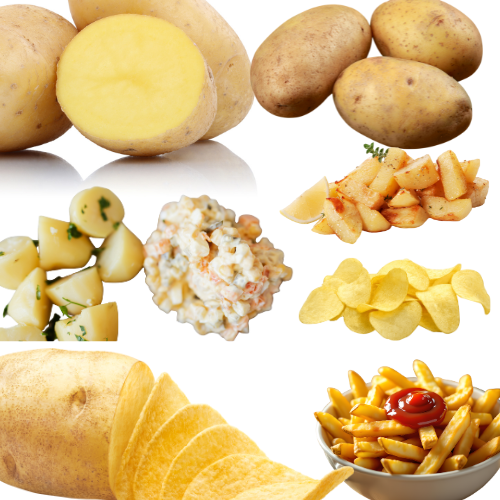
A strategic analysis of production, processing power, varietal sovereignty and East Africa’s emerging share
Compiled April/May 2026
Anthony Muchoki
Executive Summary
The world produces roughly 390 million tonnes of potatoes a year, but the political economy of the tuber is far narrower than that volume suggests. Two countries grow nearly 40% of the world’s supply. Two small European states quietly dictate the genetics that travel into farmers’ fields from Pakistan to Peru. Four firms control almost all of the frozen-fries shelf space across North America. And in October 2026, for the first time in the more-than-thirty-year history of the World Potato Congress, the global industry will gather not in Lima, Lelystad or Edinburgh, but on the shores of Lake Naivasha in Kenya’s Great Rift Valley.
That convergence — Asian volume, Dutch genetics, North American processing capital, and an African hosting moment — frames the central tension of 2026: who sets the rules for the world’s third most important food crop, and whose interests do those rules serve?
Three structural shifts give 2026 its particular character. First, Royal HZPC’s February 2026 acquisition of Ireland’s IPM Potato Group consolidates Dutch genetic control across the British Isles and into the Mediterranean. Second, McCain Foods is wrestling with both a CAD-1-billion family dispute and an ambitious 100%-regenerative-acreage commitment by 2030, while Lamb Weston has executed a top-to-bottom leadership refresh under its ‘Focus to Win’ strategy. Third, and most consequentially for African strategists, Tanzania has activated three new agricultural corridors under AGCOT, Kenya is finalising a Potato Industry Master Plan 2026-2035, and Rwanda has released eleven new climate-resilient potato varieties that already command over half of national basic-seed demand.
This report maps the architecture of the global potato industry, profiles the institutions that govern it, contrasts the dominant varieties of the Global North against East Africa’s evolving varietal landscape, examines the regional outlook for Kenya, Tanzania, Uganda and Rwanda, and confronts the cold-chain, value-addition and seed-sovereignty gaps that continue to keep East African producers at the lowest-margin end of the global chain.
1. The Global Architecture of Potato Power
The architectural logic of the global potato industry rests on a triad of power: Asian volume, European genetic control, and North American processing capital. Each leg of that triad has shifted noticeably in 2025-2026, and the cumulative effect is a more concentrated, more vertically integrated industry than at any point in the modern era.
1.1 The Volume Powers: Asia in Front, Europe Mid-Pack, the EAC Rising
According to FAOSTAT and verified by 2024 trade data, global potato production reached approximately 390 million metric tonnes in 2024, harvested across roughly 17 million hectares. The production hierarchy at the top of 2026 is unambiguous, but volume is not the same as market influence. China processes only about 15% of its potato output, and India processes around 7%, meaning the vast bulk of Asian production never enters the high-margin global value chain.
| Rank | Country | Annual Production (Mt) | Processing % | Market Role |
| 1 | China | 94.8 | ~15% | Volume leader; fresh-market dominant |
| 2 | India | 58.0 | ~7% | Volume leader; low-margin fresh |
| 3 | Ukraine | 21.0 | <10% | Regional supply; geopolitical exposure |
| 4 | Russia | 18.9 | <10% | Domestic food security focus |
| 5 | United States | 17.8 | >60% | Processing capital; global export hub |
| 6 | Germany | 10.5 | ~40% | Seed and processing specialist |
| 7 | Bangladesh | 10.2 | <5% | Domestic staples focus |
| 8 | France | 9.0 | ~35% | High-quality fresh and seed export |
| 9 | Netherlands | 6.8 | ~50% | Genetic gatekeeper; global seed hub |
| 10 | Poland | 8.5 | ~30% | Processing & starch specialist |
The data underscore a structural reality often obscured by aggregate output figures: the United States, with roughly one-fifth of China’s volume, exerts vastly greater commercial influence because over 60% of its crop enters the processing economy. The Netherlands, ninth in volume, dominates seed genetics. This is the asymmetry that defines the global potato economy.
1.2 The Genetic Gatekeepers: Dutch Consolidation Accelerates
If China and India grow the world’s potatoes, and McCain and Lamb Weston fry them, the Dutch decide what gets planted in the first place. According to recent trade data, three Dutch and one German seed-potato firm — Agrico (35%), HZPC Holland (21%) and Europlant Pflanzenzucht (14%) — together account for roughly 70% of Netherlands seed-potato exports, and the Netherlands is itself the world’s dominant exporter of certified seed.
Royal HZPC Group, founded in 1898, closed its 2024/25 financial year with global revenue of €525 million (about USD 603 million) and total worldwide tonnage exceeding one million tonnes for the first time. The company exports to more than 90 countries and operates in 16.
In February 2026, HZPC finalised its acquisition of the IPM Potato Group, founded in 1950 and the market leader in seed potato breeding and export in Ireland and the largest exporter of protected varieties in the United Kingdom. The deal expands HZPC’s total acreage by approximately 1,800 hectares — concentrated primarily in Scotland, a region renowned for producing high-health, pathogen-free seed. More strategically, the merger gives HZPC direct access to IPM’s grower networks across Ireland, Scotland, France, the Netherlands and England, and opens accelerated routes into approximately 40 Mediterranean markets.
Two elements of the deal deserve careful attention from African policy strategists. First, IPM’s 50-year research partnership with Teagasc, Ireland’s national agri-food research institute, transfers into HZPC’s institutional portfolio — meaning Dutch breeding now has direct access to publicly-funded Irish potato science. Second, HZPC has committed to retaining IPM’s brand identity and management, which signals a federation model rather than full assimilation. The implication is that even where ‘European seed’ arrives in Egypt, Algeria, Kenya or Tanzania bearing different brand names, the breeding pipeline behind those varieties is increasingly singular.
Belgium plays a complementary role through processing. The country’s western regions — particularly West Flanders and Hainaut — host a dense cluster of fry-processing plants that, together with Dutch peers like Aviko and Farm Frites, anchor Europe’s industrial potato economy. The European Potato Processors’ Association (EUPPA) represents more than 90% of Europe’s processed-potato production by both value and volume, with 51 production facilities across the EU producing roughly 7.5 million tonnes of french fries and other potato products per year.
1.3 The Processing Titans: Concentration, Crisis and Climate Strategy
The frozen-potato segment — the highest-margin tier of the value chain, anchored by french fries and quick-service restaurants — is one of the most concentrated agri-food markets in the world. Four firms control approximately 97% of the USD 68 billion North American frozen-potato market, and the global potato-processing market was valued between USD 43 billion and USD 49 billion in 2025 and is projected to reach USD 72-73 billion by 2032-2034.
| Firm | NA Market Share | Revenue (USD) | 2026 Strategic Notes |
| Lamb Weston (USA) | 40% | $3.6B | Leadership overhaul Feb 2026; ‘Focus to Win’ strategy under Jan Craps (Exec Chair) |
| McCain Foods (Canada) | 30% | $7.0B | Family dispute over CAD 1B+ stake; regenerative ag goal 100% by 2030 |
| J.R. Simplot (USA) | 20% | $6.0B | Hash brown leadership; QSR breakfast segment |
| Cavendish Farms (Canada) | 7% | $4.1B | Tater tot innovation; integrated with Irving family operations |
| Top-4 combined | 97% | USD 68B mkt | Subject to ongoing US antitrust scrutiny on coordinated pricing |
Two corporate developments in early 2026 deserve particular attention from East African processors and policy makers. McCain Foods, the world’s largest manufacturer of frozen potato products, faced significant governance challenges in early 2026 due to a family dispute over a stake valued at over CAD 1 billion (about USD 735 million). The dispute has raised concerns about investment stability and potential ripple effects across the global fast-food supply chain — a reminder that the ‘rule-makers’ of the global potato trade are themselves subject to dynastic and capital-market shocks.
Lamb Weston, the dominant North American player, executed a top-to-bottom leadership refresh in February 2026, appointing Jan Craps as Executive Chair and James D. Gray as Chief Financial Officer to accelerate its ‘Focus to Win’ strategy. The Lamb Weston pivot signals a renewed emphasis on margin discipline, supply-chain resilience and selective international growth — including, by implication, sourcing diversification from emerging suppliers in Egypt, Türkiye and potentially East Africa.
Both processing titans are simultaneously the primary drivers of the regenerative-agriculture shift. McCain has committed to implementing regenerative practices across 100% of its global potato acreage by 2030. The company now operates three commercial ‘Farms of the Future’ — in Canada, South Africa and a 202-hectare facility launching in North Yorkshire, UK in 2026 — testing controlled traffic farming, year-round soil cover and circular nutrient systems built on partnerships with the University of Leeds and the National Pig Centre. According to McCain’s 2025 sustainability report, 69% of its global acreage is ‘onboarded’ to its regenerative agriculture framework, and 44% has reached the more advanced ‘engaged’ tier.
Behind the green branding lies a hard commercial calculation. A 2018 internal study warned McCain that climate volatility threatened the long-term supply of fries, and the regenerative pivot is, in the company’s own framing, an ‘assured supply’ strategy. For East African producers, the strategic implication is consequential: the world’s largest fry processors are now actively scouting climate-resilient sourcing, and the question is whether African suppliers can position themselves to capture a share of that pivot rather than be displaced by it.
2. The Institutional Architecture: Who Writes the Rules
The global potato industry is governed by a network of public research institutions, trade organisations and international forums that set the standards for science, trade and nutrition. Understanding this institutional architecture is essential for African policy makers, because the trait priorities, certification standards and trade rules that flow from these bodies ultimately shape what is grown in Nyahururu, Kabale, Musanze and Mbeya.
2.1 The International Potato Center (CIP)
Headquartered in Lima, Peru and operating as part of the CGIAR Integrated Partnership, the International Potato Center is the world’s most influential public-sector potato research institution. CIP delivers science and innovation on root and tuber crops through a global network of public and private partners across Africa, Asia and Latin America. Its current Director General, Dr. Simon Heck, is scheduled as the first plenary speaker at WPC Kenya 2026.
CIP’s reach in East Africa is profound. Analysis of Kenya’s varietal landscape indicates that approximately 52% of the genetic pedigree of leading Kenyan varieties such as Sherekea and Wanjiku can be traced to the CIP genebank. Through an East African potato breeding network linking national partners in Ethiopia, Kenya, Rwanda and Uganda — with Tanzania and Nigeria as observers — CIP and CGIAR centres co-define the trait priorities (late blight resistance, bacterial wilt tolerance, short dormancy, climate resilience) that shape what farmers ultimately plant.
This is where the seed-sovereignty conversation begins. CIP germplasm is offered as a global public good, and the Center has historically partnered with national research institutions like KALRO (Kenya), RAB (Rwanda) and NARO (Uganda) to localise breeding. But the practical effect is that the trait priorities set in CGIAR Product Design Teams flow downstream into national variety releases — and from there into farmers’ planting decisions across the EAC.
2.2 The 13th World Potato Congress: Naivasha 2026
The World Potato Congress is the global potato sector’s biennial gathering, rotating across continents and bringing together breeders, traders, processors, regulators and scientists. Until 2026, it had never been held in Sub-Saharan Africa.
The 13th World Potato Congress will take place from October 26 to 30, 2026, at Sawela Lodges and Convention Centre on the shores of Lake Naivasha, hosted by the National Potato Council of Kenya (NPCK) and FreshCrop Limited. The Congress is expected to attract over 1,000 delegates from more than 60 countries, and operates under the theme ‘Global Potato Partnership for Enhanced Food Systems, Nutrition Security and Trade’. The congress agenda includes plenary sessions, technical talks, exhibitions, field visits to commercial potato farms in the Rift Valley, and a trade exhibition connecting global buyers with African producers.
| Theme | Speaker / Presenter | Affiliation | Strategic Objective |
| Climate-Smart Tech & Genetics | Dr. Simon Heck | Director General, CIP (CGIAR) | Climate resilience and global potato R&D |
| Inclusivity & Youth in Seed | Christella Uwase | Bountiful Farmers Ltd, Rwanda | Sandponic minituber multiplication |
| Global Trade & Policy | Cedric Porter | World Potato Markets | Shifting trade flows and regulation |
| Varietal Development | Dr. Nigel Crump | AuSPICA (Australia) | International seed research partnerships |
| Processing Expansion | Allen Wang | SnowValley Food, China | Rise of processing in East Asia & Africa |
| Soil & Water Health | Dr. Chad Hutchinson | TriCal Group | Soil productivity and water management |
| Food Security & Africa | Prof. Hamadi Boga | AGRA | Potato’s role in continental food security |
| Adoption & Innovation | Dr. Dinah Borus | Senior Agricultural Scientist, Nairobi | Apical Rooted Cuttings: adoption use cases |
The congress will also include technical tours showcasing Kenya’s growing industrial capacity — including visits to Norda Industries (Urban Bites brand), Propack Kenya (Krackles brand), and Hanna Roses, which has diversified from cut flowers into certified potato seed production. These visits matter strategically: they are the public-relations face of a Kenyan processing sector that, until very recently, was almost invisible to global potato capital.
The Naivasha congress matters for three reasons beyond its symbolic geography. First, it places African production realities — equatorial double-cropping, smallholder seed systems, late blight pressure under climate variability — at the centre of the global research agenda. Second, it offers a rare chance for East African breeders, regulators and processors to negotiate directly with Dutch seed houses, North American processors and Andean germplasm holders on something approaching home turf. Third, by elevating Kenya’s NPCK and KALRO into the Congress’s organising architecture, it confers institutional legitimacy on the Sub-Saharan African potato sector in ways that will outlast the five days of meetings.
2.3 Europatat, RUCIP and the European Rule-Setters
While the WPC convenes the global community periodically, day-to-day European potato trade is governed by a much older institution. Europatat — the European Potato Trade Association, established in 1952 — represents national associations and individual companies trading seed, ware and early potatoes across the continent. Its membership now includes more than 30 associations and companies, including Dutch giants Agrico, HZPC, Meijer and Stet.
Europatat’s most consequential output is the RUCIP framework — Rules and Practices of the Inter-European Trade in Potatoes — which has been the legal backbone of the European potato trade for nearly seventy years. A revised RUCIP 2025 framework took effect on October 1, 2025, modernising contract standards, dispute resolution procedures and documentation requirements for cross-border potato trade. Because European seed potatoes flow into Egypt, Algeria, Pakistan and increasingly East Africa, RUCIP’s de facto influence extends well beyond the EU’s borders.
Alongside Europatat, the European Potato Processors’ Association (EUPPA) and Starch Europe shape the policy environment for processed and starch markets, and the UNECE Specialized Section on Standardization of Seed Potatoes sets the international quality benchmarks (the UNECE S-1 standard) that increasingly serve as a reference for East African Community seed-policy harmonisation.
2.4 The African Layer: NPCK, AGCOT, COMESA and CAADP Kampala
Africa’s institutional architecture is younger and more fragmented, but consolidating quickly. The National Potato Council of Kenya (NPCK), launched in 2010 as a public-private partnership, is the most developed national potato body in the EAC, coordinating farmers, researchers, seed multipliers, traders, processors and regulators. Tanzania’s AGCOT framework, which formally absorbed SAGCOT in April 2025, now serves as the country’s unified agricultural transformation vehicle (see Section 4).
At continental level, the African Union’s CAADP Kampala Strategy and Action Plan 2026-2035, launched on May 5, 2025, aims to mobilise USD 100 billion, lift agrifood output by 45 percent, triple intra-African trade in farm goods, and cut post-harvest losses in half. The Kampala framework is the third generation of CAADP commitments — after Maputo 2003 and Malabo 2014 — and it provides the continental envelope inside which national potato strategies, including Kenya’s emerging Potato Industry Master Plan 2026-2035, must operate.
The AU held its Continental Consultation on the CAADP Kampala Result Framework and Biennial Review in March 2026 — the operational mechanism through which member states will be held accountable for the Kampala commitments. For the potato sector, this matters because CAADP’s post-harvest-loss-reduction target depends critically on the kind of cold-chain and value-addition investments analysed in Section 5.
3. Varietal Sovereignty: Russet Burbank Versus Shangi
If you want to understand the political economy of the potato, follow the variety. The contrast between the dominant industrial varieties of the Global North and the locally-evolved, market-driven varieties of East Africa exposes a fundamental tension: who decides what farmers plant, and on whose terms?
3.1 The Global North: Russet Burbank, Innovator, Fontane
The Russet Burbank — bred from a chance Burbank seedling in Massachusetts in the late 1800s and selected for its russet skin in 1914 — is the variety against which all others are still judged. Russet Burbank accounts for over 70% of the ultra-processed potato market in North America and more than 40% of US potato growing area, and it is the standard tuber behind McDonald’s french fries. Its long oval shape, high dry matter (22-24% starch), and storage tolerance at 7°C for up to five months make it the textbook fast-food potato.
The Russet’s global travel companions are equally well-known to the trade: Innovator (a long fry-shape variety widely grown across Europe, North Africa and the Middle East), Fontane (a high-yielding French variety used by Farm Frites and others for fries), and Santana (a chip- and fry-grade variety popular in Egypt’s winter-grown crop). HZPC’s recent newcomers — Cardyma, Invictus, Quintera, Travolta and Castor — are explicitly being positioned as ‘the four musketeers’ succeeding Innovator in the global fry segment.
What unites these varieties is that they were bred for industrial uniformity, long dormancy, mechanical harvesting and processing parameters (low reducing sugars, consistent fry colour, defined shape). They are also, almost without exception, varieties that take 110–150 days to mature — a critical constraint for African smallholders operating on shorter, climate-variable cycles.
3.2 East Africa: Shangi’s Quiet Empire
Now compare the East African landscape, dominated above all by Shangi. Officially released in 2015 but spreading rapidly across Kenyan production areas since 2005, Shangi now occupies around 80% of Kenya’s potato production area. It is high-yielding, cream-skinned, with good taste and quick cooking time and moderate late blight resistance.
But Shangi’s true genius — and the reason no breeder predicted it would dominate the market — is what was originally classified as a defect. Shangi has very short tuber dormancy and matures in 75-90 days. Initial breeder assessments treated short dormancy as a negative trait. Smallholder farmers, women cottage processors and traders saw it differently. Shangi’s short dormancy and early maturity make it suited to year-round production. Traders rely on continuous supply, processors get a steady raw-material flow, and farmers can find planting material when needed — giving them greater control over their productive activities.
In a market with limited cold storage and unreliable seed systems, Shangi’s ‘weakness’ became its market-conquering strength. As variety-analysis researchers concluded, varietal adoption is shaped not just by agronomic traits but by social context — access to markets, inputs, labour, and the economic logic of women-led cottage processing.
3.3 The CIP Climate-Smart Wave: Unica, Wanjiku, Nyota
Alongside Shangi, a second wave of varieties is reshaping the East African landscape — and these are explicitly products of CIP-NARS partnerships. They are bred to withstand the rising temperatures, erratic rainfall and disease pressure associated with climate change.
- Unica was bred by CIP in Peru in the 1990s and released in Kenya in 2016, and is known in Rwanda as Cyerecyezo. It is high-yielding, drought-tolerant, high in zinc and iron, and grows well at altitudes even below 1,400 metres above sea level. It is moderately resistant to late blight and highly resistant to potato virus X (PVX) and potato leafroll virus (PLRV), with yields up to 40 tonnes per hectare and maturity in just three months.
- Wanjiku (CIP393371.157) was released in Kenya in 2017 alongside Chulu, Lenana and Nyota. It offers high yield potential of over 40 tonnes per hectare and strong resistance to potato virus X, potato virus Y, and late blight. The variety has gained traction particularly with farmers seeking processing-grade output.
- Nyota is celebrated for heat tolerance and high fresh weight, making it a critical asset for farmers in warmer, semi-arid regions where traditional varieties fail.
- Sherekea, Tigoni, Kenya Karibu and Kenya Mpya round out the locally-adapted formal-sector portfolio, while Dutch varieties like Markies, Sagitta, Saviola, Musica and Faluka have been introduced for specific chip and crisp processing segments.
| Variety | Origin | Maturity | Yield (t/ha) | Key Trait / Use |
| Russet Burbank | USA, 1914 | 140-150 days | 30-50 | Industry standard for fries; high dry matter, long storage |
| Innovator | Netherlands | 110 days | 40-50 | Fry-grade; HZPC’s traditional bestseller |
| Fontane | France/NL | 120 days | 45-55 | High-yield fry variety; widely processed |
| Shangi | Kenya (informal) | 75-90 days | 18-25 | 80% of Kenya’s market; short dormancy enables year-round supply |
| Unica (Cyerecyezo) | CIP, Peru → Kenya 2016 | 90 days | Up to 40 | Drought-tolerant; high zinc/iron; mid-altitude resilience |
| Wanjiku | CIP-KALRO, Kenya 2017 | 90-120 days | >40 | Late blight, PVX, PVY resistance; processor preferred |
| Nyota | CIP-KALRO, Kenya 2017 | 100 days | 30-40 | Heat tolerance; semi-arid suitability |
| Sherekea | CIP-KALRO, Kenya | 120 days | 30-40 | Late blight resistance; chip processing |
| Sagitta | Netherlands → Tanzania | 100 days | Up to 50 | Adopted in Iringa; up to 200 sacks/acre reported |
| Gisubizo | Rwanda 2024 | 100-110 days | 35-45 | Among Rwanda’s 11 newly released varieties |
3.4 The Adoption Gap and the Breeder-Processor Disconnect
Despite their superior agronomic traits, climate-resilient potato varieties (CRPVs) face a stubborn adoption problem. A 2020 study in Meru County, Kenya, found that the actual population adoption rate for these climate-resilient varieties was only 6.3%, while the potential adoption rate — given full access to information and quality seed — was 30.7%. That five-fold gap between potential and reality is the single sharpest measure of why East African potato productivity remains stuck below 12 tonnes per hectare against a biological potential of 40.
A 2024 study of potato processing companies in Kenya, Rwanda and Uganda found a parallel tension: processing companies pay high attention to traits affecting processing efficiency and consumer acceptance, while breeders, despite knowing what processors need, focus more heavily on production and disease resistance traits. The result is that processing companies in the EAC use a mix of locally-selected varieties from public international germplasm and varieties introduced by Dutch seed companies — neither perfectly suited to the regional context.
This is the crux of what intercultural-development scholars increasingly describe as East Africa’s seed-sovereignty question. When 80% of a country’s market is dominated by a single variety, the formal seed system meets less than 5% of national demand, processing-grade varieties come either from CIP germplasm or from Dutch breeding houses, and adoption of climate-resilient alternatives remains stuck below 7% — the question of who sets breeding priorities is no longer abstract. It is a question about food sovereignty, farmer autonomy and the long-term shape of African agri-food systems.
4. East Africa: Market Share and the Master Plan
4.1 Kenya: From 13th-Largest Area to Continental Leader
Kenya’s potato sector punches above its weight. In 2024, Kenya harvested the 13th largest potato area in the world at 225,950 hectares, sitting between Egypt and France in the global rankings. The value chain contributes an estimated KES 61 billion (about USD 470 million) to the national economy and supports around 800,000 smallholder farmers, with an estimated 2.5 to 3.5 million people engaged across the broader value chain.
National yields, however, languish at around 10 tonnes per hectare against a potential of 30-40 tonnes per hectare, hobbled by recycled seed, bacterial wilt, late blight and limited storage. The dysfunctional formal seed system is the most binding constraint: the formal seed system supplies less than 5% of national demand, while informal recycling and unverified market tubers account for over 95%.
The Export Surge
The export story has been transformational. Kenyan national statistics show that in 2025, almost 250,000 tonnes of fresh potatoes were exported — up 97.6% on the 2024 figure, with Uganda taking nearly all of the trade and South Sudan absorbing about 595 tonnes. Tridge’s transaction-level data tells an even more dramatic story: Kenya led global YoY shifts in fresh-potato transactions with a +209.7% increase, ahead of Brazil (+78.3%) and Vietnam (+76.6%). Seed-potato exports also jumped sharply — from 128 tonnes in 2024 to 1,125 tonnes in 2025.
This is the headline 200%+ growth figure, and it represents a genuine inflection. But two caveats matter: first, fresh-potato exports earn far less than processed exports (the average Kenyan fresh potato export price in 2025 was about USD 313 per tonne, against EU fresh-potato benchmarks of USD 1.13-1.34 per kilogramme); second, almost all the trade goes to one neighbour, Uganda, making the export base structurally fragile.
The 10-Year Potato Industry Master Plan (2026-2035)
To sustain this growth and address the structural constraints, the National Potato Council of Kenya (NPCK), in collaboration with CIP and AGRA, is finalising a 10-year Potato Industry Master Plan (2026-2035). This strategic blueprint aims to transform the sector into a competitive driver of agricultural growth by focusing on certified seed multiplication, processing-grade variety development, value addition (chips, frozen fries, starch, flour, flakes), and enhanced industry coordination across counties. The Master Plan is designed to align with the Crops (Irish Potato) Regulations 2019, the AU’s CAADP Kampala Strategy 2026-2035, and the EAC seed-harmonisation agenda.
Processing Dynamics: From Cottage to Industrial
As urbanisation accelerates, demand for processed potato products — chips, fries, starch, and flour — is rising sharply. Kenyan processors such as Sereni Fries (a pioneer in high-quality frozen products that currently works with 500-700 farmers annually), FreshChips, Norda Industries (Urban Bites brand), and Propack Kenya (Krackles brand) are scaling capacity to meet this demand. The constraint is supply-side: processors require varieties with high dry matter (above 20%) and low sugar content to meet global quality standards for fries and crisps, and they struggle to secure consistent supply because certified-seed adoption remains low. The Master Plan’s processing-grade variety pipeline is the policy response.
4.2 Tanzania: The National Activation of AGCOT
Tanzania’s potato story is inseparable from the country’s broader corridor strategy. The Southern Agricultural Growth Corridor of Tanzania (SAGCOT), launched at the 2010 World Economic Forum on Africa in Dar es Salaam, was built as a public-private partnership to commercialise smallholder agriculture in the Southern Highlands. Its potato component was extraordinarily successful: through strategic partnerships facilitated by the SAGCOT Centre, potato productivity among smallholders rose from 7 tonnes per hectare in 2015 to 28 tonnes per hectare in 2021, with some farmers surpassing world records at over 50 tonnes per hectare.
In April 2025, Prime Minister Kassim Majaliwa formally launched AGCOT — Agricultural Growth Corridors of Tanzania — replacing SAGCOT’s regional pilot with a nationwide framework covering four corridors. Between February 10 and 24, 2026, nationwide policy consultations in Arusha, Singida, Mwanza and Mtwara formally activated the three new corridors, and Corridor Blueprints and Greenprints, modelled on SAGCOT’s implementation framework, are expected to be completed by the end of March 2026. The framework operationalises Tanzania’s Long-Term Perspective Plan 2026/27-2050/51 and the Agriculture Master Plan 2050, which targets a USD 100 billion agricultural GDP.
| Corridor | Regions Covered | Priority Value Chains | Strategic Impact |
| Southern | Mbeya, Njombe, Iringa, Songwe | Potatoes, Maize, Dairy, Pulses | Core breadbasket; ~65% of national food output |
| Northern | Arusha, Kilimanjaro, Manyara, Tanga | Horticulture, Cold Chain, Livestock | Gateway for global exports; EAC trade hub |
| Central / Lake | Dodoma, Singida, Mwanza, Tabora | Sunflower, Rice, Livestock, Fisheries | Sunflower expansion 204k → 420k MT in 4 yrs |
| Mtwara | Lindi, Mtwara, Ruvuma | Soybeans, Cashews, Avocados, Potatoes | Diversification; AfCFTA supply via Mtwara Port |
In the Southern Highlands regions of Iringa, Njombe and Mbeya — which account for 70% to 80% of national potato output — productivity has risen significantly. Yields in Iringa have climbed from 5.2 tonnes to 18 tonnes per hectare. The establishment of the Potato Council of Tanzania on June 27, 2024, provides the organised industry support needed to address challenges in seed quality, soil health and market access. Farmers using high-yielding varieties like Sagitta report harvests of up to 200 sacks per acre, a transformation that is enabling rural families to pay for university fees and improve their standard of living. The SAGCOT model mobilised USD 6.34 billion in cumulative investment between 2010 and 2024, empowered 1 million farmers, placed 1.3 million hectares under climate-smart agriculture, and created over 253,000 jobs.
4.3 Rwanda: The Regional Hub for Seed Innovation
Rwanda is the largest Irish potato producer in the East African Community on a per-capita basis and the third largest in Sub-Saharan Africa. More importantly for regional dynamics, it has emerged as the de facto seed-potato hub for the African Great Lakes Region. High-quality Rwandan seed potatoes are already reaching the highlands of the Democratic Republic of Congo, Uganda and Burundi — although due to regulatory challenges, these seed potatoes are often mislabelled as ware potatoes to navigate cross-border trade barriers.
In late 2024, Rwanda released eleven new potato varieties bred for high yields and climate adaptability, marking the most ambitious single-year varietal release in the country’s history. By the 2025 planting season, over 52% of the demand for basic seed potatoes was for these new varieties, including Cyerecyezo (the Rwandan release of Unica) and Gisubizo. The country also hosts what is described as Africa’s largest minituber facility, has developed a national seed catalogue, and is moving toward formal regional integration through COMESA frameworks.
Christella Uwase’s work commercialising Sandponic-system minitubers — featured as a plenary speaker at WPC 2026 — is emblematic of the entrepreneurial agripreneur model emerging in Musanze and beyond. Sandponics allows for the rapid production of disease-free seeds in a controlled environment, offering a scalable solution to the chronic seed shortage in Sub-Saharan Africa.
4.4 Uganda: The Sleeping Giant
Uganda is the fifth-largest producer in East Africa after Kenya, Ethiopia, Rwanda and Tanzania. Production is dominated by smallholder systems with average farm sizes of about 1.5 hectares and yields of around 6 tonnes per hectare. The crop is concentrated in the highland districts of Kabale, Kisoro and Kanungu in the Kigezi sub-region, and increasingly in the Mount Elgon zone.
Uganda’s standout development is the Kisoro Potato Processing Industry, established by a Ugandan investor returning from coastal Kenya, which has organised over 4,500 Irish potato farmers from Uganda, Rwanda and eastern DRC into a single supply association. The plant explicitly targets the high-end restaurant trade in Kampala that previously imported French fries from South Africa and Egypt — a textbook example of regional import substitution. The Ministry of Agriculture, Animal Industry and Fisheries (MAAIF) has formally identified potatoes as a priority crop in its Development Strategy and Investment Plan.
4.5 The Aggregate Picture: An EAC Master Plan in Practice
Aggregating the four EAC potato producers — Kenya, Tanzania, Uganda and Rwanda — yields a regional production base of roughly 4.5-5.5 million tonnes annually (Kenya 1.6-1.8 Mt, Rwanda ~1 Mt, Tanzania ~1.5 Mt with strong upside under AGCOT, Uganda 0.3-0.5 Mt). Africa as a whole produced roughly 27.1 million tonnes in 2022, meaning the EAC accounts for around one-fifth of continental output.
In export terms, the picture is starkly different. Kenya and Egypt lead African potato exports, but Egypt’s volumes — driven by winter-grown processing varieties going to Europe and the Gulf — dwarf Kenya’s regional fresh-potato trade. Kenya’s recent surge has lifted the EAC’s continental visibility, but the structural reality is that East African potatoes remain largely a fresh, regionally-traded commodity rather than a processed, globally-traded one.
What is emerging in 2026 is an integrated regional master plan in all but name. Kenya’s Potato Industry Master Plan 2026-2035, Tanzania’s AGCOT-anchored Agriculture Master Plan 2050, Rwanda’s seed-policy reforms and 11 new variety releases, Uganda’s MAAIF priority designation, and the COMESA-EAC Horticulture Accelerator (CEHA) framework together constitute a layered architecture that — for the first time — treats the potato as a strategic regional commodity rather than a national subsistence crop. WPC Naivasha 2026 is positioned to function as the moment where these strands are publicly tied together.
5. The Cold-Chain and Value-Addition Deficit
5.1 The Hard Numbers
The single clearest measure of the gap between the Global North and the EAC is post-harvest loss. In Europe and North America, post-harvest potato losses are typically 5-10%, supported by integrated cold-chain infrastructure, mechanical handling and contract-grower systems. In East Africa, potato post-harvest losses run at 20-25% due to poor storage, rough handling and high temperatures, while perishables more broadly lose between 30% and 50% of harvest value across East Africa, with high-temperature, high-humidity environments pushing beyond that range.
The cold-chain infrastructure deficit is the proximate cause. Africa’s cold-chain market was valued at around USD 10.88 billion in 2024 and is projected to reach USD 14.85 billion by 2029, but it remains underdeveloped relative to global standards, generating post-harvest losses of up to 40% according to the Global Cold Chain Alliance. South Africa leads continental cold-chain capacity. East Africa is catching up — but from a structural deficit so severe that smallholder cold-storage access at the farm level is, by most assessments, virtually nonexistent.
5.2 Strategic Cold-Chain Investments: ARCH and the New Pallet Economy
Investment in cold storage is shifting from isolated, donor-funded projects to integrated logistics ecosystems. ARCH Emerging Markets Partners is leading this shift with its 15,000-pallet facility in Nairobi’s Tatu City Special Economic Zone — a LEED Gold certified site that sources approximately 40% of its power from off-grid solar energy and serves as a model for sustainable logistics in the region. ARCH is constructing additional 8,000-pallet facilities in Kampala, Dar es Salaam, Mombasa and Kigali, scheduled for launch in late 2026 and 2027. Together with broader investments by other operators, these developments are expected to help reduce regional food losses by 30 to 50%, while also strengthening storage and distribution capabilities for temperature-sensitive goods.
The strategic implication for the EAC potato sector is that, for the first time, an integrated cold-chain backbone is being laid across all four major EAC capitals simultaneously. If aligned with AGCOT’s Northern Corridor (Tanzania), Kenya’s processing-grade Master Plan, and Rwanda’s seed-hub model, this backbone could fundamentally reshape East African potato economics within five to seven years.
5.3 Solar-Powered On-Farm Solutions
For smallholders, the ‘first-mile’ cooling challenge is being addressed by innovators like InspiraFarms and ColdHubs. InspiraFarms offers modular, energy-efficient cold rooms and packhouses that can be powered by hybrid solar systems. These facilities can reduce food loss by up to 40% and are often delivered through a ‘Cooling-as-a-Service’ (CaaS) model, making them affordable for cooperatives and small agribusinesses. In Tanzania’s Southern Highlands and Kenya’s Nyandarua, these solar-powered centres are critical for maintaining the quality of potatoes and other horticultural crops before they reach urban markets. The IFDC’s Pesi Farmers’ Cooperative Society model in Nyandarua, with its 120-tonne community cold store, points toward what scaled deployment could look like at the cooperative level.
5.4 The Value-Addition Asymmetry
Cold-chain failure is only half the picture. The deeper asymmetry is in value addition. The EU processes roughly 50 million tonnes of potatoes annually into 7.5 million tonnes of frozen products through 51 industrial facilities. Kenya, by contrast, has perhaps a dozen industrial-scale potato processing operations and a much larger universe of small-scale chip and crisp cottage processors — overwhelmingly women-led — that operate without certified-seed contracts, formal cold storage or branded retail distribution.
The economic consequence is that an East African potato farmer typically captures 10-20% of the final consumer value of their crop. A Belgian or Dutch grower captures 25-35%, with the balance distributed across processing, branded retail and food service. McCain’s regenerative-agriculture commitment is, in part, a recognition that long-term supply security requires re-investing in farmer livelihoods — but that re-investment flows almost exclusively to McCain’s contracted growers in Canada, the UK, France, the Netherlands, Argentina and South Africa, not to smallholders in Nyandarua or Njombe.
6. Policy, Trade, and the Sovereignty Debate
6.1 The EAC Seed and Plant Varieties Bill 2025
The integration of the East African potato market depends on the harmonisation of seed and trade regulations. The East African Community is currently navigating the complexities of the Seed and Plant Varieties Bill 2025, tabled before the East African Legislative Assembly (EALA) in June 2025. The Bill seeks to harmonise certification standards and facilitate the movement of seeds across borders, aligning with the African Continental Free Trade Area (AfCFTA) and the EAC Common Market Protocol.
The Bill has, however, encountered significant resistance from civil society and smallholder-farmer groups. Critics argue that the Bill’s alignment with the UPOV 1991 convention would constrain the traditional rights of farmers to save, exchange and sell indigenous seeds, potentially placing the region’s seed policy under the influence of global corporate interests. The debate highlights a fundamental tension: the need for formal, standardised systems to attract investment versus the need to protect Farmer-Managed Seed Systems (FMSS) that currently supply 80% to 95% of seeds in Africa.
Proponents of the Bill, including the African Union through its CAADP Kampala Strategy (2026-2035), argue that harmonisation is essential to reduce Africa’s massive food import bill and build a resilient agricultural economy. Opponents argue that any framework allowing private breeders to assert intellectual property over varieties partly derived from publicly-funded CIP germplasm — or from informal farmer selection, as in the case of Shangi — risks transferring seed sovereignty out of African hands. The resolution of this debate, more than any single technical reform, will determine whose interests the next generation of EAC potato policy serves.
6.2 Standard Operating Procedures for Cross-Border Trade
To facilitate the safe movement of potatoes and prevent the spread of quarantine pests like the Potato Cyst Nematode (PCN) — a pathogen first confirmed in Kenya in 2015 and now spreading across the highlands — the EAC has developed harmonised Standard Operating Procedures (SOPs) for inspection. These SOPs provide a transparent and scientifically-justified framework for inspecting both seed and ware potatoes at border crossings, ensuring that regional trade can expand without compromising plant health.
Three structural shifts would meaningfully narrow the gap between EAC potato sovereignty and global market dependence. First, regional seed harmonisation through COMESA-EAC is the single highest-leverage policy reform — but only if accompanied by safeguards for farmer-managed seed systems and explicit protection of public-sector breeding (CIP-NARS pipeline) from IP capture. Second, distributed cold-chain infrastructure tied to farmer cooperatives, scaled from the Pesi Cooperative model and aligned with ARCH’s pallet-economy backbone. Third, deliberate value-addition policy backed by the kind of pan-African industrial finance the AU’s CAADP Kampala Strategy 2026-2035 envisages — converting smallholder volume into branded products that capture margins currently flowing to McCain, Lamb Weston and Aviko.
7. Strategic Reflection: Whose Potato, Whose Plate?
The story of the 2026 global potato industry is the story of three tensions.
The first is the tension between volume and value. Asia grows the world’s potatoes and East Africa grows them faster than the global average, but the value sits in a North Atlantic processing economy that increasingly relies on Andean germplasm, Dutch genetics and Canadian-American capital. That asymmetry is structural and will not resolve through good intentions.
The second is the tension between formal and informal seed systems. The CIP germplasm flowing into Kenyan, Rwandan and Ugandan varieties is offered as a public good, but the rules around variety registration, intellectual property and cross-border seed movement increasingly mirror Northern frameworks. Shangi’s empire — built outside any formal release process and holding 80% of Kenya’s market without ever fitting a target product profile — is a quiet rebuke to the assumption that Northern breeding pipelines automatically produce the right varieties for Southern conditions.
The third is the tension between continental rhetoric and corridor-level execution. CAADP Kampala 2026-2035 is the most ambitious agricultural reform commitment Africa has ever made. Its success will depend on whether national vehicles like AGCOT, NPCK and Rwanda’s RAB can translate continental targets into on-the-ground investments — in seed multiplication labs, cold stores, processing plants, harmonised standards, and farmer cooperative finance.
WPC 2026 in Naivasha will not resolve these tensions. But it will, for the first time, force them onto a stage where Sub-Saharan Africa is the host, not the guest. From the volcanic highlands of the Rift Valley to the boardrooms of Lelystad, Idaho Falls and Toronto, the conversation is shifting.
The question is whether that shift will accelerate African seed sovereignty, value capture and food security — or simply convert one more African crop into a quietly extracted commodity. The answer will be written in the corridors that AGCOT activates, the seed catalogues that COMESA harmonises, the cold stores that come online in Mbeya and Musanze between 2026 and 2027, and the contracts that Kenyan, Rwandan and Tanzanian processors sign or refuse to sign in the months following Naivasha.
The potato, once a subsistence staple, has become the strategic anchor of Africa’s agricultural future. Whether it remains so — on African terms — is the open question of the decade.
Annex: Key Data Reference
The following reference table consolidates the principal statistics cited in this report, with attribution to allow cross-checking and citation in derivative works.
| Indicator | 2024-2026 Figure | Source |
| Global potato production | ~390 million tonnes (2024) | FAOSTAT |
| China production | ~94.8 Mt | FAOSTAT |
| India production | ~58 Mt | FAOSTAT |
| Global processing market | USD 43-49B (2025) → USD 72B (2034) | Fortune BI / Maximize |
| Lamb Weston NA market share | 40% of USD 68B market | USDA / industry |
| McCain global frozen share | 18% | Fortune BI |
| Top-4 NA concentration | 97% | USDA |
| HZPC global revenue 2024/25 | €525M (~USD 603M) | HZPC AR |
| HZPC + IPM combined acreage | +1,800 ha (Scotland-led) | HZPC AR 2026 |
| Kenya potato area (2024) | 225,950 ha (13th globally) | World Potato Markets |
| Kenya value chain | KES 61B (~USD 470M) | NPCK / GoK |
| Kenya yield gap | 10 t/ha actual vs 30-40 t/ha potential | KALRO / MoALD |
| Kenya 2025 fresh exports | ~250,000 t (+97.6% YoY) | KNBS |
| Kenya YoY transaction shift | +209.7% (highest globally) | Tridge |
| CRPV adoption gap (Meru) | 6.3% actual vs 30.7% potential | Taylor & Francis 2020 |
| Tanzania potato yield rise | 7 → 28 t/ha (2015-2021) | SAGCOT/AGCOT |
| Iringa yield jump | 5.2 → 18 t/ha | Potato Council TZ |
| SAGCOT investment 2010-2024 | USD 6.34B mobilised | AGCOT Centre |
| Rwanda new varieties (2024) | 11 released; >52% basic seed demand | Potato News Today |
| EAC potato post-harvest losses | 20-25% | TraceX / GCCA |
| Africa cold-chain market | USD 10.88B (2024) → USD 14.85B (2029) | GCCA |
| ARCH Tatu City facility | 15,000 pallets, 40% solar, LEED Gold | GCCA |
| WPC 2026 attendance | 1,000+ delegates from 60+ countries | WPC Inc. |
| CAADP Kampala mobilisation target | USD 100B by 2035 | African Union |
Selected Sources & References
This report draws on FAOSTAT, the World Potato Congress, the National Potato Council of Kenya (NPCK), the International Potato Center (CIP), Europatat, the European Potato Processors’ Association (EUPPA), the AGCOT Centre, Tridge, World Potato Markets, McCain Foods, Lamb Weston, Royal HZPC Group, the African Union, and peer-reviewed research from the CGIAR Initiative on Market Intelligence, Springer Nature’s Potato Research journal, and the Taylor & Francis Cogent Food & Agriculture journal.
Primary institutional sources
- World Potato Congress 2026 official site: wpc2026kenya.com
- National Potato Council of Kenya (NPCK): npck.org
- International Potato Center (CIP): cipotato.org
- AGCOT Centre Tanzania: agcot.org
- African Union CAADP Kampala Strategy 2026-2035: au.int/en/caadp
- Europatat: europatat.eu
- Royal HZPC Group: hzpc.com
- McCain Foods sustainability framework: mccain.com/sustainability
Key 2025-2026 industry reporting
- PotatoPro and Potato News Today (continuous industry coverage)
- World Potato Markets / Cedric Porter (weekly trade reports)
- Tridge transaction-level fresh-potato benchmarking
- Fortune Business Insights & Maximize Market Research processing-market reports
- Global Cold Chain Alliance (GCCA) regional reports
- Kilimokwanza.org analytical features (Tanzania/Kenya value-chain coverage)
Peer-reviewed research
- Naziri et al. (2024). Supply and demand of processed potato products in Kenya, Rwanda and Uganda. Potato Research, Springer Nature.
- Adoption of climate-resilient potato varieties in Meru County, Kenya. Cogent Food & Agriculture (Taylor & Francis, 2020).
- Gender analysis and potato breeding priorities in Kenya. Frontiers in Sustainable Food Systems (CGIAR-affiliated study, 2024).
- VarScout reports on Kenya’s varietal landscape. CGSpace / CGIAR (multiple).
Compiled May 2026 by Anthony Muchoki for use across Kilimokwanza.org editorial production, and Synergy Africa Limited strategic advisory work. Sections of this report may be excerpted with attribution.