

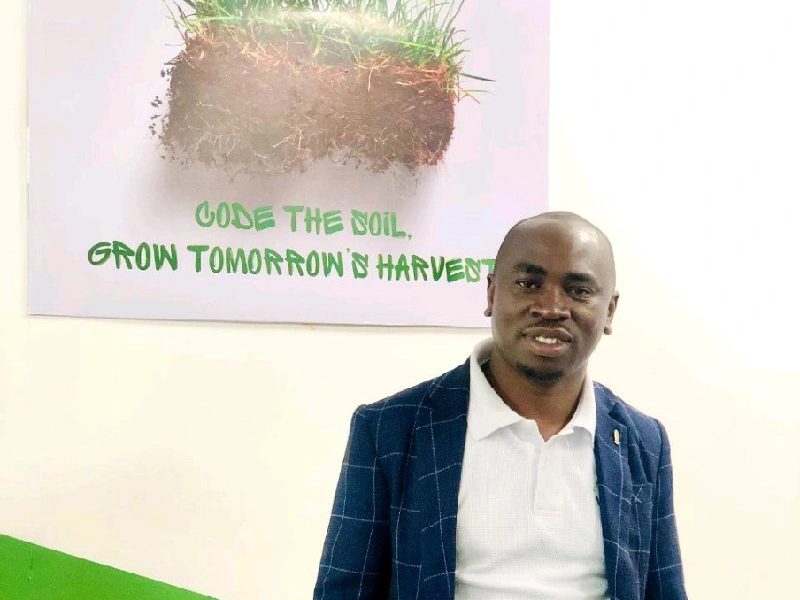
How Geophrey Tenganamba turned a childhood of “guesswork agronomy” in rural Tanzania into one of Africa’s most decorated soil-intelligence ventures — and what its place among the world’s 13 best fertiliser innovators reveals about the future of farming.
By Kilimokwanza.org Research | June 2026
PART I THE STORY — A TANZANIAN AGRITECH PIONEER
From rural adversity to the global stage
Growing up in a dusty village in rural Tanzania, Geophrey Tenganamba experienced first-hand the quiet desperation that defines smallholder farming across Sub-Saharan Africa. Raised by his grandmother, he spent his youth tilling fields under a system of “guesswork agronomy”.7 Like millions of others, his family was isolated: government extension officers were heavily overstretched, with a single officer often tasked with manually supporting more than 3,000 farmers.7 For seventeen years, Tenganamba never saw an advisor set foot in his family’s fields. Left to rely on trial and error, farmers routinely misapplied expensive synthetic inputs — depleting soil health, raising carbon emissions and suffering yield reductions of up to 50%.7
Determined to rewrite that story, Tenganamba co-founded MazaoHub in 2021 alongside Chief Technology Officer Adelard Josephat Urassa.7 Today the start-up — operated under the registered entity Mazao AgClimate Limited — has grown from a grassroots solution into an internationally acclaimed agritech pioneer.24 The clearest marker of that rise came when MazaoHub was selected as one of only 13 global finalists in the International Fertilizer Association’s (IFA) inaugural Cultivate Challenge.2
Geoffrey Kirenga, CEO of the Agricultural Growth Corridors of Tanzania (AGCOT) Centre, has lauded Tenganamba as a “visionary leader and tireless innovator” who has built an agricultural-intelligence system that ensures “farmers remain owners and beneficiaries of their data.” That recognition was reinforced earlier, in February 2025, when MazaoHub won the Agritech Award at the Africa Tech Summit Awards in Nairobi — celebrated for its ability to restore soil health, reduce chemical dependency and prevent localised environmental collapse.24
The innovations powering a green revolution
At the heart of MazaoHub’s success is a series of interconnected digital, biological and structural innovations designed to replace guesswork with empirical science.
1. The “Tech and Touch” model
Agritech in emerging markets has long suffered from a “last-mile trust gap”.9 Purely digital applications often fail because rural farmers lack internet connectivity, smartphones or confidence in virtual advice.7 MazaoHub bridges this gap through a hybrid “Tech and Touch” operational model.9
- The Tech: an offline-first SaaS platform — powered by AI, augmented intelligence and automated crop dashboards — that lets field operations continue even in zero-connectivity environments.13
- The Touch: a dedicated human infrastructure of more than a hundred trained field officers and a network of physical Farmer Excellence Centres (FECs), which act as trust-building community hubs where digital science is delivered with personal care.3
2. Five-minute soil diagnostics
Instead of waiting weeks for laboratory results, MazaoHub equips its field officers with low-cost, solar-powered Internet-of-Things (IoT) soil kits and geo-tagged sensors.13 Within five minutes of a field test, the system collects real-time data on macronutrients, pH, moisture, temperature and electro-conductivity. This hyperlocal biochemical footprint is immediately processed to generate actionable, personalised crop advisories.10
3. The “Farm Clinic” (Kliniki za Kilimo)
On 18 May 2026, MazaoHub launched its most ambitious operational pivot yet: upgrading traditional rural agrovet input shops into fully connected “Farm Clinics” (Kliniki za Kilimo).19 Under this clinical framework, agriculture is treated exactly like healthcare.
- The patient: every farm is registered as a unique “patient” with a complete medical history.19
- The diagnosis: soil is tested and crops are visually assessed using crop-stage and stress-factor analysis.
- The treatment: rather than pushing products indiscriminately, the AI recommendation engine generates precise, crop-specific “prescriptions” — specifying exact quantities, timing and application practices for fertilisers, soil conditioners and crop protection.9
By shifting the market from high-volume sales to evidence-based performance management, the Farm Clinics prevent the over-application of synthetic inputs — protecting both the surrounding environment and the farmer’s pocket.9
De-risking finance and building value chains
Technological innovation is of little use if smallholders cannot afford it. Realising that financial inclusion is the ultimate catalyst for agritech adoption, MazaoHub has built alternative financial rails and market channels of its own.14
A blended-finance seed round
In September 2025, MazaoHub closed an oversubscribed US$2 million seed round, raising total lifetime funding to US$2.25 million.14 The transaction was structured through a blended-finance model to optimise capital efficiency and risk mitigation:
- Equity component (US$1.5 million): led by Catalyst Fund, with participation from Nordic Impact Fund, Mercy Corps Ventures, elea Foundation, Impacc and DOB Equity.14
- Non-dilutive capital (US$500,000): structured as debt/grant funding from the Livelihood Impact Fund.14
The fresh capital was earmarked to scale manufacturing of proprietary low-cost soil kits, expand the network of Farmer Excellence Centres and finance the commercial rollout of CropSupply.com.14 The venture had already demonstrated rare capital efficiency, using a US$50,000 grant in 2022 (funded by FCDO, UNDP and the EU) to generate over US$500,000 in revenue in 2023 — commercial traction that attracted institutional investors focused on climate adaptation, supply-chain transparency and rural digitisation.10
Converting agronomic data into credit
Smallholders are historically locked out of formal agricultural credit because they lack physical collateral or land titles.22 MazaoHub resolves this through alternative credit underwriting. Coinciding with the seed round, it signed a three-year agreement with the CRDB Bank Foundation, under which real-time soil intelligence, crop-progress data and historical transaction volumes gathered through the Farmer Excellence Centres are converted into alternative credit scores.22 The bank uses this risk-managed data to issue loans, machinery and precision tools without requiring traditional physical assets.17 The model was expanded in February 2026 through a fintech-agriculture pilot with Equity Bank Tanzania in the Rukwa Region — deployed among maize farmers in Mpui and rice farmers in Liwelyamvula — where the bank de-risks rural lending by using MazaoHub’s extension officers to track input delivery, agronomic practice and crop performance in real time.
The marketplace: CropSupply.com
To secure loan repayment, MazaoHub locks in pre-season offtake agreements through CropSupply.com, a real-time sourcing platform that gives large corporate buyers direct access to verified, traceable crops.13 A prime demonstration of this closed loop came in February 2026, when MazaoHub hosted a strategic session with 14 suppliers and representatives of Capwell Industries — one of East Africa’s largest food manufacturers — establishing a structured supply framework for up to 50,000 tonnes of maize between June and October 2026. By ensuring full traceability from soil data to final shipment, MazaoHub guarantees that farmers who adopt climate-smart practices gain immediate, intermediary-free access to high-value markets.3
Institutional backing and global profile
This ecosystem is supported by the Agricultural Growth Corridors of Tanzania (AGCOT) Centre and the UNDP-led FUNGUO Innovation Programme, funded by the European Union, the Republic of Finland and the British High Commission.21 Under AGCOT mentorship, the venture has prioritised commercial viability, shifting its focus from early-stage agritech promotion to disciplined, franchise-based sales and long-term farm-management infrastructure.14 Its global standing rose further when Tenganamba was invited to the Skoll World Forum in April 2026, aligning MazaoHub with international social-entrepreneurship networks ahead of its 2027 financing window.19 The company is headquartered in Dar es Salaam with a team of around 25, and is targeting expansion across the Central, Northern, Mtwara and SAGCOT corridors of Tanzania.15,21
Proven field impact
MazaoHub’s data-driven, closed-loop ecosystem now serves more than 54,000 active smallholders across East Africa, including over 22,000 women.3 The real-world results speak for themselves.
| 54,000+ active smallholders, incl. 22,000+ women | 150% average yield increase per hectare | 30% / 500% less synthetic input; more organic manure |
- Productivity surges. Farmers following MazaoHub’s precise agronomic guidance have achieved an average 150% yield increase per hectare, with tomato yields tripling and maize yields doubling.3
- Input optimisation. Over-application of synthetic fertilisers has been cut by 30%, sharply reducing farm-level costs and nitrous-oxide emissions.3
- Soil regeneration. Through tailored soil plans, farmers have achieved a five-fold (500%) increase in organic-manure application, accelerating soil-carbon sequestration and long-term fertility.3
“Africa’s green revolution does not require guesswork — it requires systems that actually work.”
PART II THE WIDER STAGE — THE IFA CULTIVATE CHALLENGE & THE GLOBAL FIELD
Market drivers in sustainable plant nutrition
MazaoHub’s recognition did not happen in a vacuum. The global fertiliser and agricultural-input industries are undergoing a structural transition driven by the dual imperatives of decarbonising nutrient production and optimising farm-level application emissions.1 Traditional chemical processes, highly energy-intensive and heavily dependent on fossil-fuel feedstocks, face unprecedented regulatory, geopolitical and market pressures.2 To address these vulnerabilities, the International Fertilizer Association (IFA) established the IFA Innovation Hub and launched the Cultivate Challenge, a global start-up competition and business-development programme designed to identify, accelerate and scale high-impact technologies across the agricultural value chain.4 By bridging frontier entrepreneurs and established corporates, the challenge seeks to drive structural decarbonisation, improve nutrient-use efficiency and enhance climate resilience.2
Historically, the plant-nutrition sector has been characterised by a linear supply chain with substantial carbon and environmental footprints.1 Chemical fertilisers are essential for global productivity, yet their production — via the steam-methane reforming and Haber–Bosch processes — accounts for a significant share of global greenhouse-gas emissions.2 Concurrently, downstream inefficiencies such as the over-application and volatilisation of nitrogen, and the runoff of phosphorus, drive soil degradation, eutrophication and secondary emissions.7 The IFA Cultivate Challenge prioritises four pathways in response: green and low-carbon ammonia production, microbial plant biostimulants, precision nutrient application, and digital agronomy decision-support systems.8
The inaugural IFA Cultivate Challenge
The inaugural edition attracted more than 150 applications from over 40 countries.8 Over a multi-month development cycle, the start-ups participated in an exclusive business-development programme and presented across four specialised regional showcases, culminating in a 13-startup finalist cohort — among them MazaoHub.2
Regional showcases and Judges’ Choice awards
These regional showcases served as localised screening mechanisms, identifying standout technologies for specific agricultural and geographic contexts:2
- Europe Showcase (London): won by NitroCapt, for green, highly efficient and affordable nitrogen inputs.2
- Asia-Pacific Showcase (Bangkok): won by Phospholutions, for improving phosphorus-use efficiency on farms.2
- Americas Showcase (Silicon Valley): won by LiveGrow Bio, for a microbial platform targeting nutrient delivery and emissions.2
- Africa & West Asia Showcase (Rabat): won by Peregrine Hydrogen, for novel clean-hydrogen technology in fertiliser supply chains.2
The grand final in Budapest
The cycle concluded at the IFA Cultivating Tomorrow Conference in Budapest, Hungary, on 2–4 June 2026.2 On 4 June, Peregrine Hydrogen was crowned Champion of the inaugural challenge, recognised for electrolyser technology that co-produces hydrogen and sulphuric acid using 50% less energy than conventional water electrolysis — a co-production model that sharply improves the margin profile of zero-carbon hydrogen for green-ammonia synthesis and phosphate processing.8 Several other finalists earned distinctions, demonstrating the breadth of the cohort:11
- Runner-up: PlasmaLeap, for modular, low-temperature plasma systems fixing atmospheric nitrogen into liquid fertilisers.8
- Start-up to Watch: NitroCapt, for a competitive process targeting cost-effective green-nitrogen synthesis.11
- Innovation Impact Award: Phospholutions, for enhanced-efficiency phosphorus technology that cuts farm-level runoff.2
MazaoHub did not take one of the named awards, but its place in a global cohort of this calibre — the only finalist from Tanzania — was a landmark for African agritech.
| Startup | Regional showcase | Core technology | Award / distinction |
| Peregrine Hydrogen | Rabat (Africa & West Asia) | Co-production of hydrogen and sulphuric acid via low-energy electrolysis8 | Inaugural Grand Champion8 |
| PlasmaLeap | Finalist cohort | Low-temperature plasma systems for atmospheric nitrogen fixation8 | Runner-up8 |
| NitroCapt | London (Europe) | Greener, high-efficiency processes for nitrogen inputs2 | “Start-up to Watch” & Judges’ Choice2 |
| Phospholutions | Bangkok (Asia-Pacific) | Enhanced-efficiency phosphorus formulations to mitigate runoff2 | “Innovation Impact Award” & Judges’ Choice2 |
| LiveGrow Bio | Silicon Valley (Americas) | Microbial biostimulant platform targeting nutrient-use efficiency2 | Regional Judges’ Choice winner2 |
| Paul-Tech | Finalist cohort | Real-time soil sensors and AI-driven agronomic recommendation engine12 | Finalist2 |
| MazaoHub | Finalist cohort | AI-powered farm-management SaaS and offline soil diagnostics2 | Finalist2 |
Table 1. Inaugural IFA Cultivate Challenge — finalist outcomes and distinctions.
The second edition of the Cultivate Challenge
The second edition — the 2026/2027 cycle — launched in March 2026, with applications closing on 27 March, and its 13-strong finalist cohort was revealed around the Budapest final in June 2026.8 Drawn from another pool of more than 150 submissions, the cohort spans green chemistry, biotechnology, digital platforms and climate-smart solutions, and entered a 12-month growth programme culminating in a grand-final pitch at the IFA Cultivating Tomorrow Conference in 2027.4
| Startup finalist | Country | Technological proposition | Targeted industry impact |
| Ammobia | USA | Next-generation ammonia synthesis at far lower pressure and temperature11 | Cuts industrial capital expenditure by up to 50% across all scales11 |
| Sultech Global | Canada | Micronised, wet-applied agricultural sulphur from elemental sulphur11 | Lowers carbon intensity while improving soil availability11 |
| Airovation Technologies | Israel | Carbon-mineralisation converting CO₂ and phosphogypsum into carbonate, sulphuric acid and ammonium sulphate8 | Valorises industrial waste streams into fertiliser inputs8 |
| SWAN-H | France | Boron-mediated electrochemical process for green ammonia11 | Enables modular, on-site production from renewable power and water11 |
| Puna Bio | Argentina | Extremophile-derived microbial inoculants for nitrogen fixation11 | Fixes 20% more nitrogen; aims to displace 30% of synthetic inputs11 |
| Copernic Catalysts | USA | AI-designed base-metal drop-in catalysts for ammonia plants11 | 7–20% capacity gains and 5–15% operating-cost reductions11 |
| BeCaps | Argentina | Microencapsulation turning liquid biologicals into shelf-stable solids8 | Extends shelf life; fertiliser-compatible delivery8 |
| Messium | United Kingdom | Hyperspectral satellite platform reading sub-field crop nitrogen8 | Sharpens fertiliser recommendations to curb over-application8 |
| N2 Applied | Norway | Modular, farm-scale plasma nitrogen-fixation systems8 | Fixes atmospheric nitrogen into slurry to make local fertilisers8 |
| iSDA | UK (Africa-focused) | AI “virtual agronomist” via WhatsApp on a 30m African soil dataset8 | Delivers site-specific fertiliser advice to African smallholders8 |
| Farmdar | Singapore | AI-powered satellite crop-diagnostic and monitoring platform8 | Detects early-stage nutrient deficiency and field variability8 |
| Bioprime Agrisolutions | India | Bioactive molecular coatings and targeted biological inputs8 | Enhances nutrient-use efficiency across 35+ crops11 |
Table 2. Selected finalists of the second-edition (2026/2027) cohort. Roster compiled from IFA and industry reporting; the inclusion of Bioprime Agrisolutions is reported but not yet independently confirmed against IFA’s official list.
Strategic market implications
Read together, the inaugural cohort and MazaoHub’s place within it reveal a clear convergence of upstream decarbonisation and downstream precision agriculture — with significant implications for industry, financiers and policy-makers:
- Decentralisation of ammonia production. Start-ups such as Ammobia, SWAN-H and N2 Applied are challenging reliance on massive, capital-intensive Haber–Bosch plants.8 Lower operating temperatures and pressures enable localised, on-site fertiliser production on regional renewable energy, mitigating supply-chain risk and lowering logistics-related Scope 3 emissions.
- From volume to performance. Downstream precision tools such as those from Paul-Tech and MazaoHub are shifting the market from high-volume input sales to evidence-based performance management.9 As regulation tightens around emissions and runoff, fertiliser manufacturers are incentivised to evolve from commodity suppliers into integrated plant-nutrition service providers.1
- Fintech integration as a catalyst. The MazaoHub–CRDB Bank partnership shows agritech adoption is intrinsically linked to financial access.14 Embedding financial rails directly into agronomic software — de-risking loans with real-time soil and yield data — is a scalable path to unlocking commercial capital for smallholders.17
- Biological and chemical hybridisation. The rise of biologicals — Puna Bio’s extremophile products, Bioprime’s biomolecule coatings — suggests future models will pair high-efficiency synthetic inputs with advanced microbial agents, preserving soil structure and supporting carbon sequestration.11
The plant-nutrition sector is transitioning toward a highly integrated ecosystem in which clean chemical synthesis, biological innovation, digital agronomy and inclusive finance converge.9 Ventures that master this shift — investing in decentralised production and building data-driven, last-mile distribution — will be best placed to drive food security under rising climate volatility. MazaoHub’s journey, from a grandmother’s plot to the IFA world stage, shows that this future can be built from the soil up, and owned by the farmers who work it.1
Ref.
- IFA – International Fertilizer Association. https://www.fertilizer.org/
- IFA announces winners from the inaugural IFA Cultivate Challenge. https://www.fertilizer.org/news/ifa-announces-cultivate-challenge-winners/
- MazaoHub – Start-Up Africa – Impacc. https://impacc.org/en/venture/mazaohub/
- Introducing the Cultivate Challenge – IFA. https://www.fertilizer.org/initiatives/ifa-innovation-hub/introducing-the-cultivate-challenge-2026/
- IFA Challenge – THRIVE Agrifood. https://thriveagrifood.com/ifa-challenge/
- The IFA Innovation Hub. https://www.fertilizer.org/initiatives/ifa-innovation-hub/
- About Us – MazaoHub. https://mazaohub.com/about
- Peregrine Hydrogen Crowned Champion of the IFA Cultivate Challenge – AgriBusiness Global. https://www.agribusinessglobal.com/plant-health/npk/peregrine-hydrogen-crowned-champion-of-the-ifa-cultivate-challenge/
- What the Argus Fertilizer Africa Conference 2026 Means … and Why MazaoHub’s “Tech & Touch” Model Fits. https://mazaohub.com/news/what-the-argus-fertilizer-africa-conference-2026-means-for-a-data-driven-fertilizer-market-and-why-mazaohubs-tech-touch-model-fits-the-moment
- Climate-tech app MazaoHub – CLIC, ClimateShot Investor Coalition. https://climateshotinvestor.org/publications/clic-mazaohub-case-study
- Peregrine Hydrogen Crowned Champion – IFA. https://www.fertilizer.org/news/peregrine-hydrogen-crowned-champion-of-the-ifa-cultivate-challenge/
- Paul-Tech selected as IFA innovation challenge finalist. https://paul-tech.com/paul-tech-selected-as-a-finalist-in-the-international-fertilizer-associations-innovation-competition/
- MazaoHub : Climate & Data Driven Farming Software. https://mazaohub.com/
- MazaoHub Closes $2M Oversubscribed Seed …. https://mazaohub.com/news/mazaohub-closes-2m-oversubscribed-seed-to-scale-climate-smart-data-driven-agronomy-services
- MazaoHub 2026 Company Profile – PitchBook. https://pitchbook.com/profiles/company/566888-50
- Tanzania’s MazaoHub … – Spotlight In Africa. https://www.spotlightinafrica.com/post/mazaohub-tanzania-s-agri-tech-startup-transforming-farming-through-precision-agriculture-climate-s
- MazaoHub Secures $2M Seed Round – agrotech.space. https://agrotech.space/2025/09/29/mazaohub-2m-funding-agronomy-platform/
- Tanzania’s MazaoHub raises $2m – Disrupt Africa. https://disruptafrica.com/2025/09/22/tanzanias-mazaohub-raises-2m-pre-seed-to-scale-ai-powered-climate-smart-farming-across-africa/
- We are turning traditional agrovet shops into Farm Clinics – MazaoHub. https://mazaohub.com/news/we-are-turning-traditional-agrovet-shops-into-farm-clinics-powered-by-system-ai-data-and-science
- MazaoHub – Apps on Google Play. https://play.google.com/store/apps/details?id=com.mazaohub.mazaohub
- MazaoHub Celebrates Strategic Growth with AGCOT Centre – Kilimokwanza. https://kilimokwanza.org/mazaohub-celebrates-strategic-growth-with-agcot-centre-a-journey-guided-by-vision-and-wisdom/
- MazaoHub and CRDB Bank Foundation Collaboration – TechAfrica News. https://techafricanews.com/2025/09/19/mazaohub-and-crdb-bank-foundation-collaboration-paves-way-for-smarter-inclusive-farming-in-tanzania/
- Dealmaker’s Log: April 2026 – Africa Private Equity News. https://backoffice.africaprivateequitynews.com/wp-content/uploads/2026/05/Dealmakers-Log_-April-2026-updated-and-archive.pdf
- 13 winners announced at Africa Tech Summit Awards in Nairobi – Disrupt Africa. https://disruptafrica.com/2025/02/20/13-winners-announced-at-africa-tech-summit-awards-in-nairobi/
- Africa Tech Summit Awards. https://www.africatechsummit.com/nairobi/awards/