

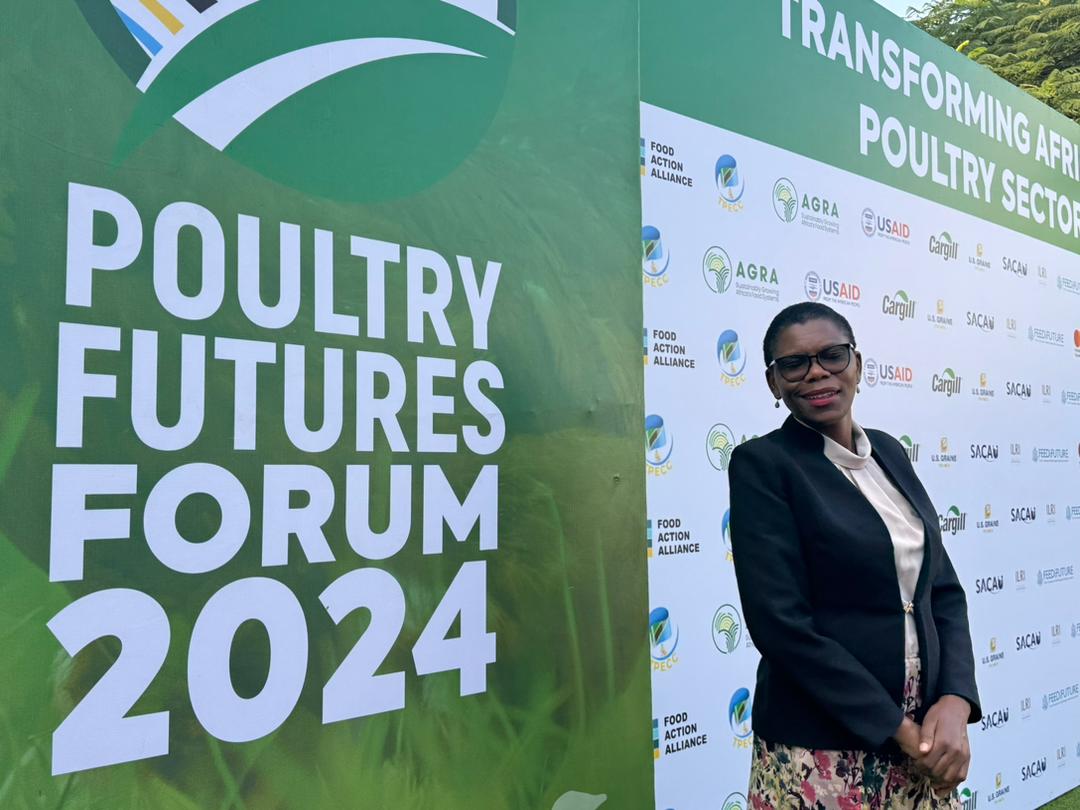
Dar es Salaam — At the 10th Africa Agri Expo and 3rd Future Food, Livestock and Poultry Expo, AGCOT Centre’s Tullah Mloge argued that Tanzania cannot scale its chicken economy without first fixing its maize and soybean value chains — and laid out the partnership model AGCOT is betting on to do both.
On the agenda for Session 6 (3 September 2026, 09:00–10:30 AM), the slot on international and local perspectives on Tanzania’s agricultural, poultry and livestock potential listed Geoffrey Kirenga, CEO of AGCOT Centre, as a speaker. When the moment came, at the Mwalimu J.K. Nyerere Trade Fair Grounds, it was Tullah Mloge, AGCOT’s Head of Partnerships and Communication, who stepped up in her place – representing AGCOT with a fifteen-minute address that, by her own admission, ran under a very tight clock.
She used it to make a single argument, repeated in different forms throughout her remarks: poultry is not a standalone business. It is the visible end of a chain that starts with feed crops, runs through finance and policy, and only then reaches the farmer’s coop.
An institution still explaining its new name
Mloge opened by addressing an identity most of the room half-recognised. “Who has ever heard the name SAGCOT?” she asked — the Southern Agricultural Growth Corridors of Tanzania, the institution’s original form. Hands went up. But since 2023, she explained, a presidential directive has instructed that the lessons learned in the southern corridor be extended nationally. What was SAGCOT is now AGCOT — the Agricultural Growth Corridors of Tanzania — operating across four corridors instead of one: the original Southern corridor, plus new Northern (Tanga–Kilimanjaro–Arusha–Manyara), Central, and Ruvuma–Lindi corridors.
It is a housekeeping point with real weight for an audience of investors and policymakers: AGCOT’s mandate, and the partnership model built around it, is no longer confined to the south of the country.
The scale of the opportunity — and the shortfall
Mloge framed Tanzania’s poultry sector within a global and continental picture. Global poultry production reached an estimated 150 million tonnes in 2024. Africa’s share of that was just 7.9 million tonnes — roughly 5.3%. Set against a continent with a rapidly growing population, accelerating urbanisation, an expanding middle class, and rising demand for affordable animal protein, the mismatch is stark.
“Can Africa produce enough poultry — competitively, efficiently and sustainably — to meet its own demand?” she asked. That, she said, is where the opportunity sits, and Tanzania is positioned to capture a meaningful share of it: the country has land available for feed crops and livestock, a young and growing labour force, and increasing private-sector investment in feed and poultry production alike.
The obstacles are equally familiar to anyone who has worked in the sector: feed costs, the quality of genetics and animal health, access to finance, weak market organisation, and policy coordination that has historically treated these as separate problems rather than one interlocking system.
A household activity becoming an economic sector
In Tanzania specifically, poultry is already one of the most widely held livestock activities in the country. Citing the 2019/20 National Sample Census of Agriculture, Mloge noted that approximately 3.7 million of the country’s 4.7 million agricultural households keep poultry — accounting for 53% of livestock-related household income nationally.
The flock itself has grown fast. According to figures Mloge cited, Tanzania’s chicken population rose from 79.1 million birds in 2019 to 180 million birds in 2024. That growth is now the base on which government policy is trying to build a formal industrial target: in August 2026, Tanzania launched its National Poultry Development Strategy 2026–2036, aiming to lift annual poultry meat production above 380,000 tonnes and egg production above 17 billion eggs per year by 2036, while raising poultry’s contribution to GDP from around 1.8% to 3%.
“Poultry is no longer simply a household livelihood activity,” Mloge said. “It is becoming a contributor to the economic sector.”
The constraint hiding behind the chicken
So what is holding the sector back? Mloge’s answer returned, as it did throughout her remarks, to feed — specifically to maize, which supplies energy, and soybean, which supplies protein, in commercial poultry feed formulations. “The future of the Tanzanian poultry industry is closely tied to the future of the Tanzanian feed industry,” she said, “and the future of the feed industry is connected to the productivity and competitiveness of our maize and soybean value chains.”
That, in her telling, is precisely where AGCOT’s interventions become relevant — not in poultry production itself, but in the crop value chains that make poultry production viable at scale.
Partnership before project
Mloge described AGCOT’s operating philosophy in four words: “partnership before project.” The premise, she said, is that agricultural transformation cannot be delivered by any single institution acting alone. Government sets the enabling policy and invests in infrastructure. Farmers do the producing. Financial institutions, research bodies and development partners each carry a piece of the puzzle that none of the others can supply on their own.
AGCOT’s role, as Mloge described it, is not to own any part of the poultry sector but to coordinate it — convening stakeholders, identifying shared bottlenecks, and helping translate common priorities into coordinated action and innovative financing arrangements.
The clearest product of that convening role to date, she said, is the Poultry Compact, developed in 2022. The Compact brought stakeholders together around a shared vision and a common set of priorities for the sector, replacing a pattern in which individual actors addressed the same structural problems separately and often at cross purposes. It also established a mechanism for ongoing coordination and accountability, which government and private-sector partners then carried forward into a Poultry Compact Implementation Plan covering 2022 to 2028. That process, in turn, fed directly into the drafting of the National Poultry Development Strategy now guiding the sector through to 2036.
The pitch to an investment audience
Speaking to a room that included government officials, financiers and private investors from across the agri-food and livestock sector, Mloge closed with what amounted to AGCOT’s institutional pitch: that its value lies not in running poultry farms, but in bringing the right actors to the same table — government, farmers, financiers, researchers and development partners — and helping them turn shared ambition into coordinated investment.
“Agriculture transformation is not the work of one person or only one institution,” she told delegates. “It is a result of a partnership working towards a common goal. As an individual, as an institution, we need to work together — bringing everyone to the table. Then we get positive, efficient and higher results.”
For a sector that already touches more than three-quarters of Tanzania’s farming households, and that government now expects to more than double in output value within a decade, that message — coordinate the chain, not just the chicken — may prove to be the harder-won half of the strategy.
AGCOT Centre was a Key Supporting Partner at the 10th Africa Agri Expo & 3rd Future Food, Livestock and Poultry Expo, held 2–3 September 2026 at the Mwalimu J.K. Nyerere Trade Fair Grounds, Dar es Salaam.
1 comment
Linking maize and soybean production with the growth of the poultry sector makes the value-chain approach especially clear. I also think the emphasis on bringing farmers, financiers, researchers and policymakers together is important because improving production alone will not solve the underlying feed and market challenges.