

DODOMA · CLOSING DAY RETROSPECTIVE · 8 AUGUST 2026
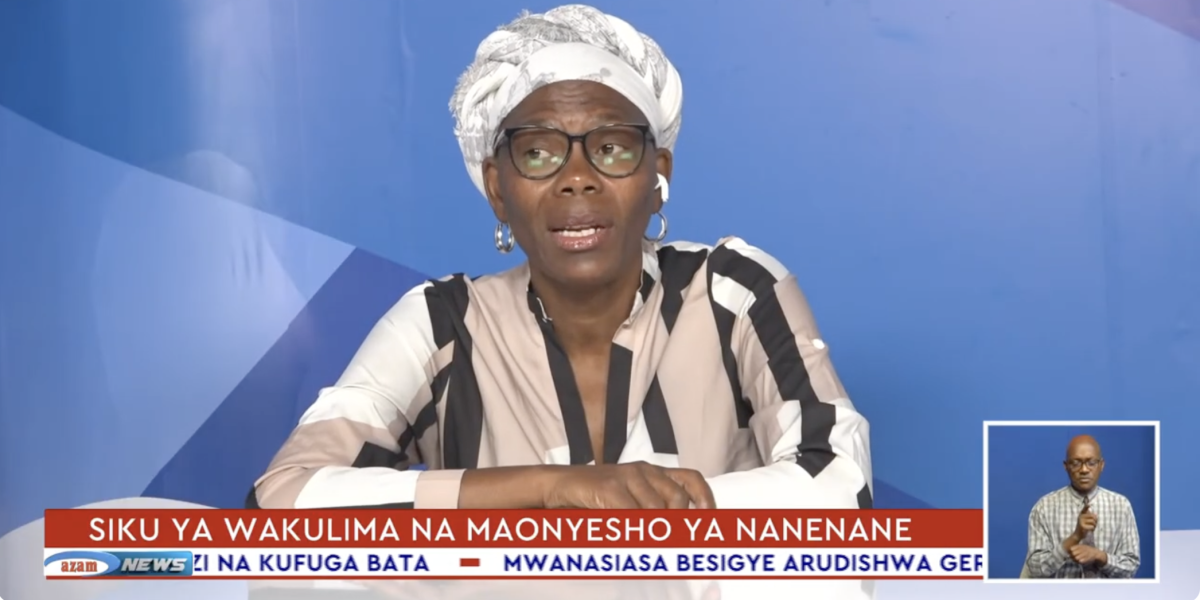
Dodoma, 8 August 2026 — On the final day of this year’s Nane Nane celebrations — the actual national Nane Nane holiday — Tullah Mloge, AGCOT Centre’s Head of Partnerships and Communication, joined Azam TV’s weekend news programme, Habari Wikendi, for a wide-ranging retrospective with host Aurelia Palali on how the exhibition has changed, what Dodoma got right this year, and whether Nane Nane can keep its identity as agriculture’s own show as it keeps growing.
Five years of quiet reorganisation
Ms Mloge’s central argument was that Nane Nane’s transformation has been gradual rather than sudden — the product of roughly five years of steady change she has watched firsthand, including hands-on involvement preparing past exhibitions in Mbeya, historically the national host before Dodoma took on that role. The clearest structural shift, she said, has been zoning: the joint preparatory committee — spanning the Ministry of Agriculture, the Ministry of Livestock and Fisheries, and the President’s Office–Regional Administration and Local Government (TAMISEMI), working through the regional administrations hosting each zone — now deliberately groups related exhibitors together rather than scattering them. Seed companies sit together; fertiliser and input suppliers sit together; government regulatory bodies — TRA, BRELA, TBS and others — sit together in their own cluster. That reorganisation, she argued, is what has given the show a more international, professional character, and is part of why visitors increasingly arrive from neighbouring countries specifically to observe what Tanzania is doing.
Dodoma’s growing pains, and this year’s fix
Ms Mloge was candid that Dodoma’s transition to hosting the national exhibition was not smooth from the start. The grounds themselves — officially the Dr. John Samuel Malecela Grounds in Nzuguni, commonly known simply as the Nzuguni Grounds, and designated as the site of Tanzania’s National and International Agricultural Exhibition — took on that national hosting role only recently. Two years ago, the grounds introduced international-standard exhibition tents for the first time — a genuine step forward, but one that came with real complaints: dust, noise, and a public sentiment she described plainly — that people wanted an agriculture show and felt they were instead getting something else. This year, she said, organisers addressed that directly: attendees looking specifically for agricultural information and technical exhibits are now physically separated from the bulk-trading and general marketplace (“gulio”) areas, cutting down the crowding and noise that previously bled into the exhibition’s more technical zones. She also pointed to visible investment in permanent infrastructure at the Nzuguni grounds, and noted that the sheer scale of land available there — larger, she said, than at most zonal venues — gives organisers real flexibility to keep refining the layout in future years.
The number driving all of it: $100 billion by 2050
Much of Ms Mloge’s framing traced back to a single figure: Tanzania’s Vision 2050 target for agriculture, livestock and fisheries to contribute USD 100 billion to the national economy by 2050, against a sector currently contributing somewhere between USD 2 billion and USD 5 billion. With 25 years to close that gap, she argued the exhibition’s core function is now unambiguous: getting farmers direct access to the technologies that can actually move that number — drone-based spraying (“ndege nyuki,” literally “bee planes”), ridge-forming implements, improved pesticides and fertiliser, and minimum-tillage conservation techniques that protect soil while cutting labour. She cited drone spraying as a concrete illustration of the economics involved: manual pesticide application on a rice field wastes chemical through drift and requires many labourers, while a single operator with a drone can cover the same ground with less product lost and, she noted, less direct chemical exposure for workers — the kind of labour-saving, health-protecting shift she believes is exactly what will make farming attractive to young people who currently see fieldwork as unappealing.
She linked this directly to a same-day government announcement: funds channelled to banks specifically for youth lending, part of the same “Jenga Kesho Iliyo Bora” (“Build a Better Tomorrow”) framework targeting Tanzanians aged 18 to 35 as the demographic expected to carry the sector toward its 2050 target. Her reading of Nane Nane’s role was direct — it exists to put new technology and financing pathways in front of exactly that age group, at scale, in one place.
Where Nane Nane ends and Saba Saba begins
Responding to a concern raised earlier in the same broadcast — traders worried about being squeezed out of an increasingly agriculture-focused Nane Nane — Ms Mloge drew a clear institutional line between Nane Nane and Saba Saba, Tanzania’s separate national trade and industry exhibition held earlier in the year. Saba Saba, she said, is the right venue for finished, value-added goods — packaged flour, processed coffee and similar consumer products — while Nane Nane’s core purpose sits a step earlier in the chain: production itself, before value addition happens. She was quick to add that this distinction doesn’t make Nane Nane irrelevant to non-farming businesses — she pointed to attendees who arrive with no farming interest at all simply to use the on-site BRELA desk to register a business, and to the general footfall the show draws regardless of sector. Her recommendation, rather than excluding traders, was the same zoning principle already applied in Dodoma: physically separate commercial/trading activity from the show’s educational and technical content, and extend that model to the zonal shows still working out their own layout.
A broader verdict on where farmers stand
Asked for a wider assessment of the sector’s progress, Ms Mloge pointed to a shift in mindset she considers more significant than any single statistic: a growing recognition among farmers that agriculture is a business rather than a subsistence activity, driven in her view by genuine improvement in the agribusiness operating environment — more seed companies bringing improved varieties, and government actively facilitating the entry of companies bringing new technology, drone services among them. Her closing point returned to labour economics: a rice field that once needed roughly 100 people to spray manually can now be covered by one person operating a drone, a shift she argued is precisely what will draw younger Tanzanians into farming who currently associate fieldwork with hardship rather than opportunity.
What this means going forward
Ms Mloge’s interview functions as something this week’s coverage hasn’t had until now: an honest, organiser’s-eye retrospective on the show itself, rather than a report from inside any single pavilion. Her account credits Dodoma’s 2026 layout as a genuine fix to problems as recent as two years ago, while treating the zonal shows in Mbeya, Morogoro and elsewhere as still catching up to that standard — and frames the entire exercise, deliberately, as instrumental to a single 25-year target rather than an end in itself.
Reporting based on an interview with Tullah Mloge, Head of Partnerships and Communication, AGCOT Centre, conducted by Aurelia Palali on Azam TV’s Habari Wikendi, broadcast 8 August 2026. Tullah Mloge’s role at AGCOT is independently corroborated by this project’s own prior reporting. Figures cited in the interview — the USD 100 billion 2050 target, the sector’s current USD 2–5 billion contribution, and the “Jenga Kesho Iliyo Bora” youth lending initiative — were given verbally in the interview and were not independently re-verified against a published government source for this piece. Watch: https://youtu.be/xH8jGDUF55U