

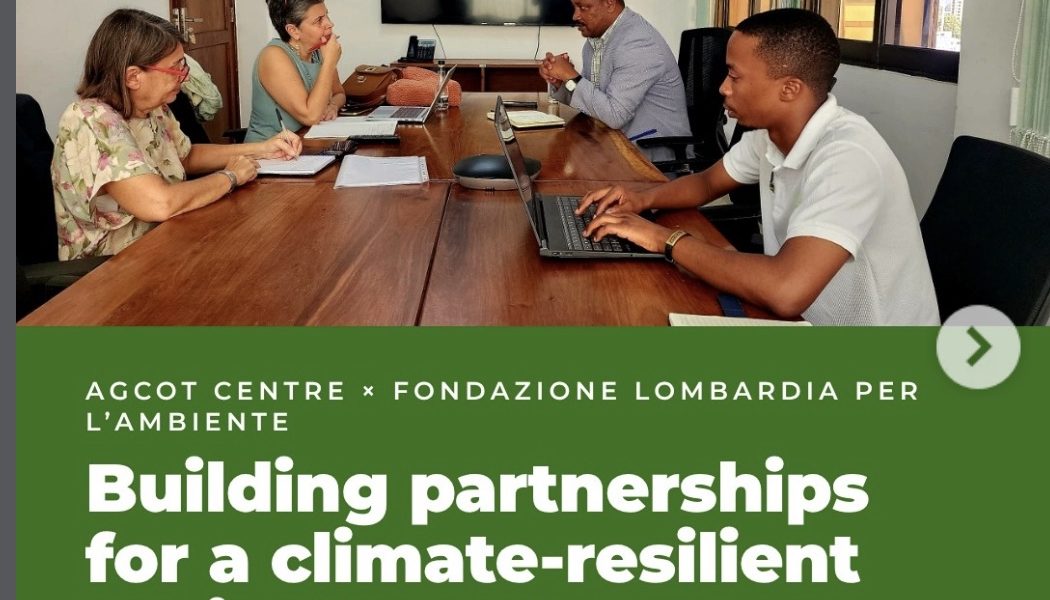
Italian delegation meets AGCOT Centre, Arusha’s Regional Commissioner and NM-AIST to advance a €2 million programme that helps farming communities in Arusha and Pemba adapt to drought and extreme rainfall
By Kilimokwanza.org Correspondent · 17 November 2026
DAR ES SALAAM, 17 November 2026 — AGCOT Centre and Fondazione Lombardia per l’Ambiente (FLA) have signalled their interest in developing a collaboration agreement, after the two organisations met on 9 November 2026 during a Lombardy Region mission to Tanzania to advance RES4CLIMA, an Italian-funded programme designed to help Tanzania’s agri-food sector withstand the effects of climate change.
The meeting focused on how farming can be made resilient to a changing climate through agroecology and agroforestry, better management of water and soil, and stronger food security. According to FLA, particular attention went to AGCOT’s role in bringing public decision-makers and implementing organisations to the same table — the step that turns climate policy on paper into concrete action on the ground.
The talks opened a two-day programme that continued on 10 November 2026 in Arusha Region, with an institutional meeting with Regional Commissioner Amos Gabriel Makalla and a visit to the Nelson Mandela African Institution of Science and Technology (NM-AIST).
Who was at the table
The Italian delegation was led by Raffaele Cattaneo, Undersecretary for International and European Relations of Regione Lombardia. He was joined by Maria Grazia Pedrana, head of the region’s European Territorial Cooperation and International Cooperation unit, and her colleague Antonino Lombardo.
FLA was represented by Stefania Fontana of its Sustainable Development research area, accompanied by consultant Barbara Migone. ICEI, the RES4CLIMA partner responsible for field trials in Arusha, sent its director Rosaria De Paoli and its local project lead, Elisa Pedrazzi.
A programme Tanzania asked for
RES4CLIMA — Strengthening resilience of the agri-food sector to climate change in urban, peri-urban and rural areas — was set up in response to a request for support from the Government of Tanzania, which faces mounting pressure on farm productivity from recurring droughts and extreme rainfall.
The programme is funded by the Agenzia Italiana per la Cooperazione allo Sviluppo (AICS) and led by Regione Lombardia. AICS records a commitment of €2,000,000, of which €1,400,000 has been disbursed. Work began on 27 June 2025 and is planned to run for 36 months, to June 2028.
It concentrates on two areas where climate shocks threaten harvests and household food security: Arusha Region on the mainland and Pemba Island in Zanzibar. Lombardy reports 14 partners — 11 from Lombardy and three from Tanzania. The Tanzanian partners listed by AICS are NM-AIST, the State University of Zanzibar and SAGCOT, the corridor initiative whose Centre now operates nationally as AGCOT Centre.
What the programme does
RES4CLIMA is organised around three strands of work:
- Institutional and academic capacity: equipping Tanzanian institutions and universities to plan and manage climate-adaptation strategies for the agri-food sector, with priorities including the sustainable use of compost and the effects of livestock farming on food systems.
- Arusha Region: participatory governance tools to make the food system more resilient, a sustainable food-production model and better food governance, with ICEI running field trials.
- Pemba Island: training on sustainable, regenerative and climate-resilient farming, natural resource management and the reuse of waste and food waste, alongside participatory spatial planning, applied research and technical support for small producers.
FLA’s own task is to review the climate-adaptation policies, strategies and plans Tanzania has adopted at national, regional and local level, compare them with European and Italian practice, identify gaps, and recommend how adaptation can be built into public decision-making. It will also consult local authorities, communities and pilot-project participants to draft guidelines for local planning, and train technical staff to apply them.
The programme has already led ICEI to open a permanent office in Arusha.
Government and science
On 9 November 2026, Cattaneo also took part in an Italian Government “system mission” led by Stefano Gatti, Italy’s Director General for Development Cooperation, and Lorenzo Ortona of the Piano Mattei mission structure. Tanzanian participants included Prof. Kitila Mkumbo, Minister of State for Planning and Investment, and James Kinyasi Millya, Deputy Minister for Foreign Affairs and East African Cooperation. Talks covered Piano Mattei projects in agriculture, education, health, energy, tourism, the environment, and research and innovation.
In Arusha the next day, Regional Commissioner Makalla commended Lombardy’s work in the region. Discussions covered RES4CLIMA and a second initiative, the Joint STI Campus, which links 11 Lombard universities with four African ones, including one in Arusha, to promote scientific collaboration and technology transfer.
At NM-AIST, the delegation met institutional leadership, including Judith Leo, and academic staff involved in both programmes, and reviewed progress with local operators implementing RES4CLIMA. The mission also included working sessions with regional technical officers and university representatives to tighten coordination among partners.
Cattaneo cast the relationship as one between equals. As reported by the Italian outlet Affaritaliani, he said Lombardy, home to one of Europe’s most dynamic university, business and social networks, had a responsibility to turn that strength into a shared opportunity, and that partnerships built on an equal footing turn cooperation from assistance into mutual development.
Why AGCOT matters to the outcome
Climate-adaptation programmes often stall in the gap between national policy and what happens on a farm. That gap is where the 9 November talks concentrated. AGCOT Centre’s mandate is to convene government, the private sector, researchers and development partners around agricultural transformation, which places it where FLA’s policy analysis, NM-AIST’s research and ICEI’s field trials can reach the officials who plan and the farmers who adopt.
A formal collaboration agreement, if concluded, would give that exchange of expertise a lasting structure. With roughly 19 months left on RES4CLIMA’s planned timeline, the test will be whether the guidelines, training and governance tools now being built in Arusha and Pemba are still in use by councils and farmers once Italian funding ends.
Sources
- Fondazione Lombardia per l’Ambiente — RES4CLIMA mission report (November 2026)
- Affaritaliani — Delegazione con il sottosegretario Cattaneo in Tanzania (11 November 2026)
- AICS OpenAid — RES4CLIMA project record
Related coverage: AGCOT hosts Italian delegation for talks on climate-resilient agriculture.
Related reading

Do you have a story or press release for African agriculture? Send it to kilimokwanza.africa@gmail.com or read how to submit.