

Kilimokwanza.org | African Agriculture and Food Systems
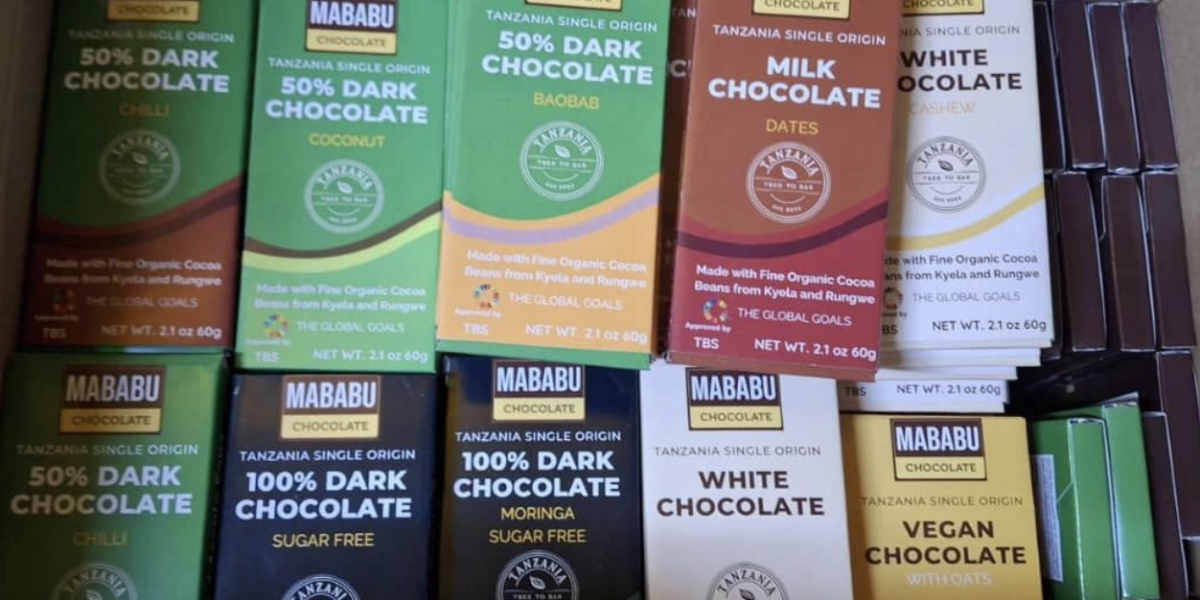
In the drive to build Tanzania into a USD 100 billion agricultural economy by 2050, no shift matters more than the move from exporting raw commodities to adding value at home. Few stories capture that ambition as vividly as that of Naomi Mwasambili and Mababu Chocolate, the flagship brand of Livy Africa — a Tanzanian company turning home-grown Southern Highlands cocoa into finished, world-class chocolate.
Her journey is a working example of how local resources, diaspora know-how, and institutional facilitation can combine to keep agricultural wealth inside the country rather than ceding it to manufacturers abroad.
The Visionaries Behind the Brand
Mababu Chocolate is the product of a family homecoming. Livy Africa is a family-led social enterprise whose founders trace their roots to Tanzania’s Southern Highlands, and who from 2017 began consolidating careers built across the United Kingdom and Africa into a single manufacturing venture at the source in Mbeya. Chris Mwasambili, Founder and Chief Executive, returned from years in England determined to challenge the export of raw beans, and is the architect of the company’s integrated “tree-to-bar” model. Miriam Mwasambili, Co-Founder and Executive Head Chocolatier, brings nearly two decades in elite international hospitality — including Executive Pastry Chef roles at Michelin-starred London venues such as Club Gascon — and governs the fermentation, drying, and refinement of Kyela cacao into gourmet bars. Naomi Mwasambili, Co-Founder and Director of Innovation, is an award-winning social entrepreneur and psychologist by training who leads the enterprise’s work on community livelihoods, agroecology, and smallholder agribusiness incubation, and is producing the documentary Added Value: The Cocoa Story.
The philosophy is “tree-to-bar”: owning the journey from the cocoa tree to the finished product. Operating from the Southern Highlands and working closely with Mababu cocoa farmers, Livy Africa has shown that Tanzania need not remain a supplier of raw beans to the world. It has the talent, the terroir, and the capacity to manufacture premium chocolate that competes both at home and internationally — alongside a growing family of brands including EcoFarm Tanzania, Naturals by Livy, and the Livy Cocoa Bar, which has helped seed a small cocoa-tourism trail in the region.
Complementary Value Chains: The Dairy Dimension
One of the most stubborn obstacles to local agro-processing is dependence on imported secondary ingredients. For years, producing premium milk chocolate in Tanzania meant importing powdered milk, because none was made domestically.
That barrier began to ease in 2025, when ASAS Dairies launched Tanzania’s first-ever locally produced milk powder — an instant full-cream product, and a genuine milestone for a dairy sector that had long depended on imports and reconstituted milk. For the first time, the building blocks of a fully Tanzanian milk chocolate — cocoa from the Southern Highlands and milk powdered at home — exist within the same economy. The SAGCOT/AGCOT Centre has championed both ASAS and Mababu as complementary “Tanzania Brands,” showcasing them side by side to illustrate exactly the kind of interlocking local value chains its mandate is built to foster.
Showcasing “Tanzania Brands” to the World
To help youth- and women-led agribusinesses reach the right buyers, the AGCOT Centre provides technical support and event preparation under the Tanzania Harvest Initiative, a platform promoting locally produced chocolates, coffees, and dairy products. Mababu Chocolate has become one of its flagship faces.
- Africa Food Systems Forum (AGRF), Dar es Salaam, 2023: With technical support from the then-SAGCOT Centre, Mababu was featured at this major summit — and was the only African chocolate maker showcasing Tanzania-made fine chocolate at the event, putting it in front of development partners and potential financiers.
- Nanenane Expo, 2024: At the national agricultural exhibitions, Naomi Mwasambili promoted these interconnected “Tanzania Brands” at the Tanzania Harvest booth alongside AGCOT leadership and ASAS, linking consumers and policymakers directly to the producers behind the products.
Developing the Broader Cocoa Sector
Mababu’s rise sits within a wider national push to organise and elevate Tanzania’s cocoa value chain — a sector where the country punches well above its weight on quality even as its volumes remain modest. Tanzania produces only around 14,000–17,000 tonnes of cocoa a year, grown by roughly 30,000 smallholders across Mbeya, Morogoro, Tanga, and Songwe, with Kyela District the long-standing anchor. Because most of it is grown organically — intercropped with banana under shade, and without synthetic pesticides — it markets naturally as “fine-flavour, organic-by-default,” a premium niche rather than a bulk commodity.
The Government wants to scale that base sharply. Under a National Cocoa Strategy led by the Cereals and Other Produce Regulatory Authority (COPRA) and the Ministry of Agriculture, the stated target is to lift production from roughly 17,000 tonnes today to 80,000 tonnes by 2030, backed by seedling distribution into new clusters in Morogoro and Tanga and a rollout of cocoa drying facilities to standardise quality. Sales are increasingly routed through the Tanzania Mercantile Exchange (TMX) digital auction, bringing transparency to farm-gate pricing through the primary cooperative societies (AMCOS).
The Kilombero Valley producer Kokoa Kamili anchors the country’s quality reputation. Working with close to 3,000 smallholder farmers, paying premium prices for wet beans and handling fermentation and drying centrally, it has secured the highest prices in Tanzania for its growers and a following among ultra-premium chocolate makers in Europe, the United States, Japan, and the Gulf — while distributing seedlings and helping plant well over 100,000 trees. AGCOT has backed efforts to deepen this expertise, including a formal memorandum of understanding between Kokoa Kamili Ltd and Sokoine University of Agriculture (SUA) to develop a dedicated Cocoa Centre of Excellence at Njage Village in Kilombero District. It has also worked to open high-value export channels: the SAGCOT/AGCOT Centre served as secretariat for a US Trade Mission — organised with Tanzania’s Ambassador to the United States, Hon. Dr. Elsie Kanza — in which partners including Kokoa Kamili took part to promote premium Tanzanian cocoa under the AGOA treaty.
Why Value Addition Matters Now
The structural challenge is stark. An estimated 92–95% of Tanzania’s cocoa still leaves the country raw — dried, fermented beans shipped under HS Code 1801, mostly to industrial crushers in Asia and Europe, with Malaysia the leading destination. Only a small share, perhaps 5–8%, is processed locally, and domestic consumption of finished chocolate remains negligible. The “wet-bean” model pioneered by Kokoa Kamili captures more value than bulk commodity sales, but it is still, technically, an exported raw bean. It mirrors the continental pattern: Africa grows roughly three-quarters of the world’s cocoa, yet captures only a small fraction of a global chocolate industry worth well over USD 100 billion.
The cost of staying at that end of the chain was laid bare in early 2026, when auction prices collapsed from the Sh32,000–36,000 per kilogramme of recent boom years to about Sh5,540 — far below the Sh10,000 indicative floor — exposing farmers to a market they do not control. This is precisely why the work of finishers like Mababu matters: a bar made, branded, and sold from Tanzania is insulated from raw-bean price swings and keeps the manufacturing margin at home. Mababu is one of a small cohort of craft brands — alongside names such as Chocolate Mamas — showing that the finished-goods frontier is within reach.
Access to premium markets, though, increasingly depends on traceability. Under the EU Deforestation Regulation (EUDR), European buyers must prove cocoa was not grown on cleared land, and COPRA and its partners are rolling out a national digital registry to geolocate smallholder plots across Mbeya and Morogoro — building the farm-to-port traceability that brands like Mababu can build on.
The Bigger Picture
This is what AGCOT’s corridor model is built to deliver. Between 2010 and 2024, the corridor approach mobilised USD 6.34 billion in public and private investment — 111 per cent of its target, reached five years early — and that facilitation muscle is now being directed at exactly the kind of value-addition stories that Mababu represents. The financial prize is rising fast, too: buyers have reconnected with Tanzanian cocoa amid West African supply shocks, and Bank of Tanzania data show export earnings more than doubling year on year — to around USD 109 million in the twelve months to January 2025, from USD 44.3 million a year earlier.
The Investment Architecture: Where TISEZA Places Cocoa
For value addition to move from a handful of craft pioneers to a genuine industry, capital has to follow — and Tanzania has rebuilt its investment machinery to make that easier. On 1 July 2025, the Government merged the Tanzania Investment Centre (TIC) and the Export Processing Zones Authority (EPZA) into a single body, the Tanzania Investment and Special Economic Zones Authority (TISEZA), established under the Investment and Special Economic Zones Act No. 6 of 2025 and led by Director General Gilead Teri. The reform folds investment promotion and special-economic-zone development under one roof, with a unified electronic investment window and a One-Stop Facilitation Centre built to clear permits and cut red tape.
For cocoa, the significance lies in where the authority positions the crop within that architecture — across two reinforcing pillars.
1. Commercial agriculture and agro-processing. TISEZA treats agro-processing as a priority driver of economic transformation, with an explicit aim of curbing the export of raw agricultural commodities. For cocoa, that means actively courting investment that moves the chain beyond raw beans — into cocoa mass/liquor, butter, powder, and finished confectionery. Entry is modest — registration floors sit at USD 500,000 for foreign-owned or joint ventures and USD 100,000 for wholly local firms — but projects reaching the USD 50 million Strategic Investor threshold unlock fast-tracked licensing through the Tanzania Electronic Investment Window, direct engagement with the National Investment Development Committee, and priority clearance of infrastructure bottlenecks.
2. Special Economic Zones and industrial parks. Having absorbed the EPZA mandate, TISEZA now controls the establishment of export-led zones and industrial parks, and is pushing agro-processing clusters along the main transit corridors. For cocoa, that points to targeted zones capable of processing Southern Highlands (Kyela) and Morogoro (Kilombero) harvests before they reach the Port of Dar es Salaam. An investor setting up a cocoa-processing plant under an SEZ licence and committing to export at least 80% of processed output — premium cocoa butter or organic craft chocolate bound for Europe or Asia — unlocks the maximum fiscal-relief package.
Registered through TISEZA’s electronic investment window, a corporate cocoa-processing entity can expect an incentive matrix along the following lines:
| Incentive type | Benefit for cocoa-processing operations |
| Import duty | 0% import duty on processing equipment, industrial machinery, factory construction materials, and project inputs, with no cap during the setup phase; raw materials for export production also enter duty-free. |
| VAT relief | 100% VAT exemption on imported capital equipment and machinery; raw materials for export production are zero-rated. |
| Corporate income tax | Under the EPZ scheme, a 0% corporate income-tax holiday for up to 10 years on qualifying value-addition — conditional on exporting at least 80% of annual output. |
| Withholding tax relief | Exemptions or reductions on withholding taxes on dividends and foreign-loan interest during the initial investment phase. |
| Local levies | A 10-year exemption from local government authority and service levies on products manufactured within the zone. |
| Regulatory ease | Access to the One-Stop Facilitation Centre, integrating BRELA, the TRA, Immigration, and the Ministry of Lands to fast-track factory land permits and expatriate work permits. |
The relief is unambiguously geared to export. Up to 20% of output may be sold into the East African Community customs territory, but anything diverted to the domestic Tanzanian market attracts full import duties and 18% VAT on the inputs used to make it. Importantly, these are not paper promises: the duty, VAT, and corporate-tax incentives are mirrored in matching schedules of the Income Tax Act and the Value Added Tax Act, giving them legal force.
Taken together, the policy direction is unambiguous: the State wants the next Mababu not merely to exist, but to scale — turning more of the harvest into branded, export-ready product on Tanzanian soil.
Conclusion
Naomi Mwasambili and Mababu Chocolate point to the future of Tanzania’s agricultural economy. By drawing on local resources at every stage — cocoa from the rich soils of the Southern Highlands, milk powdered by a local dairy — Livy Africa is capturing maximum value at home. Her success underscores a simple truth: when agribusinesses are backed by sound policy and collaborative networks, agriculture stops being about survival and becomes an engine of national prosperity and industrialisation.