

When the Soil Speaks
One Day at Tomoni Farm That Will Not Stay in Kibiti
The Applause
At six in the afternoon, with the last light coming through the mango orchards in long horizontal lines, Sisa Mcharo stood up to speak.
He had been a farmer in Kibiti for years. He knew this land. He had driven past this farm dozens of times. And he was not a man who was easily moved.
But Sisa Mcharo had been in the room all day — walking the orchards in the February heat, sitting through two hours of the kind of conversation that most Tanzanians who work in agriculture have spent careers not having — and when he finally got the floor, the last of twenty-three, he said something that the room had already been feeling for the past hour without quite knowing how to say it.
“Hii iwe mwanzo.”
Let this be the beginning.
“Isiwe ya mwisho tena tukasema: tulikutanaga miaka saba iliyopita.”
Let us not look back one day and say: we met once at Tomoni Farm and then years passed.
The applause came from everywhere in the room at once — not the polite applause of people who have been sitting too long, but the applause of people who have been reminded of something they always knew and had almost stopped believing.
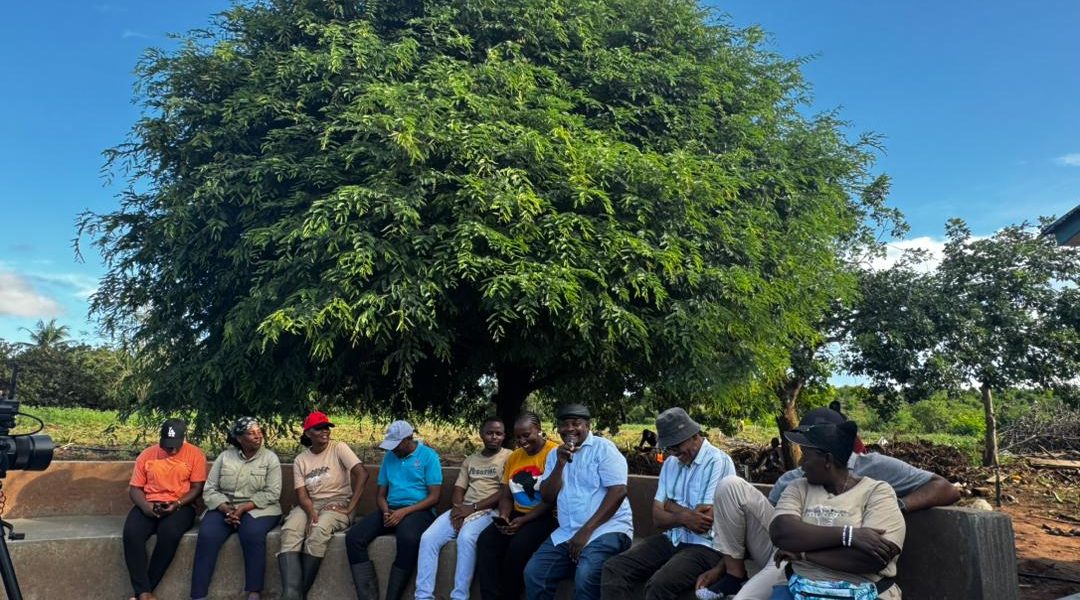
The SFO On-Farm Seminar at Tomoni Farm, Kibiti — 28 February 2026 — was over. And nothing that had happened in it would stay inside it.
It is not a conference centre. It is not a government extension office. It is not the kind of venue where Tanzania’s agricultural future is usually discussed — a hotel ballroom in Dar es Salaam with a projector screen and rows of chairs facing a panel.
It is a farm. Five hundred acres of working, producing, irrigated, grafted, managed, struggled-over and hard-won farmland in Kibiti District, surrounded by the kind of country that Tanzania has been explaining to itself for decades and not quite hearing: rich, green, humid, capable of producing almost anything — and mostly producing fruit that falls to the ground and rots.
Twenty-three people came to Tomoni Farm on 28 February 2026. They came from Songea and Tanga and Arusha and Dar es Salaam. From banks and media houses and government offices and extension services and other farms. Thousands more watched live on YouTube from wherever they were in the country.
Tanzania does not have a farming problem.
It has a conversation problem.
And on 28 February 2026, in Kibiti, the conversation happened.
The Host
There is a version of Franklin Bagala Tomoni’s story that sounds like an inspirational speech. He had a corporate career. He left it. He went to farm in Kibiti. He was right and now the farm is thriving.
That version is true. It is also not quite the point.
The point is the decade of decisions no one saw being made. The season when the phosphorus problem appeared in the south orchard and the trees showed it in their leaves before anyone understood what the leaves were saying. The years when the gravity system was just a set of pipes going into the ground and you had to believe, before you had evidence, that they would carry water to the highest point and let it flow from there.
The point is what Furaha Njovu — an old friend who visited the farm a decade ago and came back on 28 February 2026 to find something unrecognisable — described to the assembled room:
“Alikuwa anatuonyesha kitu. Ukimuangalia na kuangalia vile milima, unasema: huyu atafanyaje na kumwangalia.”
He would show us something. You looked at the hills and looked at him and you thought: what on earth is this man talking about?
She was laughing as she said it. But the room understood. They had spent the morning walking through the orchards that used to be those hills. The mango trees. The cashew stands. The seedless lemon grove that made at least three people announce quietly they needed to plant lemon trees immediately. The gravity-fed drip irrigation running to the base of every tree, connected back to the solar-powered pump, pushing water up to the elevated tank, and from there — under gravity alone — to every corner of the farm.
Gilead Daniel, a field agronomist from TAHA who walked the entire farm before the debrief, offered the technical verdict:
“Kama ni shamba lililo Florida, shamba lililo Misri — basi lifanane au likaribiane kufanana na hili. Vitu hivyo — najua unaviweza.”
If this were a farm in Florida or in Egypt, it should look like this. You are capable of this. You have done it.
Franklin Bagala Tomoni spent thirteen years at Vodacom Tanzania before Kibiti. His role for much of that time was Head of M-Pesa Sales — part of the team that took a mobile phone feature and turned it into the financial infrastructure of a nation. The logic he carried out of that career and into Kibiti was the same. The crop changed. The principle did not.
And then there is one more thing that needs to be said: he shares everything. In a sector where successful farmers guard their knowledge, Franklin showed twenty-three people his entire farm. Anthony Chamanga of TAHA said it directly:
“Mtu mwingine anapokuwa na kitu kizuri hatakutaki kumbatie. Lakini wewe umetupeleka mpaka chumbani kwako na kutuonyesha: jamani, kitanda changu ni hiki hapa. Angalieni kimetandikwa vizuri.”
Another person who had something this good wouldn’t want to embrace you. But you took us all the way into your bedroom and showed us: this is my bed. Look how it’s made.
The Reckoning
Geoffrey Kirenga did not speak until late in the debrief. He is the CEO of AGCOT Centre — the Agricultural Growth Corridors of Tanzania — and he had come to Kibiti from a road trip lasting weeks and covering 5,120 kilometres: from Ruvuma in the south to Mwanza on the lake, through Dodoma, Singida, Tabora, Tanga, Kilimanjaro, and everywhere between.
When it came to his turn, with the sun already low over the orchards, he spoke slowly, as people do when they have been carrying something heavy for a long time and are finally setting it down.
“Kila mahali nilipoenda kuna mti wa mwembe. Na kila mti wa mwembe niliokutana naye — maembe yote yameondoka chini.”
Everywhere I went there was a mango tree. And every mango tree I encountered — all the mangoes had come down.
“Yanaoza.”
They are rotting.
“Na unafika pale unasikia harufu kama ya pombe imesindikwa hivi.”
And when you arrive there you smell something like fermented drink. The sweet, alcoholic ferment of fruit breaking down. The smell of wealth dissolving before it can be collected.
Tanzania has mango trees capable of producing no fewer than 700,000 tonnes annually. Tanzania has 95 percent of its land area suitable for mango cultivation. Many of those trees are mature, productive, and capable of significant yields.
And the fruit was on the ground. Rotting.
Post-harvest loss rates for mango sit at 30 percent or above — before accounting for the untold volumes that never reach a market at all, falling under roadside trees with no harvest system, no cold chain, and no buyer who knows they exist.
“Inabidi tukomboe maembe tuliyonayo sasa hivi.”
We must rescue the mangoes we already have.
The Room Speaks
Twenty-three voices. What happened when serious people sat in the same orchard.
The format of the debrief was Franklin’s idea, and elegant in its simplicity: clockwise around the room, every person taking the floor to say what they had learned, what they felt, what they wanted to say. What followed was two hours that no conference agenda could have produced.
“Ukweli sia wanasema seeing is believing. Tumeona na tumeamini. Ukiwa na watu wachache ambao wameamua, wakadekecha muda, wakaweka investment — na ukawaona matokeo haya — ni kwamba what we are saying about agricultural transformation iko njiani itakuja.”
They say: seeing is believing. We have seen and we believe. When you have a small group of people who decided, who committed time, who invested — and you see these results — what we are saying about agricultural transformation is on its way.
She came with her two children. She wanted them to see.
Jimmy Rashidi is the proof that the decision to farm seriously produces measurable, specific, life-altering outcomes. He farms maize in Songea. Before SFO, he farmed by habit — “tunalima tu labda kwa sababu shamba lipo,” we farmed just because the land was there. After joining SFO and meeting Franklin in 2016, he shifted to commercial farming. His record yield: 4.6 tonnes per acre in a single season. His daughter is in medical school in Canada. His youngest child just completed school. Both were financed from farm income.
“Kuna watu ambao wanaweza wakaleta mabadiliko makubwa sana lakini hawapewi hiyo nafasi. Hawatambuliwi tu anavyotakiwa watambulike. Franklin alikuwa ni mmoja wa watu hao. Na kile alichochagua kufanya kiliwafungua mlango wengi wetu.”
There are people who could bring enormous change but are never given the recognition they deserve. Franklin was one of those people. And what he chose to do opened a door for many of us.
“Hajafeli Franklin. Imefeli taifa.”
Franklin has not failed. It is the nation that has failed to see him.
He introduced himself with two phrases that required explanation: close supervision and four flowers. He had planted twelve acres of sunflowers in Bagamoyo, approved the spacing, and gone back to the city for two months. He returned to find twelve acres had produced four flowers.
“Na nilikuwa navisema hivi ili wanaowatch huko vijana hau kati tamaa. Lazima ukanyage mwenyewe.”
I am saying this so that young people watching don’t lose heart. You have to press your own feet into the soil.
He came with his sister Abella. When it was his turn he began with a phrase that brought the first real laughter of the debrief:
“Sijui nisalimie.”
I don’t know how to begin.
He described the graduate employment crisis from inside it. Then he turned to his sister and made her a promise in front of the room and the thousands watching live:
“Nikuahidi tu dadangu — tuzidi kupambana. Usiniache kwenye hili.”
I promise you, sister — we keep fighting together. Don’t let go of me in this.
What Noel Robert named was the thing no development programme has found a way to address: the loneliness of being at the beginning.
She said she was confused. This was her second visit. The first was ten years ago when the farm was mostly plans and hills. Now she could not keep up with herself — at the lemons wanting lemons, at the guavas wanting guavas, her friend having to pull her from section to section. “Sijaachelewa. Bado na nafasi.” I’m not too late. I still have a chance.
“Umeibeba ndoto yako — nami nimeona ikifanikiwa.”
You carried your dream — and I watched it come true.
The room was very still for a moment. And then it was not still at all.
Edith Banzi organised the whole day. She is the mchunganishi — the connector — who assembled the seminar for months. She had almost not made it herself. Franklin called her every day in the final weeks: “Edith, wewe ndio ulikuwa unanichunganisha na watu — uhakikishe unakuwepo.” You were the one connecting me with people. So make sure you are there. She came. She brought her daughter. And she made an argument the room received as one of the day’s most urgent:
“Kama hatutowaonyesha watoto kwamba kuna maisha zaidi ya ajira, tutapoteza pesa nyingi na tutakuwa tumia nguvu zetu zote kuwasomesha lakini mwishowe hawataweza kuwa na maisha yale tunayoyatazamia.”
If we don’t show our children that there is life beyond employment, we will spend everything educating them and in the end they will not be able to have the lives we imagined for them.
The Expert Case
He has worked in mango in Tanzania since 1996. He knows the germplasm, the pests, the markets — intimately. He knows the buyers by name and by email. The germplasm collection he and AMAGRO have assembled holds more than 52 mango varieties. And then the detail that stopped the room:
“Unabadilisha mwembe kama unavyobadilisha shati. Ukiamua hili shati limechafuka — unavaa lingine.”
You change a mango variety the way you change a shirt. If you decide this shirt is dirty — you put on another. In eighteen months you are back in production with something better.
He described the nine UK mango consignments — all nine passing quality inspection — that reopened a market Mkopi estimates has been closed for over twenty years. And then the line the room will carry longest:
“Huu ni mgodi mwingine wa Tanzania. Ni wa kudumu.”
This is another mine for Tanzania. And unlike gold or tanzanite, it does not run out.
He offered his number to the room. Anyone who needs advice at any time — call him. He uses one number. He has used only one number his entire career. “Sina namba mbili. Nishindwa kuenda namba mbili.” I haven’t been able to manage a second number.
Chamanga made the structural argument the seminar had been circling toward all day, and he made it plainly. Tanzania, he said, has been investing in the wrong kind of farm.
“Mazao ya muda mrefu inaipa nguvu sekta ya kilimo ya nchi husika. Haya mazao ya muda mfupi yanakuwa kama mbolea katika ile transformation. Lakini nguvu kubwa inatoka kwenye mazao ya muda mrefu.”
Long-term crops give the agricultural sector its strength. Short-term crops are like fertiliser for the transformation. But the real power comes from long-term crops.
He named the countries that chose. Ecuador chose bananas — a long-season, perennial, high-volume crop — and built nearly four billion dollars a year in export earnings from a country of fewer than twenty million people. Mexico chose avocado, now more than two million tonnes a year into global markets. Egypt chose oranges. South Africa built a two-billion-dollar citrus industry on deliberate, sustained investment. These are not coincidences of geography. They are the outcomes of strategic choices held consistently for long enough that the volumes accumulated into genuine global competitiveness.
TAHA’s incoming strategy, Chamanga announced at the seminar, will run for ten years — not five. Because a mango tree planted today will not reach full commercial production for three to five years. Evaluating that investment on a five-year cycle systematically undervalues it: the tree is still growing when the strategy review begins.
She went to Norway last year with a specific intention: to sit across the table from the people who buy African produce and ask them directly what they want. The answer was not what most producers would expect.
“Hawataki fresh. Wanataka dried. Wanataka frozen. Wanataka paste. Wanataka fruit bars. Mwelekeo wa Afrika ni processed.”
They are not asking for fresh. They want dried. They want frozen. They want paste. They want fruit bars. The direction the world wants from Africa is processed.
The window is wider than usual: a major supplier country is in trade conflict with EU buyers, and the importers who relied on it are actively looking for alternatives. Tanzania is one of the markets they are looking at. But the products they want are not fresh.
She also named the financing instruments most Tanzanian farmers do not know exist. The Nordic Development Fund’s EEP Africa programme provides grants and repayable grants between EUR 200,000 and EUR 1 million for innovative clean energy projects in Southern and Eastern Africa — solar irrigation qualifies. AgDevCo, headquartered in London, makes investments of USD 1 million to USD 10 million across African agribusiness including East African horticulture, in equity, debt, and mezzanine formats.
“Hatujaitumia vizuri sekta binafsi yetu.”
We have not made good use of our private sector. Foreign-owned enterprises use these financing instruments routinely. We are still looking only to commercial banks.
The Next Generation
She said her name and stopped.
“Huldah Franklin Bagala. And I’m proud. Yaani nikisema hilo jina nasikia goosebumps.”
Huldah Franklin Bagala. And I’m proud. When I say that name, I feel goosebumps.
She is the daughter of the man whose farm they had spent the day walking. She had come with a fifty-fifty feeling. She had spent years not knowing what to say when people asked what her father did. The moment he announced he was leaving his corporate career to go and farm — “Unashindwa kusema kitu. Unamuangalia unasema: kwa hiyo mimi nitawaambia watu babangu ni mkulima.” You don’t know what to say. You think: so I’ll have to tell people my father is a farmer.
After Form Six, she had resisted his advice on what to study. She spent a year not enrolling anywhere. Then she went where he had pointed her and found it was exactly what she had been looking for. “I really thank that man over there.”
“Lakini leo — naweza hata nikatangaza kila sehemu. I’m that proud daughter who can say: my dad is a farmer.”
But today — I could announce it everywhere. I’m that proud daughter who can say: my dad is a farmer.
She closed with something she half-framed as a joke and half did not:
“Kuja shambani nilikuwa ni fifty-fifty. Lakini najiona kabisa nikihamia shamba any time soon.”
Coming to the farm I was fifty-fifty. But I can see myself moving to the farm any time soon.
The room applauded. Longer than any other applause of the day.
Nelson Kowero is 25 years old. He is the founder of Visionary Digital Hub. His equipment is worth close to TSh 35 million — all earned through agricultural media work. He was brought to the seminar by Geoffrey Kirenga specifically to be named: not as a farmer, but as the communications infrastructure a modern agricultural sector needs. Who tells the story of Tanzanian agriculture? Who documents the seminar, the trade fair, the market at mango peak? Nelson did not come to Kibiti to become a farmer. He came as a professional. The sector needs both.
The After
At the end, Sisa Mcharo made his request simply.
“Huu uwe mwanzo wa huu utaratibu. Isiwe ya mwisho tena tukasema: tulikutanaga miaka saba iliyopita. Iwe tukikutana at least tuseme miezi kadhaa iliyopita tulipokuwa sehemu fulani — tukajadili hivi na hivi na hivi. Kwa sababu vitu vingine inabidi viendelee kujadiliwa ili tuweze kufikia malengo endelevu.”
Let this be the beginning. Let it not be the last — so we never have to say: we met once at Tomoni Farm. Let us be able to say: some months ago we were together somewhere and we talked like this, and like this, and like this. Because some things need to keep being discussed for us to reach lasting goals.
The sun was at the edge of the orchards. The irrigation lines would run through the night, as they always do. Drip by drip, to the roots of every tree.
The orchards say: it can be done.
The gravity system says: it can be built.
The daughter says: I’m coming home any time soon.
Sisa Mcharo says: let this not be the last time.
The Numbers Behind the Day
The SFO On-Farm Seminar was self-funded. The Serious Farmers Organisation is member-run. No donor paid for that day. The participants did. That fact tells you something about the quality of conversation that followed.
| 700,000 tTanzania’s annual mango production potential (Hamadi Mkopi) | 400,000 tDemand from a single Korean buyer — in one email | 500 t/wkStanding weekly demand from Dubai buyers |
| 30%+Post-harvest loss rate before mango reaches any market | 95%Of Tanzania’s land area suitable for mango cultivation | 18 monthsTime to convert a mango tree to a new variety through grafting |
| 52+Mango varieties in AMAGRO Tanzania’s germplasm collection | 9UK consignments Mkopi facilitated — all passing inspection — after 20+ years of market closure | 10 yrsTAHA’s new strategy horizon, up from 5 years |
| EUR 200k–1MEEP Africa grants for clean energy in Southern and Eastern Africa — eepafrica.org | USD 1M–10MAgDevCo investments across African agribusiness including East African horticulture — agdevco.com | 23People in the room — plus over a hundred watching live |
All quotes drawn from the full transcript of the SFO On-Farm Seminar debrief, Tomoni Farm, Kibiti, 28 February 2026. Statements attributed to named speakers.
|
Read the full report AGCOT Special Report From Kibiti to the World Download at agcot.co.tz → |
Watch the seminar ▶ Live session recordingTomoni Farm, Kibiti · 28 February 2026 |
About AGCOT Centre
Agricultural Growth Corridors of Tanzania — the four national corridors: Central, Northern, Mtwara, and SAGCOT. |