

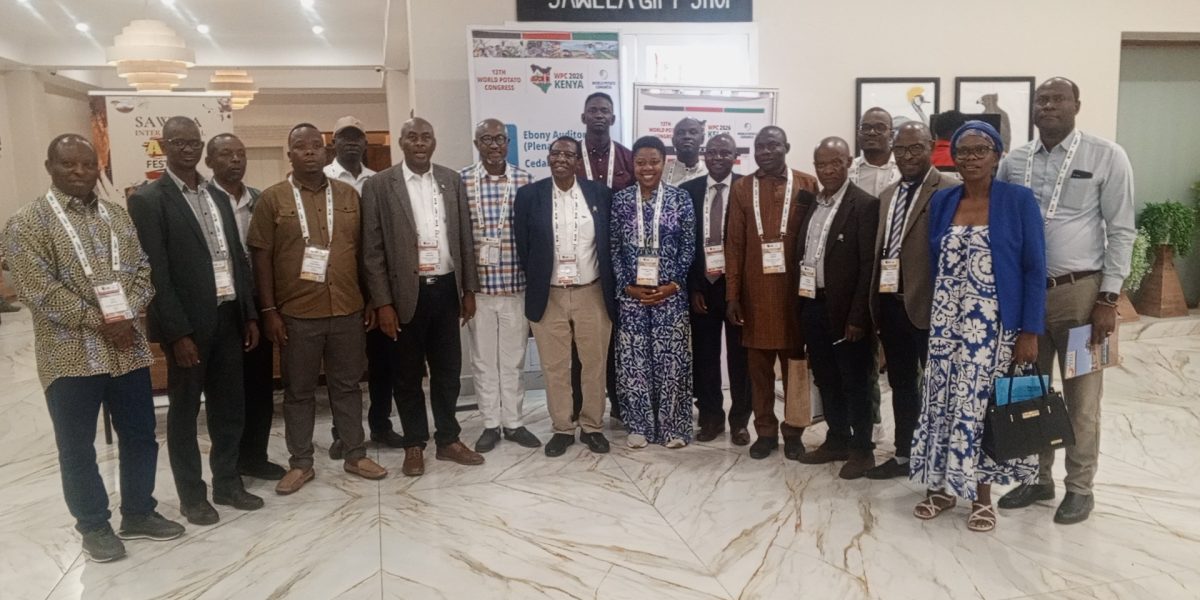
NAIVASHA, Kenya, 1 November 2026. The Potato Council of Tanzania and the National Potato Council of Kenya (NPCK) have signed a five-year Memorandum of Understanding (MoU) to cooperate on seed, standards, trade and research. The agreement was signed on Wednesday 28 October 2026, on the sidelines of the 13th World Potato Congress (WPC 2026) at Sawela Lodge, Naivasha. It was the first time the Congress had been held in Sub-Saharan Africa.
The MoU was signed by Mr Abdalla Luvanda, Board Member, on behalf of the Potato Council of Tanzania, and Mr Wachira Kaguongo, Chief Executive Officer, on behalf of NPCK. The signing was witnessed by Dr Kimani Rugendo, HSC, Chairman of NPCK, and Ms Tullah Mloge, Head of Partnerships and Communication at AGCOT Centre, in the presence of a cross-section of African delegates attending the Congress. The delegates called for a united front for Africa to advance the development of the potato value chain for food security and income generation.
The Congress was held from 26 to 30 October under the theme “Global Potato Partnership for Enhanced Food Systems, Nutrition Security and Trade”. It drew over 1,000 participants from over 62 countries, reflecting its international reach. The Tanzania–Kenya agreement advances that partnership agenda through practical cooperation on seed, research and markets.
Beyond the bilateral agreement, participants called for stronger cooperation among African potato organisations, including support for establishing national potato councils where they do not yet exist and exploring a continental association.
Statements from the councils
“Let us not allow the agreements we have signed here today to gather dust. Let us put them into action. I appeal to every African delegate present to carry this message forward and ensure that it reaches all corners, so that business people, farmers, youth and women can truly embrace this and make it a serious national priority that will be enjoyed by generations to come.”
Dr Kimani Rugendo, HSC, Chairman, NPCK
“Our farmers across Tanzania’s agricultural growth corridors have proven that potato farming is a serious, profitable business when driven by agricultural science, soil health and strong cooperatives. This MoU takes that momentum across national borders. By uniting our efforts, we can dismantle the real bottlenecks: aligning phytosanitary standards, sharing seed technology and building direct market channels, so that East Africa’s potato growers thrive together.”
Mr Abdalla Luvanda, Board Member, Potato Council of Tanzania
A framework built on four pillars
The agreement brings two of East Africa’s leading potato-producing neighbours, whose councils bring together private- and public-sector stakeholders, under a single framework for technical cooperation and trade. The MoU rests on four pillars:
- Knowledge and technology exchange: sharing technologies, innovations and best practice in seed systems, production, post-harvest handling, storage and marketing, including clean seed technologies such as rooted cuttings, tissue culture and aeroponics.
- Standards, quality assurance and regulation: sharing information on seed certification, phytosanitary standards and quality assurance, within each country’s regulatory framework: the Tanzania Official Seed Certification Institute (TOSCI) and the Tanzania Plant Health and Pesticides Authority (TPHPA) in Tanzania, and the Kenya Plant Health Inspectorate Service (KEPHIS) in Kenya.
- Trade linkages and market access: linking producer organisations, including Agricultural Marketing Cooperative Societies (AMCOS), with processors, traders and markets on both sides of the border, and supporting dialogue with the relevant government authorities on cross-border trade.
- Joint capacity building and research: joint research and on-farm trials, digital market tools, training and exchange visits for farmers, extension officers, seed producers and processors.
How the MoU will work
The MoU runs for five years. The two councils will agree annual implementation plans, approved in writing by both, setting out activities, timelines, responsibilities and resources, and each will appoint a focal person. Progress will be reviewed jointly at least once a year. Activities will be supported through cost-sharing, including in-kind contributions, and the councils may jointly seek support from development partners and investors. The councils plan to begin preparing their first joint work plan in November 2026.
Government as a facilitator of industry growth
Effective implementation depends on government support for agricultural research, extension services, quality standards and an enabling environment for private investment. Public–private collaboration connects farmers, cooperatives, businesses and researchers with the institutions that safeguard the industry. In Tanzania, TOSCI supports seed quality assurance through inspection and certification, while TPHPA oversees plant-health and phytosanitary requirements. In Kenya, KEPHIS provides seed certification and plant-health services. Their complementary roles support reliable planting material and compliant trade.
Public institutions also help strengthen formal markets and access to information. Relevant authorities have responsibilities for market coordination, quality oversight and market information, while the bodies that regulate warehouse-receipt systems oversee storage and receipt arrangements. Engagement with these institutions, cooperatives and digital trading platforms can support more transparent transactions and price discovery. Any proposed warehouse-receipt model for potatoes should first be assessed against applicable commodity requirements, suitable storage, quality control and financing arrangements. These are areas for engagement, rather than a guarantee of prices or farmer returns.
Speaking on investment in the industry, Mr Wachira Kaguongo, Chief Executive Officer, NPCK, said: “Countries that have developed strong potato industries have invested in better seed, improved varieties, mechanisation, storage and research.”
A substantial potato economy with room to grow
| Indicator | Figure | Source |
|---|---|---|
| Kenya: Irish potato production value, 2024 (provisional) | KES 72.5 billion, from 2.15 million tonnes | Kenya National Agriculture Production Report 2025 |
| Tanzania: Irish potato output, 2024/25 | 1.41 million tonnes; average yield 9.9 tonnes per hectare | National Bureau of Statistics |
| Africa: potato production, 2024 | 34.2 million tonnes (8.8 per cent of world output); yield about 15.4 tonnes per hectare against 22.9 globally | FAOSTAT |
| Kenya: certified seed demand and supply | 150,000 tonnes demand against about 24,000 tonnes produced: a shortfall of 126,000 tonnes (supply covers about 16 per cent) | Dr Patrick Ketiem, KALRO, August 2026 |
| Tanzania: certified seed | Meets about 2 per cent of demand | As stated in the press statement |
Kenya’s National Agriculture Production Report 2025 records a provisional Irish potato production value of KES 72.5 billion in 2024, from output of 2.15 million tonnes. This measures the value of production, rather than turnover across the entire value chain. The project background of the International Potato Center (CIP) estimates that approximately 800,000 Kenyan smallholders rely on potatoes for food and income, with another two million people engaged along the chain.
In Tanzania, the National Bureau of Statistics reports 1.41 million tonnes of Irish potatoes and an average yield of 9.9 tonnes per hectare in the 2024/25 agricultural year. Mbeya and Njombe together accounted for approximately 85.1 per cent of agricultural-household output, which highlights the importance of the SAGCOT Corridor for investment and farmer services.
On a consistent international basis, FAOSTAT, the statistical database of the Food and Agriculture Organization of the United Nations (FAO), records African potato production of 34.2 million tonnes in 2024, representing 8.8 per cent of world output. Africa’s average yield was approximately 15.4 tonnes per harvested hectare, compared with 22.9 globally. National survey and FAOSTAT series cover different periods and methods and should be compared with care.
The seed shortage
The seed shortage gives the commercial opportunity a concrete scale. In August 2026, Dr Patrick Ketiem, Director General of the Kenya Agricultural and Livestock Research Organization (KALRO), estimated annual certified seed demand at 150,000 tonnes against production of approximately 24,000 tonnes—a shortfall of 126,000 tonnes. In Kenya, supply therefore covers about 16 per cent of that demand. In Tanzania, certified potato seed meets about 2 per cent of demand.
Rooted apical cuttings and locally produced seed tubers under recognised quality-assurance systems offer practical opportunities to expand access to healthy planting material. Cuttings enable nurseries and multipliers to produce seed tubers. Quality Declared Seed (QDS), where authorised, provides a regulated pathway for local supply; Tanzania’s QDS regulations include potato standards. Investment in these enterprises, alongside certified seed production, farmer training and appropriate storage, can help ease supply constraints and bring reliable planting material closer to smallholders.
For farmers, the priority is to source verified planting material from registered suppliers, manage seed health carefully and renew stocks according to local extension advice and disease conditions. Opportunities also extend to affordable distribution, soil and water management, processing and regional trade. Stronger buyer connections are essential to convert higher marketable yields into better farmer returns.
The councils’ agreement provides a framework to connect seed producers, farmer organisations, researchers, service providers and buyers. The immediate investment task is to establish country-specific demand, strengthen reliable seed delivery and demonstrate profitable farmer performance, while respecting each country’s certification and plant-health requirements.
One voice for African potato
“Hosting the World Potato Congress in Sub-Saharan Africa for the first time in its history shows that Africa is becoming a driving force in global potato innovation. Beyond the benefits to our two countries, this agreement carries a message for the whole continent: Africa’s national potato bodies should work together and speak with one voice, to win a bigger share of global potato trade, build reliable regional seed systems, grow processing and improve the livelihoods of smallholder farming families across the continent.”
Leadership of the Potato Council of Tanzania and NPCK
“This agreement shows what partnership can do. At AGCOT, we see our role as an honest facilitator: bringing public policy, private investment and smallholder farmers around the same table so that value chains work for everyone. We are proud to witness two national potato bodies commit to working together on seed, standards and markets. Our shared aim is that the women and youth who power potato value chains gain the technology, markets and investment they need to build lasting prosperity.”
Ms Tullah Mloge, Head of Partnerships and Communication, AGCOT Centre
Market outlook
According to a September 2026 market assessment by commercial research firm Mordor Intelligence, the global potato market is estimated at US$124.46 billion in 2026 and projected to reach US$149.38 billion by 2031, reflecting annual growth of 3.72 per cent. The firm identifies Africa as the fastest-growing regional market, forecasting annual growth in consumption volume of 5.08 per cent. Separately, commercial research firm IndexBox valued Africa’s potato market at approximately US$11.5 billion in 2024, with projections suggesting it could approach US$14 billion by 2030, an increase of approximately US$2.5 billion, or 21.5 per cent, over six years. This positions potatoes as an already substantial African agricultural business, with significant opportunities in certified seed, mechanisation, cold storage, processing and regional trade. The bigger economic story is therefore not simply about growing more potatoes, but about how African farmers, processors and investors can capture greater value from an expanding market.
These figures are commercial market estimates and calculated projections rather than official production or trade statistics.
ENDS
Notes to editors
International demand provides additional context. Commercial research firm Mordor Intelligence currently estimates the global potato market at US$124.46 billion in 2026 and projects US$149.38 billion by 2031, at 3.72 per cent annual growth. These are commercial estimates for the broader potato market. Separately, the African Development Bank projects that Africa’s entire food and agriculture market could reach US$1 trillion by 2030.
About the Potato Council of Tanzania. The Potato Council of Tanzania is a private sector-led, multi-stakeholder apex body representing actors along the potato value chain in the United Republic of Tanzania, including farmers, seed producers, processors, traders, researchers and service providers. Its mandate is to promote a competitive, inclusive and sustainable potato industry through coordination, advocacy, capacity building and market development.
About the National Potato Council of Kenya (NPCK). NPCK is a multi-stakeholder, non-governmental, public-private partnership organisation whose main objective is to transform Kenya’s potato industry into a more competitive, self-regulating and sustainable industry. Its members include farmers, researchers, seed producers, processors, traders, input suppliers, financial and insurance providers, regulatory agencies, public institutions, national and county governments and development partners.
About WPC 2026. The 13th World Potato Congress was held at Sawela Lodge, Naivasha, Kenya, from 26 to 30 October 2026. It was the first time the Congress had been held in Sub-Saharan Africa.
About AGCOT. The Agricultural Growth Corridors of Tanzania (AGCOT) is a public-private partnership mandated to accelerate the transformation of Tanzania’s agricultural sector. Building on the proven success of the Southern Agricultural Growth Corridor of Tanzania (SAGCOT), AGCOT expands this model nationwide across the Southern, Central, Northern and Mtwara corridors. The AGCOT Centre serves as an honest facilitator, brokering investment, driving policy reform and building inclusive, sustainable value chains to unlock Tanzania’s agricultural potential, empower smallholder farmers and drive inclusive growth in alignment with Tanzania Development Vision 2050.
Media contact
Issued by AppsValle, media@appsvalle.com
Media WhatsApp: +254 715 176153
Related coverage on Kilimokwanza.org: Tanzania and Kenya Potato Councils to Sign Cross-Border Pact · World Potato Congress puts East African seed systems and regional trade in focus
Do you have a story or press release for African agriculture? Send it to kilimokwanza.africa@gmail.com or read how to submit.