

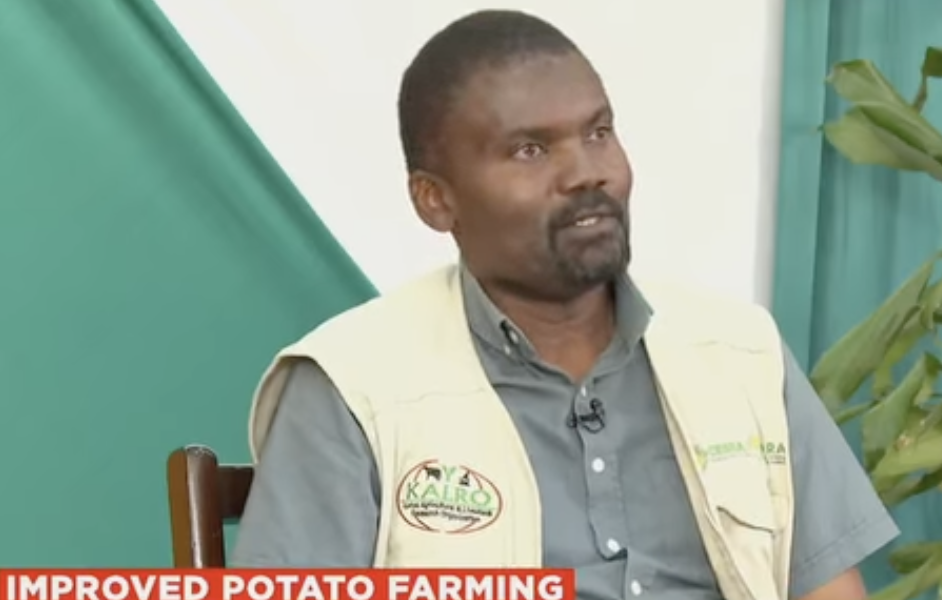
A career scientist’s 12-year journey to give Kenya’s most popular potato variety a fighting chance against its deadliest enemy
Kilimokwanza.org
TIGONI, Limuru — In the cool highlands of Kiambu County, where potato plants stretch across terraced slopes like green quilts, Dr. Moses Nyongesa stands in a confined field trial plot that could reshape the future of Kenya’s KES 50 billion potato economy. The plants around him look unremarkable—medium-height stalks with broad light-green leaves and pink flowers. But hidden in their DNA lies a revolution.
These are not ordinary Shangi potatoes. They are Shangi Kinga—”Shangi the Protector”—and they represent the culmination of more than a decade of work by Nyongesa and his team at the Kenya Agricultural and Livestock Research Organisation (KALRO).
The Problem That Won’t Die
“Late blight is the ghost that has haunted potato farmers for centuries,” says Nyongesa, the Principal Research Scientist and Director of KALRO’s Potato Research Centre in Tigoni. “It caused the Irish Potato Famine of the 1840s. Nearly 200 years later, it’s still destroying 23 percent of Kenya’s potato production every year.”
The disease, caused by Phytophthora infestans, is merciless. A single infected plant can spread to an entire field within days under the right conditions—cool temperatures and high humidity, precisely the climate of Kenya’s potato-growing highlands in Nyandarua, Nakuru, Meru, and Kiambu.
For farmers, the arithmetic is brutal: spend 12 percent of production costs on fungicides, or watch 30 percent or more of the crop disappear. Spray too late, and the disease wins. Spray too often, and the chemicals eat into already thin margins while raising health and environmental concerns.
“We’ve been asking farmers to fight a biological war with their hands tied behind their backs,” Nyongesa says. “It was time to give them better weapons.”
Why Shangi?
In a country with more than 75 potato varieties, one name dominates: Shangi. It controls 70-80 percent of Kenya’s potato market, an almost mythical level of farmer and consumer loyalty that even the International Potato Centre (CIP) has struggled to explain.
Shangi is not the highest-yielding variety. It’s not the best for processing. Its deep eyes waste material during peeling, making it unsuitable for industrial French fries. But Shangi has something more valuable than perfection: it pays the bills fast.
“Shangi matures in 75 to 90 days,” Nyongesa explains. “Within three weeks after harvest, it sprouts again, allowing farmers to plant three times a year. For a smallholder farmer trying to pay school fees or medical bills, that cash flow is everything.”
The variety’s market dominance is so complete that brokers often refuse to buy anything else. “If Shangi is available, other varieties don’t stand a chance,” says one trader at Nakuru market. “White varieties turn green in the sun. Red varieties make it hard to spot bad tubers. Shangi is what people want.”
But Shangi’s popularity made it the perfect candidate for genetic improvement. “Why develop a disease-resistant variety that farmers won’t adopt?” Nyongesa asks. “We needed to protect what farmers already love.”
The Science of Resistance
The breakthrough came through an unlikely source: wild potato relatives growing in the Andes mountains of South America. Over millions of years, these wild species evolved resistance to late blight. Scientists at CIP had identified three specific genes—collectively called the 3R-gene stack—that could confer near-complete immunity.
In partnership with CIP and Michigan State University, funded by USAID’s Feed the Future Global Biotech Potato Partnership, Nyongesa’s team began the painstaking work of inserting these genes into Shangi, along with two other popular Kenyan varieties: Asante and Tigoni.
“The process is precise,” Nyongesa explains. “We don’t change what makes Shangi special—its taste, cooking time, texture, market acceptance. We add one thing: the ability to recognize and defend against late blight.”
The work began in laboratories three years ago, moved to greenhouses for proof of concept, and then to confined field trials at three sites: Muguga in Kiambu, Njabini in Nyandarua, and Molo in Nakuru. At each location, the GM potatoes grew side-by-side with conventional Shangi under natural disease pressure.
The results were striking. While conventional plants succumbed to blight, requiring multiple fungicide applications, the 3R-gene Shangi stood healthy without a single spray.
“The resistance is robust,” says Dr. Miriam Mbiyu, a plant scientist at KALRO who worked on the nutritional analysis. “We’ve tested proteins, carbohydrates, vitamins, minerals—there’s no nutritional difference between the GM and conventional potato. The only difference is that one can defend itself.”
The Regulatory Marathon
Science is only half the journey. The other half is regulation—a process Nyongesa describes as “necessary but exhausting.”
Kenya’s National Biosafety Authority (NBA) oversees all genetically modified crops, conducting risk assessments that examine environmental impact, food safety, and potential effects on biodiversity. The process is designed to be thorough, but critics say it’s slow, and delays cost money.
“The African Agricultural Technology Foundation estimates that delays in commercializing GM crops—maize, cotton, and potatoes—have cost Kenya KES 20.3 billion over five years,” Nyongesa notes. “Every year we wait is another year farmers lose 23 percent of their crop.”
As of mid-2025, the NBA assessment was nearing completion, with public consultations expected before the end of the year. If all goes according to plan, National Performance Trials could begin in 2026, with commercial release possible by 2026-2028.
But Nyongesa is cautiously optimistic. “We’ve seen how litigation has delayed BT maize and BT cotton. We’re hopeful that the evidence will speak for itself.”
The Economics of Liberation
The potential impact is staggering. According to economic modeling published in PLOS One in March 2025, the 3R-gene Shangi alone could generate KES 31.9 billion in benefits over 30 years—through reduced fungicide use, lower crop losses, and increased yields.
For individual farmers, the math is even more compelling. A typical smallholder spending KES 15,000 per acre on fungicides could eliminate that cost entirely. Over three planting seasons per year, that’s KES 45,000 in savings—enough to pay a year’s secondary school fees.
“This isn’t just about economics,” Nyongesa emphasizes. “It’s about dignity. Farmers shouldn’t have to choose between their health and their harvest. Children shouldn’t be exposed to fungicide residues. We can do better.”
The licensing model reflects that philosophy. KALRO has committed to non-exclusive licensing, meaning multiple seed companies can multiply and distribute the GM potato. “We’re not creating a monopoly,” Nyongesa says. “We’re creating options.”
The Path Ahead
On a recent morning at the Tigoni research center, Nyongesa walks through rows of tissue-culture plants in the greenhouse—tiny Shangi plantlets growing in sterile containers, the next generation of certified seed. Nearby, the newly unveiled CIP Regional Potato Breeding Hub hums with activity, a state-of-the-art facility that positions Kenya at the center of East African potato innovation.
“People ask me if I’m worried about public acceptance,” Nyongesa says. “I tell them: farmers are pragmatic. If something works, they’ll adopt it. If it saves money and produces food, they’ll embrace it.”
He pauses, looking out over the Limuru highlands. “Shangi became Kenya’s favorite potato by accident—a researcher’s oversight during field trials gave it a head start. Now we have a chance to make it even better, on purpose. That’s what keeps me going.”
As Kenya moves closer to approving its first genetically modified potato, Dr. Moses Nyongesa remains focused on the finish line. Twelve years of potato research. Three stacked resistance genes. One goal: giving farmers the tools they need to feed a nation.
“Shangi Kinga isn’t just a variety,” he says. “It’s a promise. A promise that science can serve smallholder farmers. That research can translate into real income. That we can solve problems that have plagued us for generations.”
In the cool highlands of Tigoni, that promise is growing—one potato plant at a time.