

KILIMOKWANZA SPECIAL SERIES: ON AGCOT • WHAT TRANSFORMATION ACTUALLY LOOKS LIKE
Eighteen portraits from Tanzania’s agricultural corridor • Batch 1: The Farmers • kilimokwanza.org
The Farmer Who Is Already Thinking About Old Age
Raymond Nyagawa farms one acre of potatoes in Mtwango Village and has approximately 100 avocado trees coming into production. When Geoffrey Kirenga challenged him, in the middle of a field visit, to think about his son’s future, Nyagawa did not hesitate: “Nakuelewa. Tumechukua tulifanye kazi.” I understand. We will get to work.
By Kilimokwanza Correspondent • Mtwango Village, Njombe Region • March 2026
RAYMOND NYAGAWA — AT A GLANCE
- ISOWELU AMCOS member, Mtwango Village, Njombe
- Crop: 1 full acre Sagitta certified seed potato
- Input cost: TZS 450,000 per season, via ISOWELU
- ~100 avocado trees; first harvest last season
- CRDB financing through ISOWELU cooperative structure
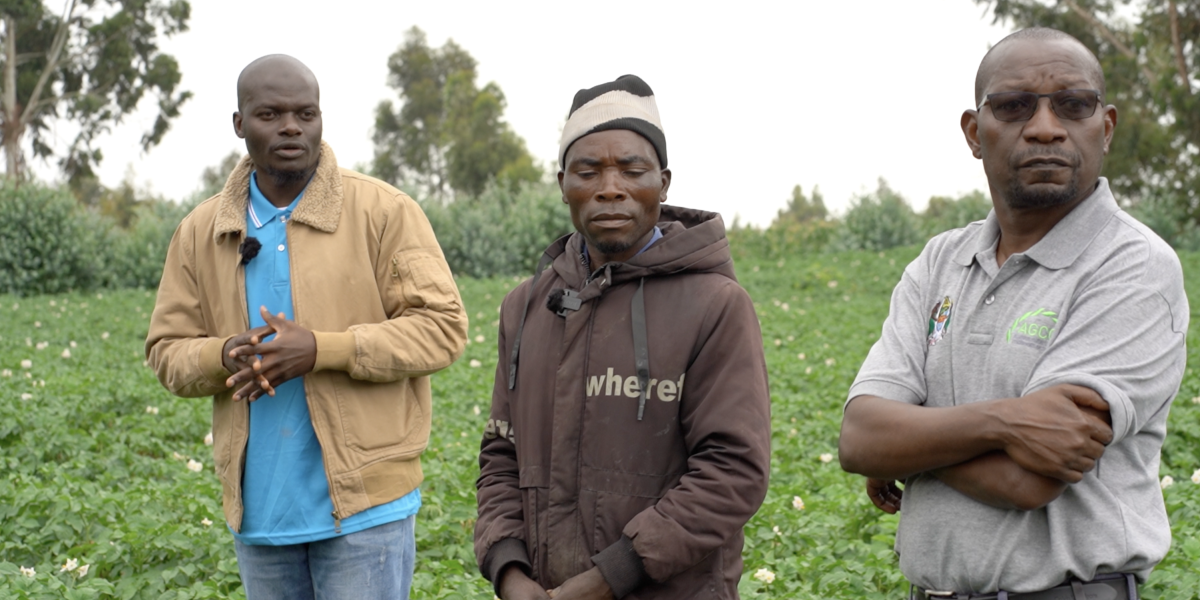
MTWANGO VILLAGE, NJOMBE • The delegation had already visited one ISOWEL0 farm that morning. The chairman, Abdalla Kajogoo, walked them down a different path for the second visit. The field was fuller, the plants taller, and the farmer standing at the edge of his plot was Raymond Nyagawa, who farms a full acre of Sagitta certified seed potatoes and has something else growing on the other side of his land that he did not mention until Geoffrey Kirenga noticed the trees.
Nyagawa has been a member of ISOWELO AMCOS since the cooperative began its certified seed programme. He gets all his inputs through ISOWELO – the Sagitta seed, the fertiliser, the crop protection inputs – financed through the cooperative’s CRDB facility at nine percent interest, repaid at harvest. The system works. Before he joined, his annual income from farming was approximately TZS 950,000. It is now between TZS 2 million and TZS 3 million, depending on the season.
“Before, the price at harvest was whatever the buyer said it was on that day. Now I know before I plant what the cooperative will do with my harvest. That certainty changes how you plan.”
– Raymond Nyagawa, ISOWELU AMCOS Member, Mtwango Village
With last season’s earnings he bought a hectare of land – TZS 900,000, paid in full from the potato income. He is growing maize on it now. He is also thinking about what to do with it next.
The Trees Kirenga Noticed
Kirenga spotted the avocado trees on the far side of Nyagawa’s plot. He asked how many. Nyagawa said approximately one hundred. Some were already bearing fruit. He had harvested five crates in his first commercial season, selling at TZS 40,000 per crate.
Kirenga asked why he had started avocado farming. Nyagawa’s answer was precise: it is a long-term crop. A potato farm requires full attention every season. An avocado tree, once established and bearing, generates income that does not stop when you get older. Nyagawa put it in Swahili terms: as his age advances, the trees will keep producing.
“Kwa sababu hicho kitakuwa ni zao la muda mrefu. Hata takapo kuwa na umri fulani, nitakuwa naendelea kuvuna.”
– Raymond Nyagawa — Because avocado is a long-term crop. Even when I reach a certain age, I will still be harvesting.
Kirenga responded with the phrase that Nyagawa seemed to have been waiting to hear confirmed: “Kwa ni hekima ya uzee.” The wisdom of old age. He was not being sentimental. He was acknowledging that Nyagawa had arrived, without a development programme telling him to, at the same conclusion that AGCOT’s entire avocado value chain strategy is built on: that a perennial export crop, planted now, pays for decades.
The Conversation About the Son
Kirenga did not stop at the avocado trees. He pushed further. He asked about Nyagawa’s family. Two children in school. He asked about the future. Then he framed the question in terms that were direct enough to land: if Nyagawa did not build a proper avocado farm – five hectares, ten, twenty – his son would not have the kind of income certainty that makes a life. A few trees is not the same as a shamba. The land is there. The water is there. The knowledge is there.
“Na ardhi ipo, maji yapo, utaalamu wapo.”
– Geoffrey Kirenga, CEO, AGCOT Centre — speaking to Raymond Nyagawa at his Mtwango farm, March 2026
Nyagawa did not deflect or qualify. He said: “Nakuelewa. Tumechukua tulifanye kazi.” I understand. We will get to work. It was not a performance for the delegation. It was the response of a farmer who had already been thinking in the same direction and who now had confirmation, from the CEO of Tanzania’s agricultural corridor institution standing in his own field, that the direction was right.
What ISOWELU Made Possible
Nyagawa’s avocado trajectory did not happen independently of the cooperative. ISOWELU had focused its energy on potatoes – the certified seed programme, the CRDB facility, the extension services – but avocado awareness had been building among its membership. The previous ISOWELU chair was himself a significant avocado farmer. TPHPA visited the cooperative the previous year specifically to help members who were growing avocado begin building the documentation records that GLOBALG.A.P. certification eventually requires.
The cooperative gave Nyagawa the income base – the potato earnings – that allowed him to invest in the land and the trees. The hundred avocados on his farm were not planted with a grant or a programme. They were planted with the returns from certified seed potatoes sold through a cooperative that the corridor model helped to build.
“The potato income gave me the ability to buy land. The land gave me the place to plant avocado. The avocado is what my children will harvest when I am old. That is three steps. ISOWELU is the first step.”
– Raymond Nyagawa
When the AGCOT board presented its field evidence to Minister Daniel Chongolo in Dodoma four days after the Mtwango visit, Nyagawa’s trajectory – potato income, land purchase, avocado investment, long-term thinking – was the kind of compounding story that corridors are designed to produce. Not a single intervention. A sequence of decisions, each one made possible by the one before.
• • •
Kilimokwanza Special Series: What Transformation Actually Looks Like • Batch 1: The Farmers • kilimokwanza.org • March 2026