

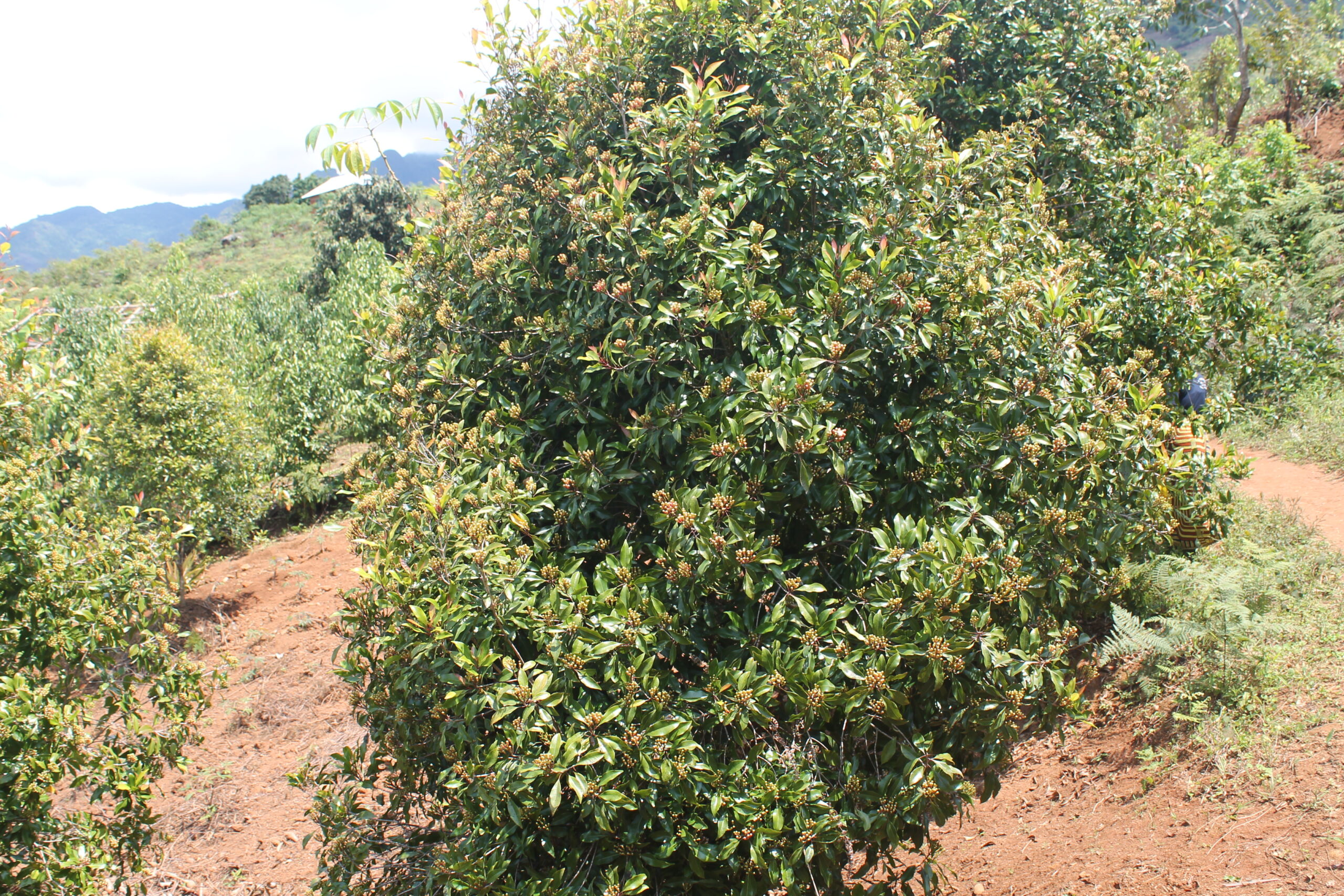
A Dutch-funded agroforestry project in rural Morogoro is showing how nature-based agriculture, farmer training, and market linkage can work together, one seedling at a time
By Kilimokwanza.org | Mkuyuni Ward, Morogoro Region, Tanzania | April 2026
On a Saturday morning in early April, a senior official at one of East Africa’s leading agricultural development organisations got on the road to visit farmers.
No delegation. No cameras pre-arranged. John Banga Nakei, Head of Corridors at AGCOT Centre (the Agricultural Growth Corridors of Tanzania) simply wanted to see whether the clove seedlings his organisation had distributed two weeks earlier were in the ground.
They were. And they were thriving.
It is a small moment, the kind that rarely makes international headlines. But in the long, difficult history of agricultural development in sub-Saharan Africa, a history littered with projects that delivered inputs and disappeared, a senior official making unannounced monitoring visits two weeks after distribution is not a small thing. It is, in fact, exactly what separates programmes that change farming from programmes that merely appear to.
Why Cloves, and Why Now
Cloves are one of the world’s most traded spices: a staple of global cuisine, pharmaceuticals, cosmetics, and essential oil production, with demand consistently outpacing supply in key markets. Indonesia dominates global production. Zanzibar, Tanzania’s semi-autonomous island region, was once the world’s leading clove producer and retains significant cultural and commercial identity around the crop. But the Tanzanian mainland, with vast tracts of suitable highland terrain, a favourable climate, and an enormous smallholder farming population, has barely begun to realise its potential.
That is the gap AGCOT is working to close. And in Morogoro Region, a three-year initiative called the Spice Agroforestry Project is providing the most concrete demonstration yet of what closing that gap might look like in practice.
The Project: Nature, Farming, and Finance Working Together
The Spice Agroforestry Project is funded by the Government of the Kingdom of the Netherlands and implemented by AGCOT across three wards, namely Tawa, Mkuyuni, and Konde, in Morogoro District, roughly 200 kilometres west of Dar es Salaam. It is built on a philosophy that has gained significant traction in global development circles: that farming and nature are not adversaries, and that the most durable agricultural investments are those which restore landscapes rather than degrade them.
In practice, this means clove trees planted alongside banana trees for shade, black pepper grown between rows, soil terraced to reduce erosion, and water conservation built into the farm design from the outset. It is agroforestry: the deliberate integration of trees, crops, and farming systems, deployed not as an environmental concession but as a productivity strategy. Trees provide microclimate regulation, reduce chemical input dependence, and build the long-term soil health that makes farming viable across generations rather than just across seasons.
The project’s results to date reflect the breadth of this ambition. Over 1,200 farmers have been linked to formal market actors. Thirty metric tons of spices have been purchased from project participants, generating USD 183,662 in farmer revenue. A spice processing centre and solar dryer are operational in Tawa Ward. Interest-free loan pathways have been established, in collaboration with the Morogoro Regional Secretariat, to help promising farmers acquire equipment for essential oil production, a higher-value processing tier that dramatically increases returns per kilogram of raw spice.
And critically: 1,211 farmers, youth, and women have been trained, not just in planting, but across the full value chain. Agroforestry integration. Biodiversity conservation. Post-harvest handling. Quality standards. Financial literacy. The curriculum is designed to produce farmers who understand their crop from soil to shelf.
On the Ground in Mkuyuni Ward
The road through Mkuyuni Ward runs from the village of Mkuuni through Kibwaya towards Mfumbwe, three communities now bound together by a shared project and, increasingly, by shared knowledge of how to grow cloves well.
It was along this road that Extension Officer Ali Maganga led the April 11 field tour, walking through one of the project farms with the easy confidence of someone who had supervised every step of its preparation. Maganga is the agricultural extension officer for Mkuyuni Ward, the locally deployed agronomist who bridges institutional programme design and the realities of smallholder farm life. In Tanzania’s agricultural system, extension officers are the last mile. They are the ones who dig the demonstration holes, explain the spacing standards, and return weeks later to check whether the advice was followed.
Maganga had distributed the seedlings himself. He had supervised the planting. Now he was walking the farms.
“We worked together with the farmers,” he explained. “We prepared the holes properly, at the right spacing and depth, the conditions these trees need from the very beginning.”
Zuberi Mwande’s Farm: What Success Looks Like at Two Weeks
The farm that anchored the day’s visit belongs to Zuberi Mwande, a smallholder farmer in Mkuyuni Ward who received no fewer than 100 clove seedlings under the project.
Two weeks after planting, the results were striking. The plot was neatly laid out, the young transplants standing in clean rows with banana trees intercropped between them, providing the partial shade that cloves require during their early years, while simultaneously offering the farmer a harvestable crop in the interim. Black pepper and sweet potato occupied the spaces between, creating a layered, productive system that generates income at multiple timescales: weeks, months, and years.
The spacing, nine metres between rows and nine metres between individual trees, had been precisely measured and marked by Maganga before planting began. This standard, recommended for optimal clove cultivation, allows the trees the canopy space they need as they mature, while keeping the farm manageable and well-ventilated. It is the kind of technical detail that sounds minor but determines whether a farm produces well or merely survives.
“The seedlings are establishing beautifully,” Maganga said, moving slowly between the rows. “You can see they have taken to the soil. This is exactly what we hoped for.”
One feature of Mwande’s farm lent particular weight to that optimism: an older clove tree, planted on the same land years before the project began, stood as living evidence that Mkuyuni’s soils and microclimatic conditions are genuinely suited to the crop. The 100 new seedlings were not a speculative bet. They were a deliberate, technically informed expansion of something already proven to work.
A Motorcycle, and What It Represents
At the edge of Mwande’s farm, Maganga’s motorcycle leaned against a tree. It appeared briefly in the video footage of the visit, an unremarkable detail in isolation, but a telling one in context.
Agricultural transformation in rural Tanzania does not arrive by helicopter. It arrives on motorcycles, on muddy paths, at farms that have no postal address and frequently no mobile signal. The extension officer, the agronomist who travels these paths, speaks the local language, knows the farmers by name, and returns after the rains to check on what was planted, is among the most important figures in any serious rural development programme. They are also among the most chronically under-resourced.
What the Spice Agroforestry Project has done, in part, is invest in this function. The 1,211 training participants are not just farmers; they include extension workers whose technical capacity has been deepened. The monitoring framework that Nakei is now activating through his Saturday visits creates institutional accountability that reinforces what extension officers do on the ground every day.
The motorcycle represents a system that is, for once, working as it should.
Beyond the Farm: Building a National Spice Industry
The April visits in Mkuyuni Ward are taking place within an ecosystem of complementary initiatives that AGCOT has been building simultaneously, because distributing seedlings without market access, or developing markets without processing infrastructure, or training farmers without financing pathways, produces only partial results.
The Spice Strategic Partnership brought together 19 government bodies, 12 private sector organisations, including Get Aroma Ltd, a leading spice processing company, and eight civil society groups alongside smallholder farmers to formally establish a coalition for Tanzania’s spice industry. The group has agreed on a governance framework and committed to conducting a comprehensive sector study to identify bottlenecks and develop sustainable, market-aligned solutions. It is, in effect, the institutional superstructure that gives AGCOT’s field-level work somewhere to go.
The Zanzibar Learning Exchange recognised that Zanzibar, Tanzania’s island region and long the world’s most famous clove-producing territory, holds institutional knowledge that the mainland needs. AGCOT facilitated a study visit for 53 delegates from Morogoro and Tanga regions to Zanzibar, resulting in a draft Memorandum of Understanding between the Mainland Government and the Zanzibar Revolutionary Government. If formalised, the MoU would establish a unified national framework for protecting and promoting Tanzania’s clove and spice market, aligning mainland growth ambitions with island expertise in a way that strengthens both.
Jisomeshe na Mkarafuu, which translates roughly as “Educate Yourself with Cloves,” is perhaps the project’s most inventive dimension. The campaign distributed over 8,000 clove seedlings, valued at approximately USD 10,000, to 800 Form One secondary school students across five wards in Morogoro. Each student plants and nurtures a clove tree at home. As the trees mature, they restore degraded land, build carbon stocks, and generate income that these students can use to fund their own continued education. A clove tree, in this framing, is a scholarship: an investment in a young person that compounds over time, in the soil and in the classroom simultaneously.
The Numbers Behind the Story
Aggregate project data tells a story that individual farm visits can only partially convey:
- 580 farmers received high-quality spice seedlings, covering over 327 hectares of land
- 1,211 people trained across agroforestry, conservation, post-harvest handling, and financial literacy
- 1,200 farmers linked to formal market actors
- 30 metric tons of spices purchased from project farmers
- USD 183,662 in farmer revenue generated
- 40% of benefiting farmers are youth; 20% are women
- 8,000 seedlings distributed to secondary school students under the youth campaign
- 53 delegates from Morogoro and Tanga participated in the Zanzibar learning exchange
- 19 government bodies, 12 private sector organisations, 8 civil society groups committed to the Spice Strategic Partnership
These are not projections. They are results from a programme still in active implementation, with monitoring visits still underway, processing infrastructure newly operational, and tens of thousands of seedlings only weeks old in the ground.
The Regional Political Will
Behind every successful agricultural development programme is a political environment that either enables or obstructs it. In Morogoro Region, the Spice Agroforestry Project has benefited from a Regional Administrative Secretary, Dr. Musa Ali Musa, who is by all accounts a genuine champion of spice crop expansion.
Maganga spoke of Dr. Musa directly during the field visit, describing a senior official who has pushed consistently for serious uptake of cloves, cardamom, and allied spice crops in every district across Morogoro Region with the soil conditions to support them. His position, that agricultural diversification into high-value spice crops should be pursued at scale and not merely piloted, aligns closely with what AGCOT is building on the ground.
The combination of Dutch development finance, AGCOT’s implementation expertise, active extension services, and engaged regional leadership is precisely the kind of multi-stakeholder alignment that development practitioners spend years trying to assemble. In Mkuyuni Ward in April 2026, it is assembled and operational.
What This Model Suggests
The Spice Agroforestry Project is not a large programme by the standards of international development finance. Its geographic focus is deliberately concentrated. Its beneficiary numbers, while meaningful, are modest in the context of Tanzania’s millions of smallholder farmers.
But its design is instructive for a much wider audience.
It integrates environmental and agricultural goals rather than trading one off against the other. It builds market linkages before farmers have product to sell, so that when the harvest comes, there is somewhere for it to go. It invests in processing infrastructure to move value addition closer to the farm gate. It deploys creative mechanisms, such as a youth campaign that turns school students into tree stewards, to extend its reach beyond conventional programme boundaries. And it takes monitoring seriously enough that a senior official is making field visits on Saturday mornings two weeks after seedling distribution.
None of these things are revolutionary in theory. Development practitioners have understood these principles for decades. What is harder, and rarer, is executing them together, in the same programme, in the same set of villages, at the same time.
In the clove fields of Mkuyuni Ward, that execution is underway. The seedlings are in the ground. The extension officer is on the road. The processing centre is open in Tawa. The partnership coalition has its terms of reference. The MoU with Zanzibar is in draft.
And Zuberi Mwande’s farm, two weeks from planting, is beautiful.