

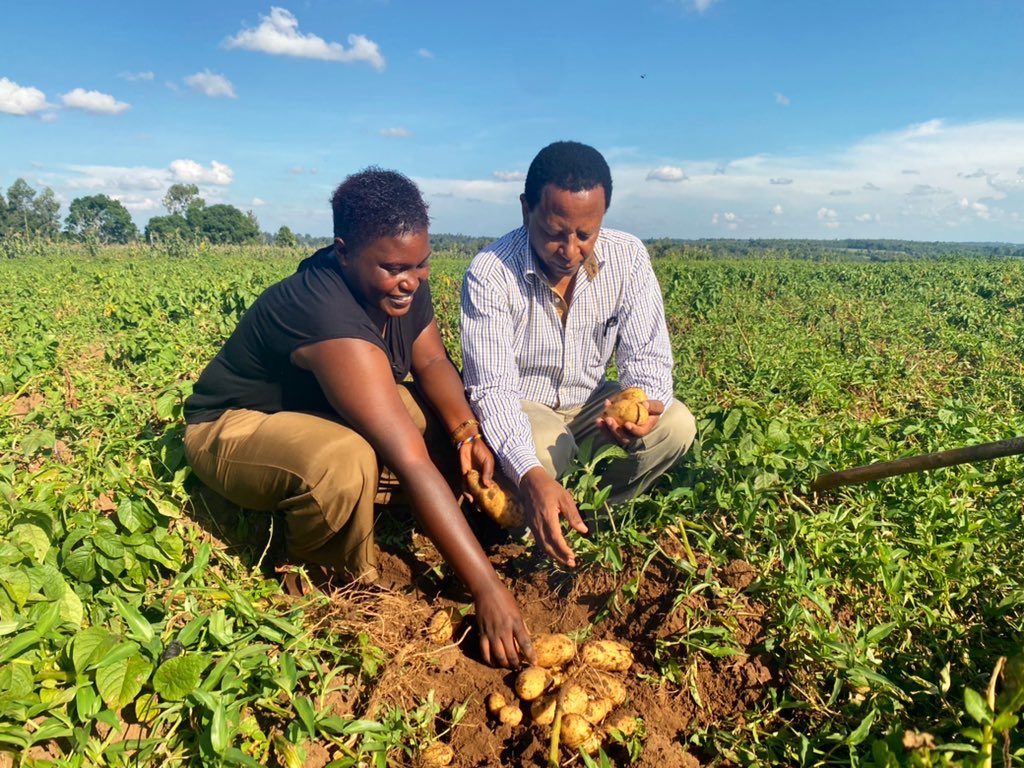
National output has jumped 89% in a single season. Behind the headline sits over a decade of corridor-building by AGCOT, led by Geoffrey Kirenga that gave a generation of young farmers a reason to stay on the land.
By Kilimokwanza Correspondent
Seven tonnes. That was all a hectare of potato land returned to a Tanzanian smallholder in 2015 – the yield of recycled seed, untreated blight and a market rigged against the grower. A decade on, the same highlands can give thirty, fifty, even fifty-nine tonnes. The numbers tell a revolution. But the deeper story is who is harvesting them: a generation of young people who once saw no future in the soil, and now see a business.
And the country has noticed. In the space of a single season, Tanzania’s Irish potato harvest leapt by 89.1 per cent – from 1.47 million tonnes in 2022/23 to 2.78 million in 2023/24 – one of the steepest jumps any of its crops has recorded. That surge did not fall from the sky. It is the visible edge of a deliberate national project, written across four overlapping blueprints: the Agricultural Sector Development Programme II (ASDP II), the Agenda 10/30 roadmap, the Fourth Five-Year Development Plan (FYDP IV) and the Agriculture Master Plan 2050. Together they have promoted the round potato from afterthought to priority – a designated Commodity Value Chain, singled out for the rare mix of food security and wealth it can deliver.
If those plans now read like a coherent national strategy, they also read like something Geoffrey Kirenga has been building, corridor by corridor, for the better part of a decade. As Chief Executive of the Agricultural Growth Corridors of Tanzania (AGCOT Centre, formerly SAGCOT), he has spent years arguing a single, stubborn proposition: that a smallholder crop, organised properly and wired to markets, finance and science, can outcompete anyone – and that proving it changes what farming means to the young.
“Make no mistake, the potato value chain has fundamentally reduced youth poverty in the Southern Highlands. Today, the youths in the SAGCOT corridor know that potatoes are a wealth creator, not just a subsistence crop grown for household survival.”
– Geoffrey Kirenga, CEO, AGCOT Centre
The sector he inherited
It was not always a story worth telling. For all that the Southern Highlands – Njombe, Mbeya, Iringa and Songwe – grew the overwhelming majority of the nation’s potatoes, the crop was trapped at the bottom of its own potential. Seed was recycled season after season, carrying blight from one harvest to the next. Markets were informal and tilted against producers, nowhere more brazenly than in the lumbesa, the oversized, non-standard bag traders used to take far more potato than they paid for.
The national data put hard edges on the loss. Because tubers are so perishable, root and tuber crops in Tanzania spoil at rates of 15 to 45 percent between field and consumer. And for decades the money flowed the wrong way: baseline figures for ASDP II show the gap between the wholesale price and the farm-gate price for potatoes standing at a punishing 42.6 percent, most of it captured by middlemen. For a young person weighing the land against the city, the arithmetic rarely favoured staying.
“The Southern Highlands – particularly the regions of Njombe, Mbeya, Iringa, and Songwe – account for over 80% of our national potato output. For the youth in these clusters, this crop is their primary engine for job creation, improved housing, and long-term financial security.”
– Geoffrey Kirenga, CEO, AGCOT Centre
A coalition, not a project
Kirenga’s answer was not another stand-alone scheme but a coalition with the weight to fix the system itself. The Potato Strategic Partnership he championed brought government, development partners and private-sector names – HZPC, Yara, Syngenta, Mtanga Foods and others – around a single table and a single agenda: clean seed, sound agronomy and a market a farmer could trust.
“We didn’t achieve this alone; it took a powerful coalition bringing together the government, development partners, and private sector leaders like HZPC, Yara, and Syngenta. Together, we dismantled the systemic bottlenecks of poor seed quality and unstructured markets, making the potato economy a highly profitable and de-risked space for youth entrepreneurs.”
– Geoffrey Kirenga, CEO, AGCOT Centre
The results came fast. Through the AGRA-funded Scaling Seeds and Technologies Partnership, certified seed and Good Agricultural Practices lifted Njombe’s smallholders from seven tonnes a hectare to thirty-one within two years. Diffused-light stores, built cheaply and locally, kept seed alive between seasons. The lesson was plain enough: the farmers had never been the problem; the system around them had.
“Before our interventions, average potato yields for smallholders hovered at a mere 7 tonnes per hectare. By introducing climate-smart agriculture and certified seeds through the Potato Strategic Partnership, we have seen young farmers quadruple their productivity to 31 tonnes per hectare, and even up to 50 tonnes per hectare in some areas. In our Potato Centre of Excellence, we achieved a historic 59 tonnes per hectare, proving exactly what is possible when youth treat farming as a business.”
– Geoffrey Kirenga, CEO, AGCOT Centre
The state scales the template
What AGCOT proved in pockets, the government is now attempting at scale – and the design looks familiar. ASDP II’s “one-priority crop per agro-ecological zone” strategy clusters potato production where the land is naturally suited to it, concentrating support in the Southern Highlands (Mbeya, Iringa, Njombe, Morogoro) and the Northern Highlands (Arusha, Kilimanjaro, Manyara), so that storage, extension and irrigation can be deployed where they will count. The Agriculture Master Plan 2050 goes further, using geospatial crop-suitability analysis to map exactly where potatoes can expand without clearing forest or eroding biodiversity – guesswork replaced by data.
The money has followed the ambition. In 2023/24 the national agricultural budget rose by 29.2 percent to TZS 970.79 billion, funding seed, fertiliser and extension; the same year the state produced and distributed 278,155 subsidised potato seedlings to farmers, attacking the seed bottleneck that had throttled yields for a generation. The target it is all aimed at is unambiguous: doubling the national average yield from 10.81 to 18.92 tonnes a hectare by 2030, on the way to ten-percent annual growth across the crop sub-sector – the engine of the country’s “Kilimo ni Biashara”, or agriculture-as-business, creed.
Where the ceiling was redrawn
If the plans set the target, one site has already shown how high it can go. In June 2016, Kirenga helped host a Dutch Potato Trade Mission led by the Netherlands’ Minister of Agriculture – a visit that hardened into a government-to-government Memorandum of Understanding to build the value chain in full. Its most tangible legacy is the Potato Centre of Excellence, run by the Tanzanian firm STAWISHA across thirty hectares of advanced production technology. The record yield set there is the highest ever recorded in the country, and the site now works as a living classroom, drawing thousands of farmers to see what modern agronomy and mechanisation can do.
Proof you can bank
If the Centre shows what is possible in theory, the Isowelo Agricultural Marketing Cooperative Society at Mtwango village in Njombe shows what it means for ordinary farmers. When AGCOT’s board walked its rows in March 2026, the change was visible in every furrow. Founded in November 2017 by 208 farmers pooling resources to buy better inputs together, Isowelo has since grown to 630 members, nearly half of them women. In the unit growers actually count in – bags to the acre – the shift is stark: from about fifty bags before, some five tonnes, to two hundred bags today, a full twenty. A fourfold leap, delivered not by irrigation, machinery or subsidy, but by one change: swapping saved, disease-carrying local seed for certified, high-yielding Sagitta seed potato.
Member Phokasi Ndikwege made the point in plain terms, standing in her half-acre Sagitta plot with her child on her back: certified seed meant predictable germination, even spacing, fewer diseased plants to pull mid-season – a harvest she could plan around rather than gamble on. Then the cooperative did something no agricultural lender in the corridor had seen before. Through the Climate Resilient Agribusiness For Tomorrow (CRAFT) programme, Isowelo drew an input loan from CRDB Bank – about TZS 590 million to begin with, repaid without a missed beat, and then a full TZS 1 billion. The money was not for land or machinery. It was for seed: certified stock the members put to work in a single season and repaid with zero defaults. With incomes climbing, Isowelo has since invested in tractors and harvesters and laid out a 300-acre irrigated block farm, fifty acres of it reserved purely for seed production. It is exactly the kind of organised, bankable collective the national plans lean on – the strengthening of AMCOS, the Warehouse Receipt System and digital platforms like M-Kilimo are all designed to turn scattered growers into precisely this.
“Look at the young men and women of the Isowelo AMCOS in Njombe. By organizing themselves, adopting strict commercial practices, and utilizing certified seeds, they are no longer confined to local, informal markets. They are actively exporting premium potatoes to Kenya, the Comoros, and Zanzibar, completely transforming the economic landscape of their communities.”
– Geoffrey Kirenga, CEO, AGCOT Centre
“By adopting modern agronomy and standardized packaging, youth-led potato cooperatives have unlocked unprecedented access to commercial finance. They have proven to commercial banks that smallholder potato farming is a highly bankable investment when supported by the right market linkages and infrastructure.”
– Geoffrey Kirenga, CEO, AGCOT Centre
The gap that could break it
For all that, the corridor records its constraints as carefully as its gains – because the whole transformation rests on the one input in shortest supply. Njombe, the most productive potato landscape in Tanzania and one of the most productive in sub-Saharan Africa, needs roughly 120,000 tonnes of certified seed potato a year to sustain and extend the yields it has already proven are possible. It currently receives under 3,000 – less than three per cent of demand. The fourfold leap recorded at Isowelo, in other words, is open only to the minority of farmers who can get certified seed at all.
That is why seed has become the corridor’s central argument. A 350-hectare seed enterprise, Farm for the Future at Ilula, stands as the natural anchor for a national seed programme, and when the AGCOT delegation reached Dodoma in March 2026 to meet Tanzania’s Minister of Agriculture, the seed deficit was among the most concrete items it carried. The state’s own effort – 278,155 subsidised seedlings distributed in a single year – signals both the seriousness of the intent and the scale of the climb: set against one region’s annual need of 120,000 tonnes, the national seed system has a long way still to travel. Close that gap, and the surge that follows brings the problems of abundance – storage, grading, processing – rather than those of failure.
The war on waste, and the fight over price
Record harvests are only worth what survives the journey – and what the grower is paid for them. On both fronts the national frameworks set hard targets. FYDP IV and the Agriculture Master Plan 2050 commit to halving post-harvest losses, financing rural storage, cold-chain logistics and agro-processing hubs, and offering tax incentives for private investment in refrigerated transport, cold rooms and packhouses, so that the 2.78 million tonnes now leaving Tanzanian fields actually reach the table. On price, the goal is to cut that 42.6-percent farm-gate gap by half, using stronger cooperatives, the Warehouse Receipt System and e-extension tools to hand growers the information – and the leverage – they have always lacked. Beyond grading lies value addition, and here the gap is starkest of all: almost none of the national harvest is processed into crisps, flour or frozen product, leaving a country that grows far more potato than it can store, grade or transform – the very glut the processing investments are meant to convert into a market.
Farming for health
Running alongside the wealth agenda is a quieter one about nutrition. To push back against malnutrition and childhood stunting, the Ministry of Agriculture has been promoting biofortified, nutrient-dense crops – distributing some 250,000 early-generation sweet-potato cuttings in 2023/24 and training around 2,200 farmers across Geita, Morogoro, Mwanza, Simiyu and Mara, backed by a hundred community demonstration plots. It is a reminder that the tuber economy Kirenga has helped commercialise is being asked to do two jobs at once: build incomes, and build healthier communities.
The change that spreads itself
The hardest thing to engineer is also the most durable: belief. And it is now travelling on its own, carried by the farmers who have already made the leap and have the houses, the machinery and the bank statements to prove it.
“What excites me the most is the mindset shift we are seeing on the ground. Through our ‘Mkulima kwa Mkulima’ (Farmer to Farmer) initiative, young, successful potato farmers from Njombe and Ruvuma are now travelling to train their peers in Mbeya, Dodoma, and Kigoma. They have become the ultimate ambassadors of commercial agriculture because they have tasted its financial rewards.”
– Geoffrey Kirenga, CEO, AGCOT Centre
It helps that the work itself has been made to look modern. Mechanisation, better storage and disease-resistant genetics have turned potato farming from a fallback into an enterprise – the kind of venture that holds a young person’s attention.
“Youths are naturally attracted to innovation and technology. By introducing advanced mechanization, low-cost diffused light stores for seed preservation, and high-yielding, disease-resistant seed varieties, we have made the potato value chain an attractive, modern enterprise for the next generation.”
– Geoffrey Kirenga, CEO, AGCOT Centre
Built to outlast its builders
Kirenga has been deliberate about leaving behind institutions rather than memories. AGCOT was a founding subscriber to the Potato Council of Tanzania, now registered under the BRELA Act and giving the industry a formal voice for the first time. It is a founding member, too, of the Jumuiya Potato Platform, the East African Community initiative launched in Kampala in 2022 to open seed-potato trade across all seven partner states; and with the Tanzania Official Seed Certification Institute and the Netherlands Embassy it helped create the Tanzania Potato Variety Catalogue to speed high-yielding, climate-resilient varieties into farmers’ fields.
“With the official establishment of the Potato Council of Tanzania, we are institutionalizing this success. We are ensuring that the youth who have invested their energy into the potato value chain have a structured, coordinated, and globally competitive market for decades to come.”
– Geoffrey Kirenga, CEO, AGCOT Centre
The export horizon
The destination all of this is pointed at is the regional market. FYDP IV and Agenda 10/30 want Tanzania not merely food-secure but a premier, export-driven agricultural power, and ASDP II sets out to triple the value of potato exports by 2030, measured against a 2017/18 baseline of roughly USD 169,295. The early signs are striking: formal Irish-potato exports had already climbed to USD 1.41 million by 2023, flowing mainly to regional buyers such as Uganda and Rwanda. The scale of the wider bet is enormous – FYDP IV envisages a resource envelope of TZS 477.7 trillion, with the private sector expected to mobilise up to seventy percent of it. Isowelo’s tubers crossing into Kenya, the Comoros and Zanzibar are a preview of what the plans intend to make routine.
A proof of concept for the nation
Set the 89-percent surge beside the corridor that helped trigger it, and the relationship is clear: the national plans did not invent the model, they scaled it. The potato is, for now, the clearest evidence the Agriculture Master Plan 2050 has – proof that a crop written off as subsistence can be organised, financed, modernised and exported, and that doing so can move a generation out of poverty rather than merely feed it.
“Tanzania’s agricultural revolution depends on making agribusiness profitable for the youth. The potato value chain in the AGCOT corridors stands as our ultimate proof-of-concept – when you link young farmers to the right technologies, partnerships, and markets, extreme poverty is eradicated, and true national wealth is created.”
– Geoffrey Kirenga, CEO, AGCOT Centre
Kirenga has done more than raise a yield curve. He has changed what the East African potato sector believes itself capable of, and bolted that belief to institutions – and now national policy – that will outlive any one programme. The measure of it is not in the record book at the Centre of Excellence, nor even in the 2.78 million tonnes the country now harvests. It is in the young grower who once planted last year’s blighted seed and now grades potatoes for Nairobi, Moroni and Zanzibar – and in the quiet arithmetic, finally, of a child of the highlands choosing to stay.
Kilimokwanza.org – Telling the story of African agriculture.