

At the IGNITE 2026 National Youth Agricultural Opportunity Dialogue, one message resonated powerfully: agriculture is no longer a sector of survival—it’s a sector of enterprise, innovation, and scalable wealth creation for young people.
Held on Saturday, 17 January 2026, and broadcast by Mchongo Television, the national dialogue brought together students, young professionals, agribusiness leaders, and policymakers under the rallying theme Learn. Connect. Build the Future. It was a space where young people challenged institutions directly, and where lived success stories replaced abstract theory.
The Question That Changed Everything
One defining moment came when a confident young participant stood and declared: “I am also a result of AGCOT. I am a beneficiary of AGCOT opportunities.”
Then came the challenge—the questions many Tanzanian students are asking right now:
- Can university graduates realistically employ themselves through AGCOT’s information hubs?
- What concrete support actually exists?
- Can AGCOT point to real examples of young people who started from the bottom and succeeded?
These weren’t abstract questions. They were about belief. About possibility. About proof.
Agriculture Is a Business, Not a Backup Plan
John Banga, AGCOT’s representative, responded by reframing a long-standing misconception.
“Agriculture and livestock must be treated as serious business sectors,” he explained, “no different from manufacturing or technology—except that they are still filled with untapped opportunities.”
For decades, he noted, Tanzania has practiced agriculture the way parents and grandparents did: half an acre for food, a little surplus to share. But modern agriculture must generate income, markets, and growth. The reason Tanzania has produced relatively few visible agricultural millionaires isn’t lack of opportunity—it’s lack of commercialization and professional investment across value chains.
AGCOT’s 15-Year Mission: Small Plots, Big Returns
Building on the foundation laid during the SAGCOT phase, AGCOT is deliberately transforming agriculture into a commercially productive sector—starting at the smallest scale.
“Even half an acre or one acre can generate both household food security and marketable surplus if used professionally,” Banga emphasized. “The land is already there. What is needed is information, market linkage, and the confidence to treat agriculture as enterprise.”
The Raha Aloyce Story: From Screenhouse to Seven Nurseries
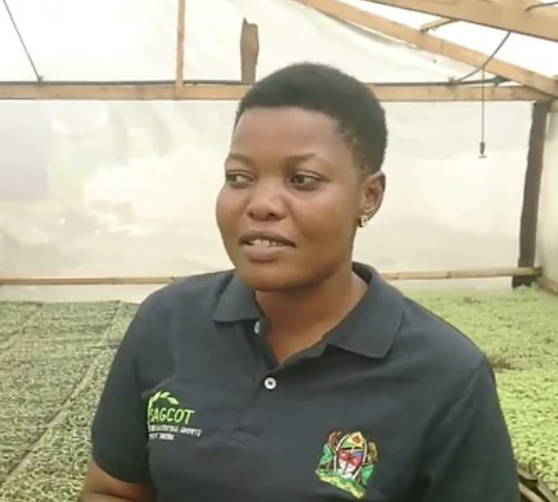
To illustrate the point, John Banga shared a story that captured the room’s attention—the real-life trajectory of Raha Aloyce, founder and owner of Raha Vegetable Farm.
The Beginning: One Screenhouse, 200 Trays
At 28 years old, Raha Aloyce made a strategic decision: rather than grow vegetables herself, she would focus on commercial seedling production—tomatoes, peppers, and other horticultural crops.
Most farmers raise seedlings informally in open fields. Raha chose the professional route, starting with a small screenhouse (greenhouse) and just 200 seedling trays, each holding around 200 seedlings.
Within three weeks, the seedlings were ready for farmers. At TZS 100 per seedling, each tray generated TZS 20,000.
Demand rose rapidly.
The Growth Phase: Capacity and Scale
Within six months, the three farmers she started with had grown to over twenty—more than her existing capacity could serve.
This is where AGCOT stepped in. Rather than offering handouts, AGCOT became a facilitator, helping Raha unlock growth through targeted support and market linkages.
The results were dramatic:
- Months 6–12: Capacity expanded from 200 trays to over 1,000 trays, with new screenhouses added
- Year 1 end: Raha Vegetable Farm expanded beyond Morogoro
- Years 2–3: The farm was serving farmers across 21 regions of Tanzania
- Year 4 (Today): Seven commercial nurseries across four regions, supplying over 600 farmers nationwide
The Numbers That Tell the Story
Her monthly income has grown from approximately TZS 5–6 million to over TZS 20 million—purely from seedling production. That’s proof that value-chain specialization pays.
As John Banga pointed out to the audience of young people: many of them were academically more qualified than Raha Aloyce was when she started.
The Message to Tanzania’s Youth
The applause that followed was emphatic.
John Banga’s conclusion was direct: “The future of agriculture will not be built only in lecture halls, but in value chains, markets, and enterprises. Through AGCOT information hubs, partnerships, and ecosystem facilitation, young people can access knowledge, connect to opportunities, and scale real businesses.”
His closing challenge resonated through the hall: “The opportunities are already there. The question is whether we are ready to take them.”
The Proof Is Already Here
IGNITE 2026 made one thing clear: youth agribusiness success in Tanzania is no longer hypothetical. It’s happening right now. Raha Aloyce and AGCOT are living proof of what’s possible when opportunity meets preparation, when information meets action, and when young people choose to build enterprises, not just survive.
The question now is: who’s next?
IGNITE 2026 was broadcast by Mchongo Television. For more information on AGCOT opportunities, visit Agcot.co.tz.