

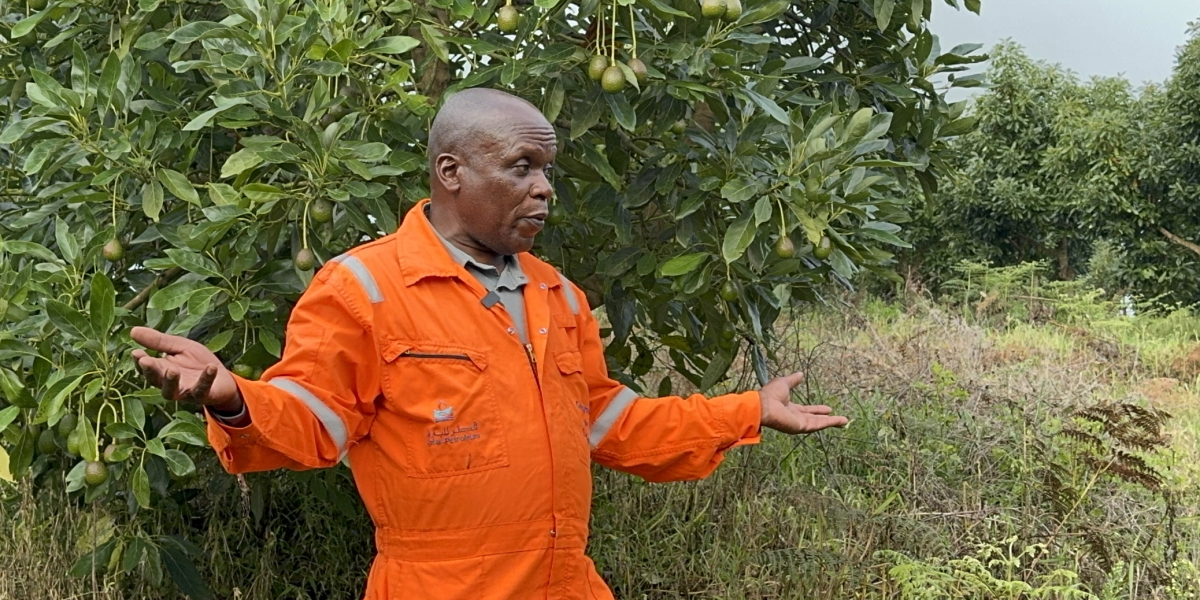
When the farmer behind the “300 kilos per tree” claim invites you into his orchard, the grass on the ground turns out to be the teacher.
By Kilimokwanza Correspondent
When Beno Mgaya tells Tanzanians that a single, well-fed avocado tree can yield as much as 300 kilos in a harvest, many listeners reach for their scepticism before they reach for their notebooks. The number sits uncomfortably above what most Southern Highlands farmers see. Independent field studies place average yields in the avocado belt somewhere between 76 and 124 kilos per plant depending on the district, a range that already makes the crop lucrative, but nowhere near the figure Mgaya is prepared to defend.
He is used to being doubted. His response, in a short video recorded on his own farm and now circulating among Tanzania’s fast-growing avocado community, is to stop arguing and start walking. Past the tree rows. Over the mulched ground. Into the evidence.
“When I give the history, that maybe Beno Mgaya is producing around 300 kilos per tree, people treat it like a fairy tale,” he says, speaking in Swahili from the shade of his orchard. “Now this is my farm itself. If you look at the trees just as they are, with bare leaves only, you can’t say they produce 300 kilos. There must be something behind it.”
That something is the quiet, unfashionable work of feeding. And nearly every frame of the clip is an argument that high-yield avocado farming is less about miracle varieties and more about monastic discipline.
The 300-kilo arithmetic
The gap between Mgaya’s claim and the regional average is not a minor one. At 300 kilos per tree on standard planting densities, a single well-managed acre can produce several times what an under-fed orchard delivers. That is the difference between treating avocado as a supplementary crop and treating it as a serious, exportable enterprise.
The Southern Highlands (Mbeya, Njombe and the newer plantings around Rungwe and Kilimanjaro) have become the engine of Tanzania’s avocado ascent. National production reached 198,162 tonnes in 2023/24, up from just 34,866 tonnes six years earlier, with the Tanzania Horticultural Association tracking roughly 20 percent growth per year over the past five years. Exports have followed the same trajectory: from 17,711 tonnes worth USD 51 million in the 2021/2022 season to 35,627 tonnes worth USD 100.90 million in 2023/2024, crossing the nine-figure export threshold for the first time in the sector’s history.
That is the macro story. The micro story, the one Mgaya is telling from inside his own rows, is simpler and more unforgiving. Production of close to 200,000 tonnes sounds enormous on a national balance sheet. Divide it across the number of trees actually in the ground, and the average tree is doing a fraction of what it could.
Mgaya is not arguing for a new variety. He is arguing that most trees in Tanzania are being kept hungry.
An avocado tree is a dairy cow
His central metaphor is one any highland farmer will recognise instantly. “An avocado farmer is like a dairy farmer,” he says. “When you want plenty of milk, it is your effort in feeding. When you want little, that too is your effort.”
The comparison is deceptively powerful, because it quietly removes the excuses. It refuses to let the conversation drift into talk of secret varieties, hidden soils, or luck of the highlands. Yield, in Mgaya’s framing, is arithmetic: inputs plus attention, repeated year after year. The tree does not owe you anything. It pays out in exact proportion to what you put in.
It is also a reframe aimed at a specific audience: smallholders who planted Hass in the excitement of the post-2020 avocado boom, watched the market mature, and now wonder why their trees are producing unevenly. Mgaya’s answer is not “your soil is bad.” It is “your feeding plan is thin.”
Last year’s compost, this year’s restraint
On the farm itself, he walks through what that arithmetic looks like across the calendar. Last season, the beds were dressed heavily with the organic manure that underwrites much of Tanzania’s highland avocado belt. This year, that investment is still paying dividends, which means the farmer’s job shifts.
“This year I won’t bother with compost issues,” he explains. “I’ll do the normal cleaning. These grasses, I’ll return them to the tree bases, and I’ll start irrigating when the time comes to irrigate.”
In other words: last year you feed the soil; this year you protect what you fed it with. The farm does not demand the same intervention every season. What it demands is that the farmer know which season this is.
The months of February through April are, in Mgaya’s calendar, the preparation window: the quiet period when the orchard floor is tidied, the mulching is re-laid at the base of each tree, and everything is positioned for the irrigation season that follows. It is the least photogenic time in the avocado year. It is also, in his telling, the most important.
“Avocado is a good pension. You cannot get that from worthless stocks or worthless sugar.”
Beno Mgaya
Mulch as armour, not afterthought
The grass cuttings scattered across the orchard floor are not an aesthetic choice. They are the single most visible tool in Mgaya’s moisture strategy. When irrigation begins, the mulch becomes armour against evaporation. More importantly, it protects the fine feeder roots that live in the top few centimetres of soil.
“When you pour water,” he says, “the upper roots don’t burn. The roots remain safe.”
The principle he is describing is basic agronomy, but in orchards where tilling remains the default, it is routinely missed. The most productive roots on an avocado tree are the ones closest to the surface. Those are also the ones most easily killed by heat, by drought, or by the blade of a hoe. Cover them, and they multiply. Expose them, and they retreat, taking yield with them.
This is where the peer-to-peer value of Mgaya’s video begins to show. Field studies of Southern Highlands farmers have found that around 73 percent report inadequate access to agricultural extension services. That is a structural gap the state cannot close quickly. What can close it, at the speed of a WhatsApp video forwarded from Njombe to Iringa to Rungwe, is a farmer with a camera, a good orchard, and the willingness to explain what he actually does.
Why the hoe is no longer welcome
The sharpest piece of extension wisdom in the clip arrives almost in passing.
“Now in this farm,” Mgaya says, “I am no longer allowed to start tilling.”
The reason is that the feeder roots have now spread across the entire orchard floor, meeting one another between the trees. To till is to sever. A mature avocado orchard, in his framing, is not a field to be turned but a living network to be layered: grass on grass, mulch on mulch, water threaded carefully in between.
It is a small sentence with enormous implications for how Tanzanian smallholders think about their farms. Most farming intuition in the country is annual-crop intuition, shaped by maize, beans and vegetables. You clear the land. You turn the soil. You plant. You harvest. You turn the soil again.
Orchard farming inverts nearly all of that. The soil you turn in year three is the soil you should have been feeding since year one. The “weeds” you remove are often the mulch you will wish you had kept. The hoe, that universal tool of Tanzanian smallholder agriculture, becomes in a mature avocado orchard a quiet liability.
The planned hard prune: a three-year gamble
Not everything on Mgaya’s farm is about restraint. Next season, he is planning a deliberate, almost uncomfortable intervention: bringing the canopy down.
“The trees are going up,” he observes. “We’ll have to cut so that everything stays level, stays low. I’ll have to accept that I’m entering a loss year. But within three years, I’ll still be enjoying the fruits.”
The goal is to make harvesting easier, because the higher an avocado canopy climbs, the more labour, risk and fruit loss ride on every pick. Workers climb. Ladders extend. Fruit falls and bruises. Buyers at the grading shed, where Tanzania already loses a significant share of its crop to postharvest damage before fruits reach European ports, notice and discount accordingly.
Mgaya is clear-eyed about the cost of the intervention. A hard prune means a reduced harvest in the short term. But his arithmetic stretches across decades, not seasons. Within three years, he believes, the orchard will repay the cut with interest: easier picking, better light penetration, stronger structure, and continued fruiting well into the tree’s productive life.
It is the kind of multi-year thinking that separates orchard farming from annual cropping. You are not planting for this harvest. You are shaping for the next decade.
“Parachichi is a good pension”
If there is a line to carry out of the clip, it is his closing thought. “Parachichi ni pension nzuri.” Avocado is a good pension.
Not, he adds, the kind of pension you get from worthless stocks. Not the sugar rush of a quick profit that collapses overnight. A well-fed, well-pruned avocado tree, over twenty years, becomes something closer to a savings account than a crop. It pays out, season after season, for as long as the feeding discipline holds.
In the same breath, Mgaya makes a striking claim about the deeper economics of Tanzanian rural life. Many of the “other diseases” farming families carry, he says, are produced by a lack of money. Health, in his view, sits downstream of income. Income, for a highland smallholder, sits downstream of what the orchard can be persuaded to yield. A tree that produces 300 kilos instead of 80 is not simply a better tree. It is, over time, a better hospital bill, a better school fee, a better retirement.
That framing of avocado as long-horizon household infrastructure rather than seasonal cash is increasingly the way Tanzania’s avocado champions are pitching the crop to young farmers entering the value chain. Government programmes, including the Enable Youth initiative supported by the African Development Bank, have begun pairing training and inputs with financial services for youth entering avocado farming, recognising that the crop only pays its pension if the young farmer stays long enough to collect it.
Where this fits in Tanzania’s avocado story
Mgaya’s video lands at a pivotal moment for the sector. Tanzania has officially launched the 2025/2026 avocado buying season in Njombe through the Cereals and Other Produce Regulatory Authority, with government commitments to strengthen the value chain, expand modern storage, and grow exports. The regulatory scaffolding around the crop is firming up. Market access is widening into the European Union, the Middle East, India, and, since the 2022 phytosanitary protocol, China.
What has not kept pace is the productivity of the individual tree. The difference between Tanzania’s national export numbers and its export potential is, in large part, the difference between what an average highland avocado tree yields today and what a well-managed one could yield tomorrow. That gap is where Mgaya’s 300-kilo arithmetic becomes a national, not just a personal, conversation.
For the Agricultural Growth Corridors of Tanzania (AGCOT) and its Ihemi Cluster, which covers the heart of the Njombe avocado belt, peer-led extension from farmers like Mgaya is not a supplementary channel. It is, increasingly, the frontline. A two-minute video in fluent Swahili, filmed by the farmer himself, can reach more smallholders in a week than a formal extension visit can reach in a year. And because the speaker is not a trainer but a practitioner, the message carries the authority of a working orchard behind it.
The lesson that lives on the orchard floor
Watching Mgaya walk his rows, what stands out is how little of his teaching depends on jargon, imported inputs, or expensive equipment. The grass is free. The compost is last year’s. The restraint around the hoe costs nothing. The three-year pruning plan requires patience, not capital.
For Tanzania’s avocado sector, now one of the most closely watched export stories coming out of East Africa, the bottleneck is rarely the tree. It is the feeding. The mulching. The moisture management. The willingness to prune hard and wait.
Or, as Beno Mgaya would put it: the cow is willing. The question is how well you feed her.
The Numbers Behind the Green Gold
Avocado, often referred to as Tanzania’s “green gold,” has experienced explosive growth over the last decade, transitioning from a localised crop to a rapidly expanding, high-value export commodity. Official production statistics can sometimes be inconsistent across different government and district-level agencies, but the overall trajectory tracked in national and AGCOT data is unmistakably upward.
National Avocado Production
Tanzania’s national production has risen nearly sixfold in six seasons, with a sharp single-year dip in 2020/2021 that coincided with disruption across much of East Africa’s horticulture supply chain.
| Season | Production (MT) | Notes |
| 2017/2018 | 34,866 | Baseline year |
| 2018/2019 | 113,885 | |
| 2019/2020 | 161,542 | |
| 2020/2021 | 38,892 | Sharp dip recorded |
| 2021/2022 | 188,711 | Recovery and growth |
| 2022/2023 | 195,000 | |
| 2023/2024 | 198,162.86 | +1.6% year-on-year |
Source: National production statistics compiled from government and district-level agencies.
Production by SAGCOT/AGCOT-Facilitated Partners
Among smallholder farmers and commercial partners operating directly under the SAGCOT/AGCOT framework, tracked production has more than doubled in five years. By FY 2025, 4,307 engaged avocado farmers generated USD 16.6 million in farm-level revenues, a concrete measure of the corridor programme’s effect on household incomes.
| Year | Production (MT) | Engaged Farmers | Farm-Level Revenue |
| 2020 | 6,751 | N/A | N/A |
| 2021 | 7,620 | N/A | N/A |
| FY 2025 | 14,798 | 4,307 | USD 16.6 million |
Source: SAGCOT / AGCOT Centre partner production data.
Export Growth: From 86 Tonnes to Nine Figures
The commercial story is perhaps the most striking. In 2011, Tanzania exported just 86 metric tons of avocado, worth USD 22,000. By the 2023/2024 season, exports reached 35,627 metric tons, generating USD 100.90 million in foreign earnings. That is a volume increase of more than 400-fold and a value increase that has taken the sector past the nine-figure threshold for the first time in its history.
| Season | Volume (MT) | Value (USD) | Milestone |
| 2011 | 86 | $22,000 | Early exports |
| 2021/2022 | 17,711.49 | $51 million | Scale-up phase |
| 2022/2023 | 26,826.30 | $77.3 million | China access opens |
| 2023/2024 | 35,627.02 | $100.90 million | First USD 100M+ year |
Destination mix: Europe (~40%), India (~30%), Middle East (~19%), Other including South Africa and Kenya (~11%).
Constraints to Productivity
To convert this production boom into sustained farmer income, the sector is working to overcome several critical bottlenecks. The most visible is post-harvest loss. Between 25 and 40 percent of Tanzania’s avocado crop is currently lost in the value chain, amounting to USD 25 to 40 million in lost value each year, driven by physical damage during transport and the absence of reliable cold chain infrastructure.
Smallholder farmers also face constraints that hold back their per-tree productivity. These include pests and diseases, inadequate knowledge of modern agronomic practices (exactly the gap that Beno Mgaya’s orchard videos are beginning to address), and a historical shortage of quality, standardised seedlings.
Interventions are now being deployed at scale. The introduction of official standards for certified (non-true) seeds is intended to ensure farmers receive verified quality seedlings. Climate-Smart Agriculture (CSA) practices are being promoted across the corridor. Specialised organic fertilisers are being applied to boost soil health and tree yields. And peer-led extension, travelling at the speed of WhatsApp across the highlands, is quietly closing the knowledge gap that formal services have struggled to cover.
The story, in other words, is not finished. It is being written, tree by tree, by the farmers who have learned to feed them.