

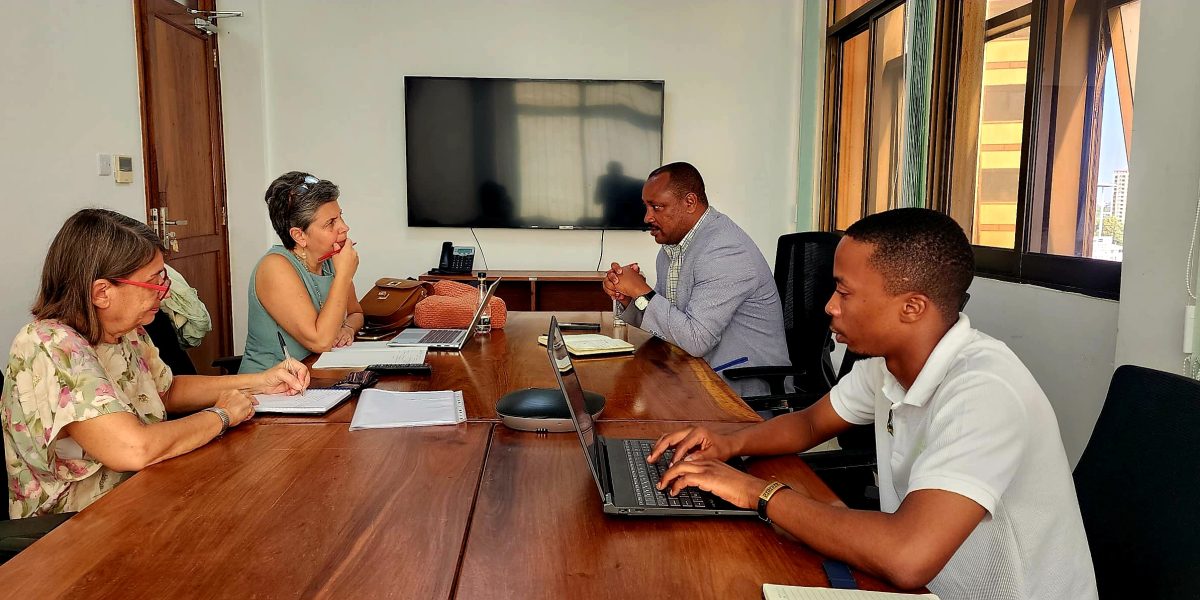
DAR ES SALAAM. The Agricultural Growth Corridors of Tanzania (AGCOT) Centre on 9 November 2026 hosted a delegation from Italy’s Fondazione Lombardia per l’Ambiente (FLA). The meeting explored how public–private partnership can help Tanzanian farmers withstand the growing impact of climate change.
The delegation included Ms Stefania Fontana, FLA Project Manager in Environmental Sustainability, and Ms Barbara Migone, International Consultant and implementing partner of the RES4CLIMA project.
The visit comes as Tanzania steps up efforts to safeguard its agricultural sector against the effects of climate change, including variable rainfall, droughts and floods that affect productivity, water resources and rural livelihoods.
A Public–Private Response to a National Priority
Under the Tanzania Development Vision 2050 (Dira 2050), the government has made building resilient food systems a national priority. The vision calls for government, the private sector and development partners to act together.
AGCOT was built for that kind of joint action. As a public–private partnership (PPP) institution, it brings government, agribusinesses, researchers and development partners to one table. Together they turn national agricultural priorities into tangible results for farmers and agribusinesses.
The FLA visit shows that model at work. Through AGCOT, an international development partner can connect with Tanzanian public institutions and private sector actors, who can turn climate finance and expertise into investment, services and practices on the ground.
RES4CLIMA: Connecting Climate Science with Agricultural Transformation
RES4CLIMA is an international cooperation initiative led by Italy’s Lombardy Region, one of Europe’s leading agricultural and economic centres and home to Milan, with funding from the Italian Agency for Development Cooperation (AICS).
Aligned with Italy’s Piano Mattei for Africa, which identifies Tanzania as a priority partner, the initiative seeks to strengthen climate resilience throughout the agri-food value chain.
Its interventions target urban, peri-urban and rural communities in Arusha Region, within AGCOT’s Northern Corridor, and on Pemba Island in Zanzibar.
The project focuses on three interconnected areas:
- Agroecological farming and soil health: Promoting agroforestry, regenerative agriculture and sustainable soil and water management practices to improve productivity, restore ecosystem health and strengthen farmers’ resilience to climate shocks.
- Post-harvest loss reduction: Introducing decentralised, energy-efficient technologies, including solar-assisted drying, to reduce food losses, preserve product quality and help farmers capture greater value from their harvests.
- Circular bio-economy: Promoting the productive use of agricultural residues and food-processing waste through composting and renewable energy solutions, reducing environmental pressure while creating new economic opportunities.
Together, these interventions demonstrate how climate adaptation can go beyond protecting agricultural production to improving efficiency, generating value and strengthening rural economies.
AGCOT’s Contribution: Turning Climate Commitments into Action
As an established in-country implementing partner of RES4CLIMA, the AGCOT Centre, formerly the SAGCOT Centre, brings institutional experience, stakeholder networks and practical coordination mechanisms to support climate-resilient agricultural development.
Two AGCOT platforms are particularly relevant:
- Inclusive Green Growth (IGG) Tool: Provides a framework for integrating environmental sustainability into agricultural investment and development, helping safeguard ecosystems, biodiversity and critical water catchments while promoting inclusive economic growth.
- National and Cluster-Level Green Reference Groups (GRGs): Provide multi-stakeholder platforms bringing together government ministries, Regional Secretariats, Local Government Authorities, regulators, researchers, private investors and Agricultural Marketing Cooperative Societies (AMCOS). These platforms help align policies, investments and local priorities, supporting the translation of climate adaptation commitments into practical action.
Through these mechanisms, AGCOT contributes to bridging the gap between national policy ambitions and implementation at regional, district and community levels.
Mr John Banga, Head of Corridors at the AGCOT Centre, said:
“Agricultural growth corridors are fundamentally transforming how we drive rural economic development in Tanzania by replacing scattered, isolated interventions with concentrated, commercially viable geographic ecosystems. A corridor is far more than physical asphalt and electricity grids; it is the vital relational infrastructure that aligns government policy, de-risks private agribusiness capital, and connects smallholder farmer cooperatives directly to industrial off-takers, certified inputs and structured markets. By scaling this spatial clustering model across our four national corridors, we are ensuring that every public dollar invested unlocks commercial investment, builds farm-level climate resilience, and directly powers our national march towards a USD 100 billion agricultural economy under Dira 2050.”
Looking Ahead: Deepening Cooperation for Lasting Impact
The engagement reaffirmed the importance of international cooperation in accelerating Tanzania’s transition towards a more productive, inclusive and climate-resilient agricultural sector.
Both parties expressed interest in advancing their collaboration through a formal Memorandum of Understanding (MoU), with potential areas of cooperation including technical knowledge exchange, joint research and capacity building.
Such collaboration offers opportunities to strengthen the adoption of climate-smart solutions, support agribusiness innovation and expand access to knowledge and technologies, particularly for smallholder farmers, women and young people.
By connecting international expertise with Tanzania’s agricultural institutions, investment platforms and farming communities, partnerships such as RES4CLIMA can contribute to a future in which climate resilience and agricultural prosperity advance together.
Stronger partnerships. Targeted science. Sustainable agricultural prosperity.
#AGCOT #RES4CLIMA #ClimateResilience #InclusiveGreenGrowth #NorthernCorridor #TanzaniaAgriculture #Dira2050
Do you have a story or press release for African agriculture? Send it to kilimokwanza.africa@gmail.com or read how to submit.