

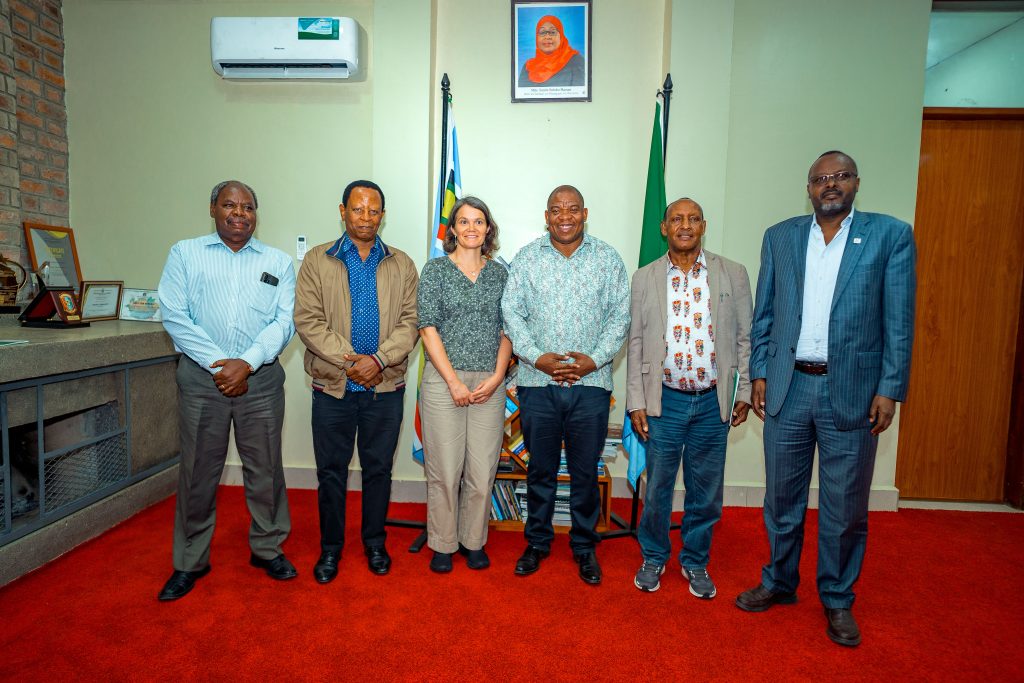
At the Njombe Regional Secretariat, 9 March 2026. AGCOT Board Chairman Dr Ally H. Laay and Board Member Laurean R. Bwanakunu join Regional Commissioner Hon. Anthony Mtaka, AGCOT CEO Geoffrey Kirenga, AGM Chair Mark Magila, and Dr. Lutgart Lenaerts, First Secretary for Agriculture, Climate and Environment at the Royal Norwegian Embassy, following a courtesy call that opened four days of field engagement across the Ihemi Cluster. (L–R: Mark Magila, Geoffrey Kirenga, Dr. Lutgart Lenaerts, Hon. Anthony Mtaka, Ally H. Laay, Laurean R. Bwanakunu.)
9 March 2026 | Iringa & Njombe Regions, Tanzania
Tanzania Farmers Earn 75 Times More After a Decade of Corridor Investment
The story behind the numbers: how one Lusitu village became the proof of concept for national agricultural transformation
AGCOT board members visit the Ihemi Cluster to see how a USD 6.34 billion investment has reshaped farming across southern Tanzania
NJOMBE, TANZANIA — Smallholder potato farmers in the Ihemi Cluster who once earned as little as TZS 200,000 a season are now taking home between TZS 15 million and TZS 20 million. Some have crossed TZS 100 million in a single year. The change did not happen by accident. Across the SAGCOT corridor as a whole, the transformation is measured differently but no less decisively: cumulative farmer revenues have grown fourteenfold since 2019, rising from a baseline of USD 42.9 million to a cumulative total of USD 606 million by the end of FY 2024.
A delegation from the Board of AGCOT Centre arrived in Njombe on 9 March 2026 for a four-day field visit to the Ihemi Cluster, a farming zone spanning Iringa and Njombe regions that has become the flagship of Tanzania’s Southern Agricultural Growth Corridor (SAGCOT). The visit, running until 12 March, is the Board’s first direct look at results on the ground since SAGCOT Centre was transformed into AGCOT Centre.
The delegation is led by Board Chairman Ally H. Laay and Board Member Laurean R. Bwanakunu, alongside AGCOT CEO Geoffrey Kirenga and Mark Magila of the Agricultural Council of Tanzania, who chairs AGCOT Centre Annual General Meeting (AGM). Representatives from the Royal Norwegian Embassy — Dr. Lutgart Lenaerts (First Secretary, Agriculture, Climate and Environment) and Yassin Mkwizu — are also part of the group, reflecting Norway’s long-term support for corridor agriculture in Tanzania.
A Burial Society That Became a Business
The centrepiece of the Day 1 visit was Lusitu Village, where the Board met Beno Mgaya, founding chair of the Lusitu Agribusiness Group. The group’s origins are unusual: it started as a burial society — a community fund for grief support — before SAGCOT identified Mgaya, and supported him to recognise that its 40 members already knew how to organise, pool resources, and trust each other.
That foundation became a commercial enterprise. The group built a packing and grading facility, enabling farmers to supply potatoes directly to buyers in Dar es Salaam, Zanzibar, and export markets in a form that commands a price premium. It established an informal Farmers Business School and a Farmer-to-Farmer (Mkulima kwa Mkulima) programme now exporting its model to other regions.
Potato yields at Lusitu have risen from an average of 5 tons per acre to over 200 bags per acre. For avocado growers, the numbers are equally striking: a farmer with 600 mature trees, harvesting 300 kg per tree at TZS 2,500 per kilogram, can generate more than TZS 400 million in a single season.
Courtesy Call: Njombe Regional Secretariat
The delegation’s first stop in Njombe was a call on Regional Commissioner Hon. Anthony Mtaka at the Regional Secretariat. What was billed as a courtesy became a substantive exchange: a direct account of what SAGCOT’s ten-year presence has produced in Njombe — and what it still needs to deliver.
Hon. Mtaka noted you cannot talk about horticulture development in Njombe and leave out SAGCOT. He noted the avocado supply chain, which has grown well beyond what most observers anticipated, to be the main commercial crop in the region. Njombe now has six factories processing avocado into oil, operating day and night shifts to keep pace with demand. The reach of the supply chain extends far outside the region: factories in Njombe are receiving raw avocado from Burundi, Kagera, Manyara, and other regions. At the same time, Njombe’s avocado seedling nurseries have become a regional export in their own right — buyers from Burundi and Dar es Salaam are now travelling to Njombe specifically to procure seedlings.
“SAGCOT has been part and parcel of the horticulture transformation in this country. Not only avocado and potato — they have their strength in every area. We are so much thankful.”
Hon. Anthony Mtaka, Regional Commissioner, Njombe Region
Hon. Mtaka credited SAGCOT’s presence across multiple sectors, noting that he first worked alongside the SAGCOT team during his earlier posting in the dairy sector. “They have their strength in every area,” he said. “In Njombe we mention potato and avocado, but I am sure in other areas they have also given transformation in horticulture.”
He also pointed to a critical constraint that the Board will need to address in the next phase: potato seed supply. Demand for certified potato seed in Njombe and the surrounding region has grown faster than the system can supply. Farmers unable to access improved varieties are falling back on local seed, with yields that lag well below the Lusitu benchmark. “We are not even meeting two percent of the demand,” Hon. Mtaka said. “That is an investment opportunity.”

At the Njombe Regional Secretariat, 9 March 2026. AGCOT Board Chairman Ally H. Laay and Board Member Laurean R. Bwanakunu join Regional Commissioner Hon. Anthony Mtaka, AGCOT CEO Geoffrey Kirenga, AGM Chair Mark Magila, and Dr. Lutgart Lenaerts, First Secretary for Agriculture, Climate and Environment at the Royal Norwegian Embassy, following a courtesy call that opened four days of field engagement across the Ihemi Cluster. (L–R: Mark Magila, Geoffrey Kirenga, Dr. Lutgart Lenaerts, Hon. Anthony Mtaka, Ally H. Laay, Laurean R. Bwanakunu.)
How AGCOT Works — And Why It Is Different
AGCOT CEO Geoffrey Kirenga used the Secretariat visit to draw a deliberate contrast between the AGCOT model and conventional development finance. “Our project is very different from others — we are always talking to the people and encouraging them to work with the sector and the government.”
Kirenga singled out Hon. Mtaka’s hands-on approach as a decisive factor in the Ihemi Cluster’s pace of change. “Whenever he was free, he was in the next room, working with us,” he said. “He is the one who is driving most of the work here.” The observation drew on a relationship stretching back to 2014, when the land that now hosts some of Njombe’s most productive farms was, in Kirenga’s description, “completely abandoned.”
From One Corridor to a National Strategy
Board Chairman Ally H. Laay reflected on the long road that brought the organisation from a single corridor in southern Tanzania to its current national mandate. Addressing the Regional Commissioner, he recalled bringing a parliamentary agriculture delegation to Njombe and Ihemi four to five years ago. The question the MPs kept raising — why is transformation concentrated here, and not across the whole country? — became the seed of a strategic shift.
That shift is now formalised in the organisation’s name: AGCOT, the Agricultural Growth Corridors of Tanzania. “The board and the AGM have agreed: maintain the economy here, so that when we build other corridors, we build on what we have already learned,” Laay said. Ihemi is no longer the destination — it is the template. The corridor’s FY 2024 results show what replication could mean at scale: farmers associated with SAGCOT partners generated USD 255.3 million in annual revenues that year, surpassing the target by 118%.
Laay also explained the decision to include the Royal Norwegian Embassy in the field visit. He cited a commitment made by Norway’s leadership three years ago — conveyed directly during a meeting with the President of Tanzania — to participate substantially in the transformation of Tanzanian agriculture. The Ihemi visit, he said, was the moment to show Norwegian partners what that commitment had made possible. Norway has supported SAGCOT, now AGCOT for over a decade.
“The embassy is very happy that we have decided to support AGCOT through this agreement. We are very much looking forward to seeing what has happened here.”
Dr. Lutgart Lenaerts, Royal Norwegian Embassy, Dar es Salaam
“When we started in this corridor in 2015, everything was small. What you see now — value chains that are focused and performing, local and international investment — is what sustained, multi-stakeholder commitment looks like.”
Geoffrey Kirenga, CEO, AGCOT Centre Limited
The Ihemi Cluster has demonstrated that the model works. As Tanzania moves to replicate it across the North, Central, and Mtwara corridors, Lusitu’s story is the template — and the lesson.
About AGCOT Centre
Formerly the SAGCOT Centre, the Agricultural Growth Corridors of Tanzania (AGCOT) Centre serves as the operational and strategic engine for coordinating agricultural corridors across Tanzania. Operating as an honest broker and public-private partnership hub, AGCOT facilitates relationships between government, agro-industries, SMEs, smallholder farmers, and development partners. Headquartered in Dar es Salaam, Tanzania.