

The award-winning tree-to-bar brand expands international distribution, proving Tanzanian agricultural products can compete—and win—on global premium markets
Kilimokwanza Special Report | May 1, 2026
In the rolling terraces of Kyela district, where volcanic soils meet the climate-moderating influence of Lake Malawi, a transformation is unfolding that extends far beyond the cocoa trees. Mababu Chocolate, Tanzania’s premier tree-to-bar brand, has announced expanded distribution to the United Kingdom—a milestone that represents more than market access. It is validation of a decade-long bet: that Tanzanian farmers and processors can capture the full value chain of cocoa production, from fermentation to final retail packaging, and compete successfully against established European chocolatiers.
The announcement comes from Naomi Mwasambili, whose LinkedIn post this week confirmed that after months of testing shipping routes and distribution channels, Mababu Chocolate bars, natural cacao powder, cacao nibs, drinking chocolate, and baking chocolates are now available for UK orders through www.livyafrica.com/shop. Minimum orders are set at 10 bars, with UK postage covered by buyers.
For those tracking Tanzania’s agricultural transformation—particularly the shift from commodity exports to branded finished goods—this expansion is a case study in how value addition actually works when executed with technical rigor and strategic patience.
The Tree-to-Bar Philosophy: Keeping Value at Origin
The global chocolate industry has historically operated on colonial economics: raw materials extracted from the Global South, value added in the Global North. West African nations produce 70% of the world’s cocoa yet capture less than 6% of the $130 billion global chocolate market. The mathematics of extraction are stark.
Mababu Chocolate, produced by Livy Africa Limited under founder and CEO Christopher Mwasambili, was designed to disrupt this fragmentation. The name “Mababu”—Swahili for “Ancestors”—signals the brand’s connection to the Southern Highlands heritage of the Mwasambili family. But the brand identity is backed by industrial-grade infrastructure: fermentation protocols, quality assurance systems, tempering equipment, and retail packaging capabilities that allow the company to deliver a finished product indistinguishable in quality from Belgian or Swiss competitors.
“Tanzania’s wealth was being exported in its rawest form,” Christopher Mwasambili observed during his time in the United Kingdom, the experience that catalyzed Livy Africa’s founding. The solution was vertical integration: manage the entire journey from cocoa tree to retail bar, ensuring socioeconomic benefits are reinvested in Tanzania rather than captured by foreign manufacturers.
This “tree-to-bar” model is supported institutionally by the AGCOT Centre (formerly SAGCOT), which has prioritized expanding markets and establishing high-quality standards for Tanzanian agricultural products. The Southern Highlands have been identified as a strategic cluster for cocoa development, with AGCOT facilitating market linkages, quality training, and investment coordination across the value chain.
The Kyela Advantage: Terroir as Competitive Edge
Not all cocoa is created equal. Flavor profiles in chocolate are determined by genetics, soil chemistry, climate, and post-harvest processing—what winemakers call terroir. Kyela district, in Tanzania’s Mbeya region, produces Trinitario cocoa beans, a hybrid variety that combines Forastero’s hardiness with Criollo’s refined flavor complexity.
The terroir of Kyela is exceptional. Fertile volcanic soils, moderated temperatures from Lake Malawi’s microclimate, and shade from mature rainforest create growing conditions that produce beans with distinctive aromatic signatures: strawberry, blueberry, dried fruit as primary notes; tobacco, graham, and floral undertones in the secondary spectrum. When properly fermented and roasted, these beans achieve the sensory complexity that wins international awards.
Mababu’s 72% Dark Chocolate bar won a Silver medal at the 2020 Academy of Chocolate awards in London—validation from the industry’s most demanding judges that Tanzanian cocoa can compete at the pinnacle of craft chocolate. The brand has collected five international awards to date, and Kyela beans are now sourced by European makers like Hungary’s Rózsavölgyi Csokoládé, whose bars crafted from Mababu beans evoke rum, banana, and rice aromatics.
This quality is not accidental. It is the result of intensive agronomic training, rigorous fermentation protocols, and chemical-free organic farming practices implemented by smallholder cooperatives with support from Livy Africa’s field teams and AGCOT technical advisors.
The Manufacturing Chain: From Fermentation to Tempering
The technical journey from harvested pod to finished bar involves precise control of biochemical and physical transformations.
Fermentation is the critical foundation. Raw cocoa beans are bitter and astringent; fermentation develops the flavor precursors. At Mababu’s cooperatives, beans are placed in wooden boxes for six days. Yeasts break down the sugary pulp, then acetic acid bacteria take over as the mass is turned and aerated. Temperatures reach 50°C, killing the bean embryo and triggering internal enzymatic reactions that reduce bitterness and develop fruity aromatics.
Drying follows, reducing moisture from 60% to under 7% through solar methods—a five-to-ten-day process depending on seasonal humidity. Properly dried beans are stable for transport and storage.
Roasting unlocks final flavor. Different temperatures and durations develop specific profiles. Mababu’s roasting protocols are calibrated to enhance the strawberry and tobacco notes characteristic of Kyela Trinitario.
Winnowing cracks roasted beans and removes husks, leaving nutrient-dense nibs. These are ground into “cocoa liquor,” a process generating enough friction heat to melt internal cocoa butter, transforming solids into smooth liquid.
Tempering is the final hurdle. Cocoa butter is polymorphic—it can crystallize in multiple forms. Tempering encourages stable crystal formation through controlled heating and cooling, producing chocolate with glossy finish, firm snap, and high melting point. This is the signature of professional-grade chocolate.
Each step requires equipment, training, and quality control. Mababu’s state-of-the-art processing facility in Dar es Salaam—complemented by the micro-factory in Mbeya—represents millions of dollars in capital investment, technical transfer, and process optimization. It is infrastructure that transforms raw beans into retail-ready products bearing “Made in Tanzania” provenance.
Direct Trade: Transparent Partnerships with Kyela Farmers
The Mababu story is inseparable from its relationship with smallholder farmers, particularly the Mababu Central Cocoa Fermentary (CCF)—a cooperative of approximately 60 farming families in Kyela led by Mama Mpoki.
Since 2014, these farmers have been partners in a Direct Trade model pioneered with Askinosie Chocolate, a Missouri-based craft maker. This model is characterized by radical transparency: financial statements translated into Swahili, open meetings discussing profit margins, and profit-sharing agreements that return a percentage of international sales directly to farmers.
The Direct Trade framework survived the 2024 global cocoa price surge—a 300% increase that bankrupted many craft makers. Through dialogue and contract renegotiation, Mababu and Askinosie agreed on prices above local market rates, ensuring farmer livelihoods were protected even as raw material costs soared.
This relationship has generated tangible community development. In 2014, the Mababu CCF authored “A Vision of Greatness,” a roadmap for social investment funded by chocolate sales:
- Sustainable Lunch Program: Premium Kyela rice sold internationally, with 100% of profits funding school lunches. More than 220,000 lunches served since 2012.
- Chekechea Preschool: Early childhood education and nutrition, built by local tradespeople with locally made furniture.
- Educational Infrastructure: First textbooks for local schools, deep water well serving 2,000 residents, video-learning programs with laptops and projectors.
- Scholarship Endowments: The Maria-Upendo Maono Scholarship supports students like Maria, now studying veterinary medicine.
- Empowerment Clubs: “Empowered Girls” and “Enlightened Boys” mentorship programs reaching over 10,000 students since 2012.
This is what value addition looks like when designed with equity. The chocolate sold in London carries embedded social impact—each bar purchased funds school lunches in Kyela.
Product Portfolio: 30+ SKUs Showcasing Tanzanian Terroir
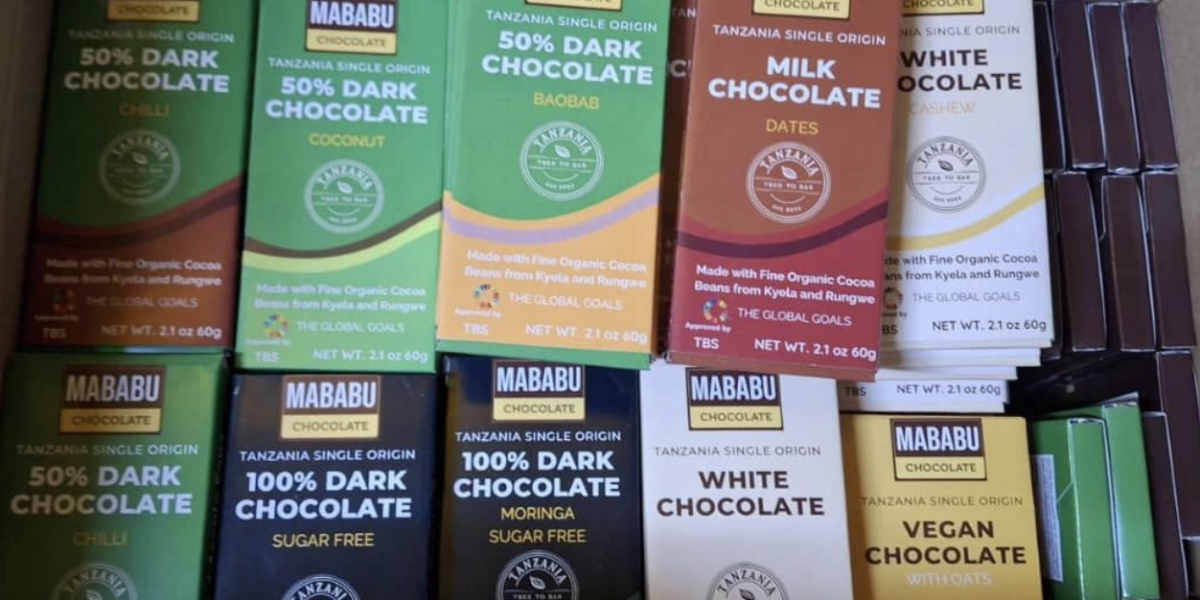
Mababu Chocolate has evolved from single-origin bars to a diversified portfolio of over 30 products, many incorporating Tanzanian superfoods:
Core Range:
- 100% Dark (sugar-free)
- 80% Dark
- 72% Dark (award-winning flagship)
- 50% Dark
- 45% Dark Milk
- Milk Chocolate
- White Chocolate
- Vegan Chocolate with Oats
Infused & Specialty Bars:
- Baobab infusion
- Moringa infusion
- Coconut blend
- Dates blend
- Traditional spiced (cinnamon, vanilla, ginger)
- Dark Chocolate + Southern Highlands Coffee
Additional Products:
- Ceremonial Cacao
- Natural Cacao Nibs (100g)
- Natural Cacao Powder (100g)
- Cocoa Husk Tea (250g)
- Macadamia Chocolate Spread
Each product tells a story of Tanzanian agriculture. The baobab comes from indigenous trees across the country. Moringa is cultivated in agroforestry systems. The coffee beans are sourced from Southern Highlands estates. This is cross-sector integration: chocolate as a platform for showcasing Tanzania’s agricultural diversity.
UK Expansion: Strategic Market Access
The UK market represents both opportunity and validation. British consumers are among the world’s most sophisticated chocolate buyers, with strong preferences for ethical sourcing, single-origin products, and craft manufacturing. The UK craft chocolate market has grown 12% annually since 2020, driven by consumers willing to pay premium prices for transparency and quality.
Mababu’s entry strategy is calibrated: direct-to-consumer sales through the Livy Africa website, targeting UK buyers, retailers, and specialty stockists. Minimum orders of 10 bars keep logistics manageable while testing market response. UK postage costs are passed to buyers, maintaining margin integrity.
This is Phase One. The infrastructure being built—shipping protocols, customs documentation, UK supplier relationships—lays groundwork for wholesale distribution. The long-term vision is Mababu bars on shelves at Whole Foods, Waitrose, and independent food halls across London, Manchester, Edinburgh.
The UK expansion follows successful distribution in Tanzania (via the Masaki showroom at 107 Toure Drive, Dar es Salaam, and retail partners nationwide) and growing international recognition. Mababu has been featured in O, The Oprah Magazine, showcased at the Africa Food Systems Forum, and presented at Nanenane Expo. International trade missions have pitched Tanzanian cocoa products for US export under the AGOA treaty.
Each market entry builds brand equity. Each shelf placement validates the tree-to-bar model. Each international award signals that “Made in Tanzania” is synonymous with quality.
The AGCOT Connection: Corridor Transformation in Action
For AGCOT Centre, Mababu Chocolate is a demonstration project—proof that corridor development works when value chains are strengthened end-to-end.
The Southern Highlands corridor strategy has prioritized cocoa as a strategic value chain, with interventions across:
- Production: Cocoa Centre of Excellence development in Njage Village (Kilombero District) through partnership between Kokoa Kamili Ltd and Sokoine University of Agriculture, providing agronomic training and quality standards to farmers.
- Processing: Support for Livy Africa’s processing infrastructure, including the Dar es Salaam facility and Mbeya micro-factory.
- Market Linkages: Facilitation of international trade missions, participation in investment forums, and connections to buyers like Askinosie Chocolate.
- Quality Standards: Training on fermentation protocols, organic certification, and food safety compliance to meet international market requirements.
The Tanzania Harvest Initiative, which showcases Mababu Chocolate as a flagship brand, is AGCOT’s platform for demonstrating domestic value addition. By processing chocolate in Tanzania rather than exporting raw beans, the country captures 4-5x more value per kilogram of cocoa produced.
AGCOT’s role is ecosystem enablement: connecting farmers to processors, processors to markets, and markets to finance. The Mababu success story validates this approach. It shows that Tanzanian agriculture can move beyond commodity extraction to branded finished goods competing globally.
Challenges and the Path Forward
Despite its success, Mababu faces headwinds that test the resilience of the tree-to-bar model.
Climate change is disrupting yields in Kyela. Farmers report increased pest pressure, disease outbreaks, and unpredictable rainfall patterns. Livy Africa has initiated a nursery project to provide cocoa seedlings for replanting diseased trees, but climate adaptation will require sustained investment in agronomic research and farmer training.
Global supply chain volatility was demonstrated in 2024’s 300% cocoa price spike. While Direct Trade partnerships survived, the episode revealed the fragility of craft chocolate economics. Mababu’s diversification into cacao powder, nibs, and ceremonial products provides revenue stability beyond bar sales, but commodity price swings remain a systemic risk.
Smallholder financing remains constrained. Farmers often lack collateral for formal credit, limiting their ability to invest in productivity improvements. Organizing into cooperatives like the Mababu CCF improves bargaining power, but scaling requires continued support from government programs, development finance institutions, and private sector partnerships.
Market penetration in the UK will require sustained brand-building. Tanzanian chocolate is unknown to most British consumers. Competing against established brands (Lindt, Green & Black’s, Tony’s Chocolonely) demands differentiation through storytelling, quality consistency, and distribution partnerships. Success is not guaranteed—it must be earned shelf by shelf, customer by customer.
A Blueprint for African Agribusiness
The expansion of Mababu Chocolate to the UK is more than a business development story. It is a blueprint for how African agricultural economies can move up the value chain—from commodity dependence to brand sovereignty.
The model rests on three pillars:
- Organizational Strength: Transitioning from fragmented smallholder production to cooperatives with collective bargaining power and shared infrastructure.
- Quality Sovereignty: Implementing world-class standards—from fermentation to tempering—that allow African products to compete on quality, not just price.
- Narrative Ownership: Using cultural heritage (“Mababu” as ancestors), terroir storytelling (Kyela’s volcanic soils), and ethical sourcing (Direct Trade transparency) to build emotional connection with consumers willing to pay premium prices.
When these pillars are in place, supported by institutional enablers like AGCOT and development partners, transformation is possible. Farmers become partners in global value chains. Processors become brand owners. Communities become stakeholders in shared prosperity.
As Mababu bars reach premium shelves in London—each package bearing the “Tanzania Tree to Bar” seal—they carry a promise: that African agriculture’s future is not in raw material exports, but in finished products bearing African brand names, manufactured on African soil, generating African prosperity.
The journey from Kyela’s cocoa terraces to London’s specialty shops is long. But it is a journey Mababu Chocolate is making—one bar at a time.
For UK orders and stockist inquiries:
Website: www.livyafrica.com/shop
Minimum order: 10 bars | UK postage applies
About Mababu Chocolate:
Mababu Chocolate is produced by Livy Africa Limited, a Tanzanian family-run enterprise founded by Christopher Mwasambili. The brand sources organic Trinitario cocoa from smallholder cooperatives in Kyela district (Mbeya region) and processes chocolate using a tree-to-bar model that retains value at origin. Mababu has won five international awards and maintains showrooms in Dar es Salaam (107 Toure Drive, Masaki) and Mbeya (New Forest). The brand is supported by AGCOT Centre as a flagship example of agricultural value addition in Tanzania’s Southern Highlands corridor.
This article is part of Kilimokwanza.org’s ongoing coverage of agricultural transformation in Tanzania’s growth corridors, documenting the shift from commodity exports to value-added production and market access for smallholder farmers.