

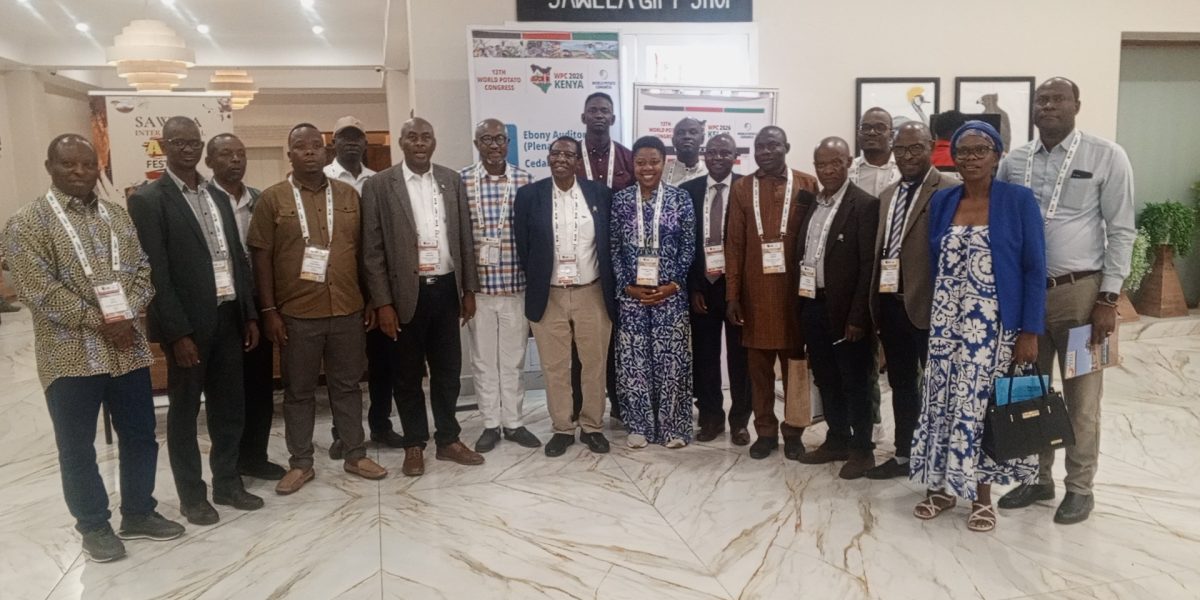
AfricaBlight’s launch, new seed technologies and a Tanzania–Kenya agreement put practical cooperation at the centre of the Naivasha gathering.
KilimoKwanza.org | Reported analysis | 31 October 2026
NAIVASHA, Kenya — A new African disease-management network, a Tanzania–Kenya cooperation agreement and university-led seed innovations gave the 13th World Potato Congress (WPC) a significance that extends beyond its place in the event’s history. The gathering set practical questions about planting material, crop protection and agricultural enterprise alongside the diplomacy of regional cooperation.
Held at Sawela Lodges in Naivasha from 26 to 30 October 2026, the Congress was the first hosted in Sub-Saharan Africa. Its theme connected global potato partnerships with food systems, nutrition security and trade. For East Africa, that combination matters immediately: a more productive crop benefits farmers most when they can obtain reliable inputs, protect their harvests and sell at a worthwhile return. Source: WPC 2026 official event information
The clearest way to assess Naivasha is therefore through the mechanisms it brought into view. AfricaBlight created a platform for collaboration on disease. The potato councils of Tanzania and Kenya signed a framework for cooperation. Egerton University reported a showcase of technologies intended to create seed businesses. Each is a starting point; none, on its own, shows that farmers’ costs have fallen or their incomes have risen.
Disease management gains a continental platform
One documented development was the launch of the AfricaBlight Network on 27 October. The International Potato Center (CIP) reported that researchers, agricultural institutions and industry partners had established the African-led collaboration to strengthen the response to potato late blight. WPC President Peter VanderZaag inaugurated the launch. Source: CIP AfricaBlight launch announcement
CIP identified priorities that include national coordinators, weather-based forecasting, farmer training, and partnerships for disease surveillance and pathogen analysis. The initiative draws on experience from other regional blight networks. Its ambitions depend on continuing finance and national capacity, so the launch is best understood as the start of a collaborative effort, not proof that disease has already been reduced.
“Effective late blight management requires more than access to tolerant varieties and fungicides,” CIP Plant Health Lead Dr Kalpana Sharma said in the announcement.
The distinction matters for the investment debate. A seed enterprise may improve the quality of material delivered to farms, but its commercial promise also depends on what happens after planting. Advice, timely warnings and effective crop protection must reach the same grower. Disease-management services deserve as much attention as the physical supply of seed.
Seed technologies move closer to the enterprise debate
Egerton University’s report of 28 October gives another concrete account from the Congress. Through its TAGDev 2.0 programme, the university showcased potato innovations led by Prof Anthony Kibe: aeroponics, apical rooted cuttings and true potato seed. It presented the work as a link between research, access to planting material and opportunities for young agribusiness operators. Source: Egerton University report, 28 October 2026
These are different technologies, with different customers and production requirements. Rooted apical cuttings are young rooted shoots that multipliers or farmers can establish to produce seed tubers; CIP describes the system as linking production under controlled conditions with subsequent multiplication. True potato seed is botanical seed and should not be confused with tubers sold for planting. Source: CIP rooted apical cuttings explanation
The official programme reflected that diversity. Its 26 October workshops covered rooted apical cuttings, hybrid true potato seeds and aeroponics alongside marketing, research collaboration and sustainability, and the published agenda also included seed systems, water management and processing. These listings show the subjects organisers put before delegates. They do not show that every technology is ready for commercial use in every participating country. Source: WPC 2026 detailed programme
For a young entrepreneur, the decisive questions are specific. Who will buy the planting material? Which varieties are wanted? What inspections apply? Can a nursery deliver within the local planting window? How much working capital is tied up before the first sale? A technology demonstration becomes an enterprise only when those questions have credible answers.
Tanzania and Kenya give cooperation an institutional framework
For Tanzania, a central development was the agreement signed on 28 October between the Potato Council of Tanzania (PCT) and the National Potato Council of Kenya (NPCK). According to the councils’ joint statement, NPCK Chief Executive Officer Wachira Kaguongo and PCT Board Member Abdalla Luvanda signed the documents. NPCK Chairman Kimani Rugendo and Tullah Mloge, Head of Partnerships and Communication at the Agricultural Growth Corridors of Tanzania (AGCOT) Centre, witnessed the signing.
The statement describes cooperation on technology and knowledge exchange, standards and quality assurance, trade connections, and capacity building and research. It names November 2026 as the starting point for preparing the first joint work plan, which gives the bilateral relationship an immediate task beyond announcing the agreement.
The practical value lies in coordination. Farmer organisations need connections with suppliers and buyers; researchers need routes for useful findings to reach farms; seed businesses need a clear understanding of the requirements in each market. The councils can help convene these actors and identify where cooperation is held back by missing information, weak relationships or incompatible commercial expectations.
The agreement does not itself authorise seed shipments or replace national inspection and plant-health decisions. Commercial cooperation must operate through the relevant authorities, including the Tanzania Official Seed Certification Institute (TOSCI) and the Tanzania Plant Health and Pesticides Authority (TPHPA) in Tanzania, and the Kenya Plant Health Inspectorate Service (KEPHIS) in Kenya. Treating these regulators as partners in implementation will be more productive than presenting safeguards as obstacles to be swept aside.
The joint statement also records a call for stronger cooperation among African potato organisations, including national councils where none exist, and for exploration of a continental association. That remains an aspiration for further discussion; a functioning bilateral work programme would give the wider ambition a practical example to examine.
The economic case begins with the right numbers
Existing production makes the case for taking the sector seriously. Kenya’s National Agriculture Production Report 2025 records a provisional potato production value of KES 72.5 billion in 2024, associated with 2.15 million tonnes. This measures the value of production; it is not the sum of all sales made by farmers, transporters, wholesalers, processors and retailers. Source: KNBS National Agriculture Production Report 2025, Table 3.14
Tanzania’s National Bureau of Statistics reports 1.41 million tonnes of Irish potatoes and an average yield of 9.9 tonnes per hectare in the 2024/25 agricultural year. Mbeya and Njombe together accounted for approximately 85.1 per cent of agricultural-household production. That concentration makes the Southern Highlands an important place to assess seed demand, producer services and links with processors and urban markets. Source: Tanzania NBS Annual Agricultural Sample Survey 2024/25, Table 3.8
For international comparison, FAOSTAT’s 2024 records put African production at 34.2 million tonnes, about 8.8 per cent of world output. Dividing production by harvested area gives an African average yield of approximately 15.4 tonnes per hectare, against 22.9 globally. The gap signals a productivity challenge, but country averages vary and do not isolate the contribution of seed quality. Source: FAOSTAT potato production and harvested area, 2024
The Tanzanian agricultural-year survey and the FAOSTAT calendar-year series should be kept distinct, and a continental average should not become a field-level promise. A farmer deciding whether to buy new planting material needs evidence on the variety, location, season, management requirements and likely financial return.
The seed figures need equal care. In August 2026, Kenya News Agency attributed to Kenya Agricultural and Livestock Research Organization (KALRO) Director General Dr Patrick Ketiem an annual certified-seed requirement of 150,000 tonnes against production of approximately 24,000 tonnes. On that stated basis, the shortfall is 126,000 tonnes and supply covers about 16 per cent of the requirement. Source: Kenya News Agency, KALRO seed estimate, 26 August 2026
This cannot be interchanged with a claim that certified seed supplies less than 5 per cent of demand across Africa; countries, dates and definitions matter. An unmet physical requirement also differs from effective commercial demand. Some growers may be unable to afford the delivered price, may want a different variety, or may lack a dependable buyer for the resulting crop.
Local seed supply needs a clear quality pathway
Quality Declared Seed (QDS) adds another dimension for Tanzania. The country’s QDS regulations include potato standards and requirements for registered producers and quality control. QDS is a defined system: describing a tuber as clean does not establish that it meets those requirements, and multiplication through cuttings does not automatically confer a legal seed category on the resulting harvest. Source: TOSCI Quality Declared Seeds Regulations 2020
The opportunity is to connect appropriate starter material, capable multipliers, inspection and local distribution. That could make smaller seed enterprises part of the response to shortages while preserving traceability and an accountable route for farmer complaints. The model must be assessed under the rules and market conditions of each country.
Farmer guidance also needs precision. NPCK’s advice on seed degeneration emphasises regular renewal of healthy stocks and positive selection when farmers retain seed. A single instruction to reuse seed for a fixed number of seasons is inadequate for all locations and disease situations; local extension advice and seed-health history should guide the decision. Source: NPCK seed potato degeneration guidance
The Congress linked production with processing and field learning
At the opening, Agriculture Cabinet Secretary Mutahi Kagwe invited investment in commercial farming, quality seed and local potato processing. The Star’s 27 October report linked his appeal to replacing imported potato products, strengthening market access and improving farmer returns, and described an emphasis on certification, cold-chain facilities and varieties suited to processors. Source: The Star opening coverage, 27 October 2026
Processing changes the production conversation. Buyers may require particular varieties, sizes and quality characteristics, as well as regular delivery, and farmers need to know those specifications before investing in planting material. More undifferentiated output is not the same as more marketable supply.
The Congress’s published field programme placed a Farmers Field Day at FreshCrop in Mau Narok on 29 October, with demonstrations covering varieties, nutrition, crop protection and production technologies. Its design connected conference discussion with practical comparison. The organisers’ webpages contain advance attendance projections, however, and these should not be treated as verified final turnout. Source: WPC Farmers Field Day programme
Technical-tour options included research and inspection facilities as well as processing businesses, among them KALRO, KEPHIS and Norda Industries. These itineraries illustrate the breadth of the value chain organisers intended delegates to examine, but the available programme information does not establish which visitors completed each option. Source: WPC technical tour programme
Crop health beyond late blight also had a place in the scientific agenda. A University of Idaho-led project briefing described a 28 October session on potato cyst nematode that brought together research perspectives from several countries. Its emphasis on connecting science, regulators and industry reinforces the case for treating plant health as shared infrastructure for a viable potato economy. Source: PAPAS, University of Idaho research project congress session briefing
What East Africa should measure after Naivasha
Taken together, these developments suggest a practical agenda for follow-through.
The first priority is a credible picture of seed supply and demand: inspected output, varieties, regional availability, delivered prices, seasonal timing and sales. That information would help businesses distinguish shortages they can serve from headline numbers they cannot convert into customers.
The second priority is farmer economics. Trials and demonstrations should track marketable yield, input and labour costs, disease outcomes, realised prices and margins. Repeat purchases of planting material would show whether growers see enough value to return without continuing demonstration support.
The third priority is accountable implementation. The councils’ work plan can name responsibilities and timelines, while research networks can explain how information will reach advisers and farmers. Youth participation should be judged by viable enterprises and paid opportunities; women’s participation should include influence over services, contracts and business decisions.
These are tests proposed by this analysis, not outcomes already delivered by the Congress. They offer a way to judge whether the relationships formed in Naivasha develop into services that growers can use and businesses can sustain.
The Congress gave East Africa a setting in which regional agreements, international science and commercial ambition could meet. Its lasting importance will emerge in the next planting and marketing seasons: through reliable planting material, better-informed disease decisions, stronger buyer relationships and improved returns for the people who produce the crop.
Do you have a story or press release for African agriculture? Send it to kilimokwanza.africa@gmail.com or read how to submit.