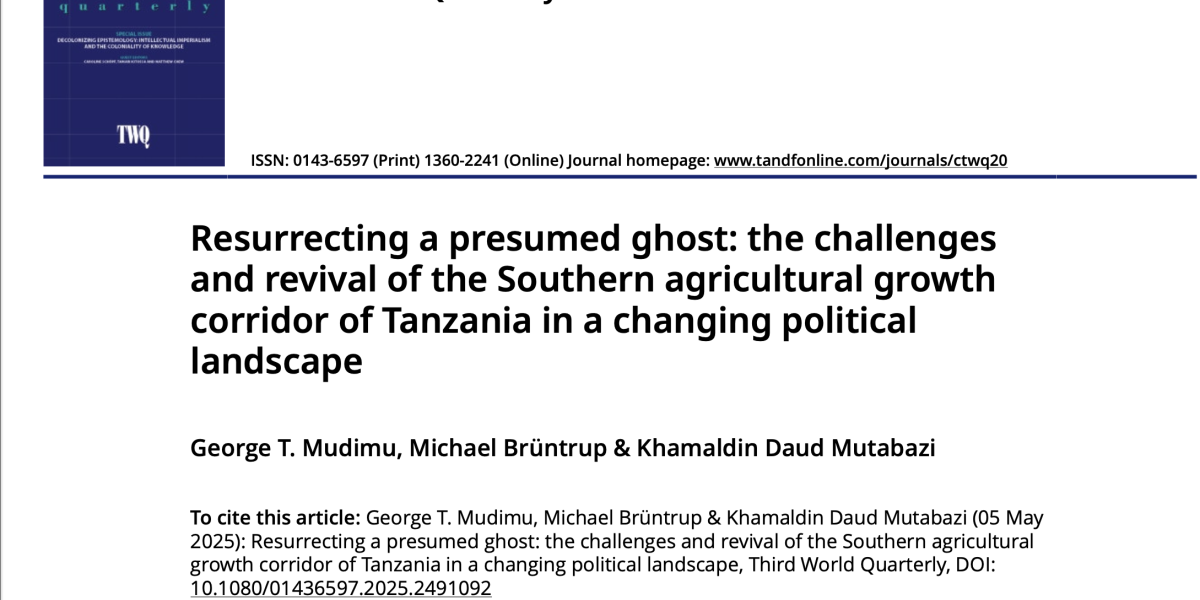
Kilimokwanza.org editorial response to “Resurrecting a presumed ghost: the challenges and revival of the Southern agricultural growth corridor of Tanzania in a changing political landscape”
Mudimu, Brüntrup & Mutabazi (Third World Quarterly, 2025)
Editorial Position
Academic critique strengthens policy when grounded in institutional reality. But when evocative metaphor displaces empirical fact, scholarship risks embedding dangerous narratives into policy discourse. This is precisely what occurs in Mudimu, Brüntrup, and Mutabazi’s characterization of SAGCOT as a “ghost project.”
Our concern is not with their political economy analysis per se, but with specific claims that are institutionally incorrect, conceptually inconsistent, and policy dangerous, particularly given Third World Quarterly’s influence among donors, governments, and development finance institutions.
What follows is not academic rivalry but policy hygiene: identifying where the paper contradicts itself, where it contradicts documented reality, and why silence would constitute tacit acceptance of misinformation.
1. The Central Error: Confusing Political Visibility with Institutional Viability
Where it appears:
Abstract (p. 2); “all but disappeared” (p. 3, ¶2); “ghost initiative” and “resuscitation” framing (pp. 14–15)
Why this is wrong:
The authors repeatedly claim SAGCOT “disappeared” or became a “ghost” under President Magufuli. Yet they simultaneously acknowledge, in their own text, that SAGCOT:
- Was never dissolved legally or administratively
- Maintained operational staffing
- Continued technical refinement without political interference
In Tanzanian governance, reduced presidential signaling does not equal institutional death. An entity that remains legally intact, staffed, and technically active is not a ghost. It is institutionally dormant in public discourse while operationally functional.
Why this matters:
This framing tells policymakers and investors that long term agricultural coordination platforms cannot survive political transition, a conclusion that is empirically false and institutionally corrosive. It discourages the multi-administration continuity essential for structural transformation.
2. Misinterpreting Institutional Adaptation as Policy Failure
Where it appears:
“Slow death” narrative (p. 9, ¶1–3); state intervention framing (p. 11, ¶2)
Why this is wrong:
The paper treats SAGCOT’s reduced prominence under Magufuli as evidence of failure. Yet the same sections document:
- Sustained agricultural investment
- Expansion of irrigation infrastructure and rural connectivity
- Strategic shift from FDI-led to state-led delivery models
This is policy reorientation, not collapse. The analytical error lies in conflating delivery mechanism (private vs. state-led) with the validity of the corridor concept itself.
Why this matters:
If accepted, this logic suggests any policy instrument not continuously branded is defunct, a position that actively discourages adaptive governance and learning-based institutional design. It punishes policy evolution.
3. Ignoring Tangible Infrastructure and Value Chain Evidence
What the paper omits:
The authors fail to engage with documented infrastructure investments within the Southern Corridor that continued throughout the period they characterize as “dormancy.” These include:
- Expansion of irrigation schemes
- Construction and rehabilitation of rural roads connecting production zones to markets
- Development of warehouse and storage facilities
- Improvements in rural electrification supporting agro-processing
More critically, the paper entirely overlooks the emergence and expansion of new agricultural value chains that were catalysed by corridor coordination mechanisms:
- Apple production systems expanding in Southern Highlands with improved market linkages
- Potato value chains developing commercial scale with enhanced storage and logistics
- Soybean production growing exponentially, positioning Tanzania as a regional leader
The paper also ignores documented productivity increases in established sectors:
- Dairy sector improvements through better breeding, extension services, and milk collection infrastructure
- Poultry value chains expanding with improved biosecurity and market access
Why this matters:
These are not anecdotal successes. They represent systematic, measurable outcomes directly linked to corridor coordination functions. By omitting this evidence, the paper builds its “ghost” narrative on selective observation, ignoring the very infrastructure and market development that validates the corridor approach.
4. Collapsing Corridor Coordination into Land Grabbing Discourse
Where it appears:
Direct linkage of SAGCOT to land alienation (pp. 5–6)
Why this is wrong:
SAGCOT was never a land allocating authority. Land governance in Tanzania resides with village governments, the Ministry of Lands, and statutory investment bodies. The paper repeatedly implies that land conflicts are attributable to the corridor itself, rather than to Tanzania’s broader land governance challenges that operate independently of SAGCOT.
This is a categorical error, confusing systemic land governance failures with corridor coordination mechanisms.
Why this matters:
This framing allows corridor platforms to be dismissed wholesale as land grabbing instruments, undermining legitimate coordination mechanisms essential for inclusive agricultural transformation. It forecloses rather than refines the policy conversation.
5. Internal Contradiction on Attribution Logic
Where it appears:
Claim that “success stories stemmed from pre-existing investments” (pp. 8–9)
Why this is wrong:
The authors correctly define corridors as catalytic systems that align infrastructure, coordinate actors, reduce transaction costs, and crowd in investment (p. 3). They then contradict this definition by criticizing SAGCOT for lacking exclusive attribution to outcomes.
Catalytic platforms operate through alignment, not direct causation. Demanding monocausal attribution from a coordination mechanism reveals fundamental misunderstanding of how such systems function.
Why this matters:
Applied consistently, this logic would invalidate industrial parks, special economic zones, growth poles, and innovation hubs globally, all of which succeed through catalytic coordination rather than direct project implementation.
6. Reducing Corridor Performance to One Instrument’s Limitations
Where it appears:
Nucleus-outgrower critique elevated to systemic judgment (pp. 8–9, 15)
Why this is wrong:
The paper treats mixed performance of nucleus-outgrower schemes as evidence of corridor-wide inadequacy, while ignoring:
- Infrastructure coordination achievements
- Policy harmonization across sectors
- Market development outcomes
- Institutional learning captured for scaling
This is instrumental reductionism, judging an entire system by the performance of one modality.
Why this matters:
It discourages modular policy design where specific instruments are refined without delegitimizing the entire institutional architecture, precisely the kind of adaptive capacity needed for complex agricultural transformation.
7. Overlooking the Institutional Ecosystem That Validates Corridor Effectiveness
What the paper omits:
The authors fail to acknowledge the thriving ecosystem of sister institutions that emerged from or alongside SAGCOT, institutions whose continued national impact demonstrates the validity and sustainability of the corridor approach:
Tanzania Agricultural Development Bank (TADB): Created under the Kilimo Kwanza policy in response to agricultural financing challenges identified during SAGCOT’s value chain development work, TADB has survived and evolved to serve as the national agricultural finance apex institution. It provides affordable short, medium, and long-term financing tailored to the agriculture sector, rural enterprises, and agribusiness players across Tanzania, demonstrating how corridor-identified gaps can catalyze permanent national institutions.
Tanzania Rural and Urban Roads Agency (TARURA): Conceived to accelerate development of rural roads for agricultural transformation beyond the reach of TANROADS, TARURA represents institutional innovation directly linked to corridor implementation challenges. By addressing the rural connectivity gaps that limited agricultural market access, TARURA now operates nationally, validating how corridor initiatives can incubate institutions with broader developmental reach.
These institutions were not “ghosts” during the period the paper characterises as dormancy. They were actively building capacity, refining approaches, and preparing for national scaling, institutional development trajectories that directly contradict the paper’s failure narrative.
Why this matters:
The continued vitality and expanding mandates of such organisations and a number of SAGCOT innovations being reoplicated in AGCOT, provide empirical evidence that the corridor concept generated sustainable institutional innovation. TADB and TARURA exist today precisely because SAGCOT and related agricultural transformation initiatives identified systemic gaps that required dedicated institutional responses. Ignoring them allows the authors to construct a misleading narrative of wholesale failure while the institutional legacy continues delivering national impact.
8. The Most Consequential Error: Mischaracterizing AGCOT as “Resuscitation” Rather Than Evidence-Based Scaling
Where it appears:
Discussion of President Samia’s administration (pp. 12–15)
Why this is wrong:
The paper claims SAGCOT was “revived” or “resuscitated” under President Samia. Yet it simultaneously documents that:
- SAGCOT’s CEO was seconded to design a national corridor system
- The approach expanded from one corridor to nationwide coverage
- Geographic concentration was deliberately corrected
- The model was validated for national scaling
What the paper fundamentally misunderstands is the demand side of this expansion. The establishment of additional agricultural growth corridors under AGCOT was not a top-down political decision to resurrect a failed project. It was a response to popular demand from regions that witnessed the transformation taking place in the Southern Corridor and actively requested similar coordination mechanisms for their own agricultural development.
This is the opposite of resuscitation. This is institutional validation through demonstrated impact and stakeholder demand.
Why this matters:
This framing actively undermines AGCOT’s policy legitimacy by presenting it as revival of a failed experiment rather than a deliberate, evidence-based national strategy driven by documented success and regional demand. It poisons the well for Tanzania’s most ambitious agricultural transformation initiative.
Why This Editorial Matters: Policy Narrative as Infrastructure
The cumulative effect of these errors extends far beyond academic debate. If left uncontested, this paper will:
- Be cited as authoritative evidence that corridors “fail” in policy briefs and investment memos
- Undermine confidence in long horizon agricultural policy among development partners
- Weaken Tanzania’s credibility in advocating for systems-based transformation approaches
- Discourage other African nations from adopting corridor coordination models
The deeper irony is that the paper’s own evidence supports the opposite conclusion: SAGCOT survived precisely because it adapted institutionally, and AGCOT exists precisely because the corridor model proved robust enough to merit national scaling based on demonstrated transformation in the Southern Corridor.
This is not academic score-settling. It is recognition that policy narratives function as infrastructure. They shape what investments flow, what reforms are attempted, what innovations are funded. When influential journals publish institutionally incorrect narratives under peer review, rebuttal becomes a matter of policy integrity.
Reference
Mudimu, G. T., Brüntrup, M., & Mutabazi, K. D. (2025). Resurrecting a presumed ghost: the challenges and revival of the Southern agricultural growth corridor of Tanzania in a changing political landscape. Third World Quarterly. https://doi.org/10.1080/01436597.2025.2491092