

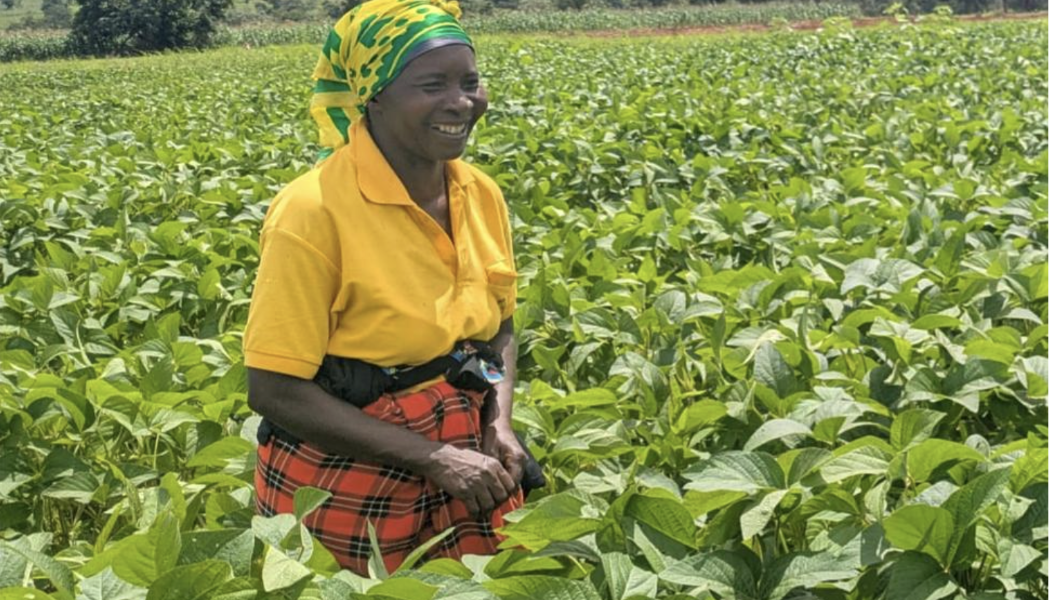
In mid-February 2026, an agronomist from Movement For Community Development (MCODE) visited a smallholder farm in Ruvuma, southern Tanzania. What they encountered was unambiguous: a uniform, vigorous stand of Uyole Soya 4 across 3 acres, planted in December 2025 and on course for harvest in May 2026. No guesswork. No gaps. Just a well-managed crop and a farmer in full command of her season.
That farmer is Ms. Cosma Ngulu.
She is one of 5,000 smallholder farmers targeted in Ruvuma under the Soybean Value Chain Support Project — and her farm is a precise illustration of what structured, targeted support looks like when it reaches the field. Following training on improved agronomic practices, Ms. Ngulu adjusted her plant spacing, tightened her planting schedule, and intensified her field management. The changes were incremental. The results are not.
Her neighbors have taken notice. They are visiting her rows, asking questions, and quietly reconsidering their own approaches. This is how value chain transformation moves through a farming community — not through mandates, but through visible results and organic peer learning.
Ms. Ngulu’s progress is not an isolated case. Across Tanzania, an estimated 21,000 soybean farmers are currently in active production. The expanding value chain has already generated over 550 jobs across aggregation, processing, input distribution, and market coordination — early but tangible evidence of systemic change.
Behind this momentum is a coordinated, long-term investment framework. The Soybean Value Chain Support Project (2025–2029), implemented by PASS Trust — a Tanzanian institution specialising in agricultural financing and development — in partnership with AGCOT Centre (Agricultural Growth Corridors of Tanzania) and MCODE, is designed to reach 22,500 farmers, distribute 900 metric tonnes of certified seed, establish 40 aggregation centres, and enable structured annual trade of 20,000 metric tonnes. The initiative is underpinned by USD 4.3 million in blended finance.
The strategic rationale is compelling. Tanzania currently imports tens of millions of US dollars worth of soybean meal annually to sustain its rapidly expanding poultry and livestock sectors. Scaling domestic soybean production is therefore not merely an agricultural priority — it is a direct policy response to feed security vulnerabilities, foreign exchange pressures, and the long-term competitiveness of Tanzania’s agro-industrial base.
The case for soybean extends beyond macroeconomics. At the household level, it is a high-protein food security crop. At the landscape level, it fixes atmospheric nitrogen, reducing input dependency and reinforcing climate-smart farming systems. Across the value chain, it generates employment pathways for rural youth in processing, logistics, and trade.
If current investment trajectories hold, Tanzania is projected to achieve annual soybean production of 350,000 to 500,000 metric tonnes by 2030 — substantially closing the gap between domestic supply and industrial demand, and catalysing growth across the feed, processing, and livestock value chains.
Ms. Ngulu’s 3 acres, viewed in isolation, are a modest holding. Viewed in context, they are something else entirely — a ground-level reflection of what becomes possible when farmer capacity, structured market systems, and coordinated institutional investment converge. Tanzania’s soybean transformation is not a future ambition. It is already taking shape, one well-managed farm at a time.
BACKGROUND: Tanzania’s Soybean Journey — From Scarcity to Strategic Crop
Tanzania’s soybean story is one of the most consequential agricultural transformations on the continent — and it is still unfolding.
As recently as 2012, national soybean production stood at just 8,100 metric tonnes. By the 2023/2024 agricultural year, that figure had climbed to 48,531 metric tonnes — a near sixfold increase in just over a decade. Yet even this growth has not kept pace with demand. Estimated annual domestic requirement has reached approximately 140,000 metric tonnes, forcing Tanzania to import heavily from Zambia and Malawi. In 2021/2022 alone, the country imported around 52,000 metric tonnes of soybeans, representing 91 percent of total demand at the time.
The crop’s strategic importance is not difficult to understand. Soybean constitutes approximately 30 percent of poultry feed formulation, making it the primary protein source for Tanzania’s fast-growing livestock and aquaculture industries. Chronic underproduction has historically driven up animal feed costs, constraining the entire livestock sector and inflating food prices for consumers.
Systemic bottlenecks compounded the challenge. Smallholder farmers relied predominantly on low-yield recycled seed with limited access to quality inputs or extension support. Processing infrastructure — particularly solvent extraction capacity for edible oils and seed cake — remained severely underdeveloped. Market linkages were fragmented, and coordinated investment was largely absent.
The turnaround began with deliberate institutional intervention. Through the SAGCOT Centre’s facilitation, Tanzania secured a landmark export opportunity when Dar Lyon became the first private company to contract 300,000 metric tonnes of soybean exports to China — a market with annual demand of three million tonnes. By 2023, soybean had become a significant export earner, valued at USD 92.7 million, with China and India as primary destinations.
Concurrently, the Tanzania Sustainable Soybean Initiative (TSSI), funded by the Royal Norwegian Embassy, drove the transition from subsistence production toward commercial scale by distributing certified seed and scaling climate-smart agronomic practices. New high-yield, drought-tolerant varieties sourced from IITA’s breeding programme in Zambia were introduced, tested, and certified through the Tanzania Official Seed Certification Institute (TOSCI), while local seed multiplication companies such as Sange Agro began producing certified seed domestically.
At the policy level, the Ministry of Agriculture and the Ministry of Livestock and Fisheries committed to developing a standalone National Soybean Development Strategy (NSDS) 2024–2030. Advocacy efforts also secured the removal of VAT on soybean seed cake — a targeted reform that directly improved farmer returns and incentivised processing investment.
The Institutional Architecture: From SAGCOT to AGCOT
The broader platform enabling Tanzania’s agricultural transformation — including its soybean ambitions — has itself undergone a landmark evolution.
The Southern Agricultural Growth Corridor of Tanzania (SAGCOT) was launched in 2010 as a public–private partnership under Tanzania’s Kilimo Kwanza (Agriculture First) vision to accelerate agricultural transformation. The model gained international recognition in January 2011 when H.E. Jakaya Mrisho Kikwete presented it at the World Economic Forum in Davos, and it was officially launched on May 6, 2011, in Dar es Salaam by Prime Minister Mizengo Kayanza Pinda.
The results exceeded all projections. Between 2010 and 2024, the initiative mobilised USD 6.34 billion in cumulative investment — surpassing its original USD 5.71 billion target by 111 percent and achieving this milestone five years ahead of schedule. Of that total, USD 5.02 billion (79.2 percent) was directed toward critical backbone infrastructure including energy, roads, and rural electrification, while USD 1.32 billion (20.8 percent) flowed into agribusinesses, processing facilities, and value chain development. The SAGCOT corridor today accounts for over 65 percent of all food production in Tanzania, with more than one million smallholder farmers empowered, climate-smart agriculture introduced across 1.3 million hectares, and upwards of 253,000 jobs created.
The scale of this success generated pressure — and ultimately a mandate — to replicate it nationally. On March 17, 2023, at the Africa Food Systems Platform at State House, President Samia Suluhu Hassan officially directed SAGCOT to expand its mandate across the entire country. On April 19, 2024, the Minister for Agriculture, Hon. Hussein Bashe, led a national consultation endorsing investment blueprints for three new strategic corridors: Mtwara, Central (Great Lakes), and Northern.
To reflect this expanded national mandate, SAGCOT formally transitioned to AGCOT — the Agricultural Growth Corridors of Tanzania. The transformation is recognised as Flagship No. 7 within Tanzania’s Agriculture Master Plan (AMP) 2050, which targets an agricultural GDP of USD 100 billion, USD 20 billion in net agricultural exports, and the eradication of hunger.
AGCOT’s official national launch took place in Dodoma on April 27–28, 2025, marking the beginning of a bold, corridor-by-corridor scale-up. Agile implementation teams are now deployed across the country, executing corridor-specific investment compacts and mobilising resources across both public and private sectors.
It is within this architecture — the institutional depth of AGCOT, the commercial momentum of PASS Trust, and the ground-level reach of MCODE — that Ms. Cosma Ngulu planted her December crop. And it is within this architecture that her May 2026 harvest carries meaning beyond the weight of the grain itself.
The Soybean Value Chain Support Project (2025–2029) is implemented by PASS Trust in collaboration with AGCOT Centre and Movement For Community Development (MCODE), supported by USD 4.3 million in blended finance.
🌱 #SoybeanTanzania #AgricultureTransformation #AGCOT #PASSBlueSeed #MCODE #FoodSecurity #ValueChain #TanzaniaAgriculture #WomenInAgriculture #RuralDevelopment #AMP2050