

By Kilimokwanza Correspondent
The question of why so few Tanzanians eat enough fruit and vegetables is often framed as a market problem, a behaviour problem, or an affordability problem. A baseline evaluation published in July 2025 by researchers from the International Food Policy Research Institute and partners suggests it is also, at a foundational level, a farming problem.
The research brief, titled Vegetable, Fruit, and Staple Crop Production and Input Use: Baseline Findings from the FRESH End-to-End Evaluation (Tanzania Evaluation, Research Brief 3, July 2025), assessed agricultural production across 1,968 farming households within the broader sample of 2,611 households participating in the FRESH end-to-end evaluation in Arusha and Kilimanjaro. The data it presents reveals a farming system structured overwhelmingly around staple crops, in which fruit and vegetable cultivation plays a secondary, marginal, or entirely absent role for the majority of households.
The Numbers That Define the Structure
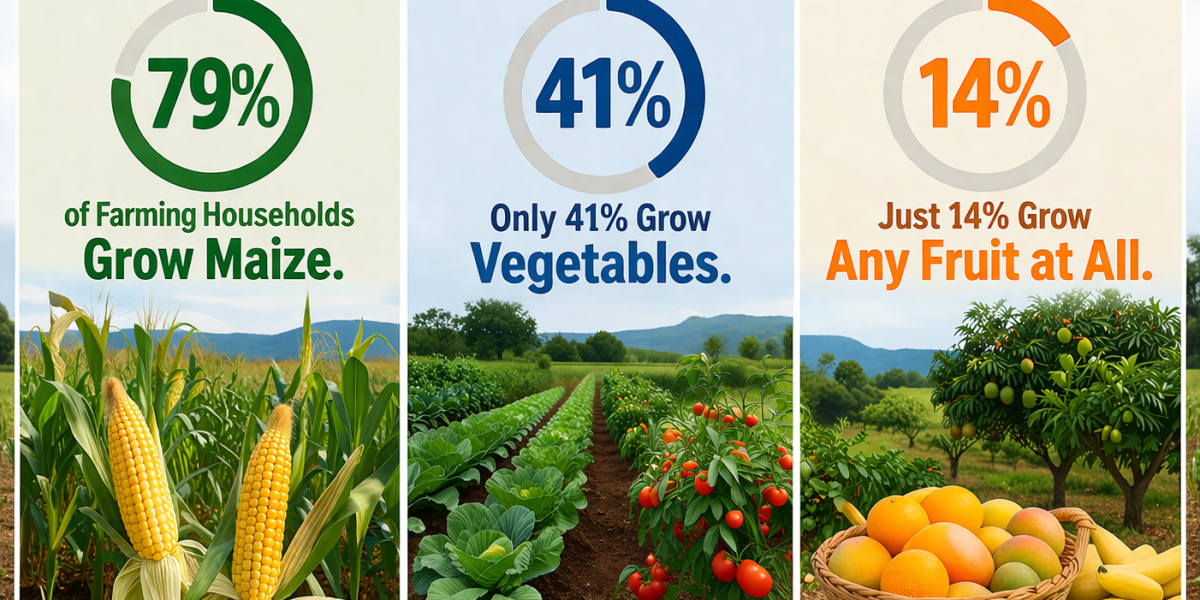
Of the 1,968 farming households surveyed, 79% cultivated staple crops during the long rainy season. A further 41% cultivated staple crops during the short rainy season. By contrast, only 41% cultivated any vegetables, and just 14% cultivated any fruit.
The three largest groups of households in the sample were those farming staple crops only, at 52%, those farming staple crops and vegetables, at 28%, and those farming vegetables, fruit, and staple crops together, at just 6%. The smallest identifiable group in the entire dataset was households farming fruit and staple crops during the short rainy season: just 13 households, representing less than 1% of the sample.
These proportions are not incidental. They reflect deeply embedded farming priorities shaped by food security concerns, market incentives, cultural practice, and input availability. Staple crops, primarily maize and kidney beans, feed families and are the backbone of household food security across both regions. Vegetables and fruit, while nutritionally critical, come second in the farming calendar and the farming budget.
What Smallholder Farming Looks Like on the Ground
The brief paints a precise picture of the physical reality of smallholder farming in the study area. Most farming households were smallholders with less than two acres of land, operating a single plot and cultivating one or two crops. The average total land cultivated across all household types was 1.8 acres.
Vegetable farming households cultivated an average of 2.2 vegetable types. Fruit farming households cultivated an average of 1.6 fruit types. These are not diversified, nutritionally optimised farms. They are small, constrained operations making rational decisions about which crops to prioritise given the land, labour, inputs, and market access available to them.
Households that farmed more crop categories did cultivate more land and operate more plots. The households farming staple crops, vegetables, and fruit together averaged 3.8 plots and 5.8 acres, suggesting that crop diversification is correlated with greater resource endowment. The least wealthy households were concentrated in the staple-only group: 22% of staple-only households were in the lowest wealth quintile, compared to 15% of households that also grew vegetables or fruit.
Fertiliser and Pesticide Use: A Proxy for Intensity
The input data reinforces the picture of a farming system that invests most heavily where staple crop production is the priority. Among households farming only staple crops, 53% used any fertiliser. Among those farming staple crops and vegetables, that proportion rose to 86%, and among those farming staple crops, vegetables, and fruit together, it reached 92%.
Chemical pesticide use followed a similar gradient: 4% for staple-only households, rising to 22% for those also growing vegetables, and 19% for those growing all three crop categories. Households that diversify into vegetables and fruit are more input-intensive across the board, suggesting that vegetable and fruit cultivation requires and attracts greater agricultural investment.
The Policy Implication
The finding that only 41% of farming households grow any vegetables, and only 14% grow any fruit, is not simply a farming statistic. It is a structural explanation for why the dietary surveys conducted by the same research programme found that nearly 99% of women in Arusha and Kilimanjaro consume less than the WHO-recommended 400 grams of fruit and vegetables per day.
If the supply of fruit and vegetables is not being grown by most farming households in the region, then the market must source it from a subset of specialist growers, transport it across distances, and sell it at prices that reflect those costs. The dietary deficit is, in part, a production deficit. And the production deficit is not primarily a knowledge or technology problem. It is a structural problem rooted in how smallholder farms allocate their most scarce resources: land, labour, and money.
Interventions that focus only on consumer behaviour or market access without addressing the incentives and constraints that keep 59% of farming households out of vegetable cultivation will work at the margins of this problem. The FRESH end-to-end approach, which combines supply, demand, and food environment interventions simultaneously, is designed with this systemic reality in mind. The baseline data now makes the scale of what needs to change impossible to ignore.