

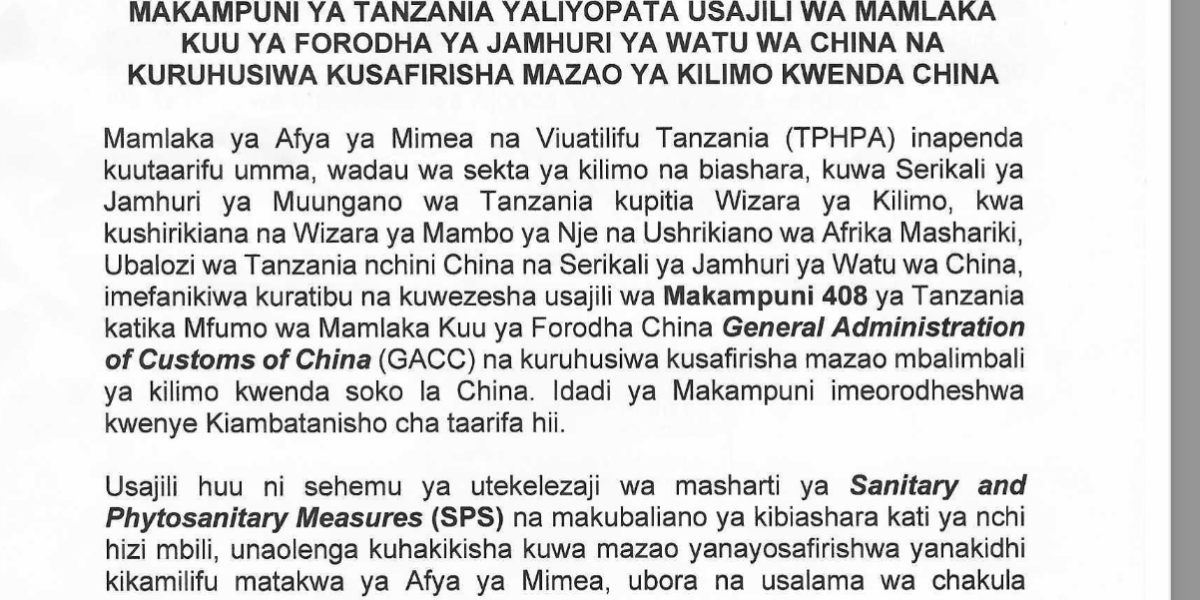
Registration under Chinese customs authority marks Tanzania’s largest single agribusiness market entry, positioning country as emerging force in global agricultural trade
ARUSHA, February 4, 2026 — Tanzania has secured a landmark trade victory with the registration of 408 domestic companies under China’s General Administration of Customs (GACC), clearing the path for immediate export of agricultural products to the world’s most populous nation and second-largest economy.
The Tanzania Plant Health and Pesticides Authority (TPHPA) announced the development in an official statement released Tuesday, describing it as a transformative moment for the country’s agricultural sector and a validation of Tanzania’s progress in meeting rigorous international phytosanitary standards.
“This registration represents a major advancement for our country,” said Prof. Joseph Ndunguru, Director General of TPHPA. “It will enhance the value of our agricultural production, expand foreign trade opportunities, and strengthen economic returns for our farming communities.”
The approval follows sustained diplomatic and technical engagement between Tanzania’s Ministry of Agriculture, the Ministry of Foreign Affairs and East African Cooperation, Tanzania’s Embassy in China, and Chinese regulatory authorities—a coordinated effort spanning multiple bilateral forums and technical working groups.
From niche to diversified export portfolio
Unlike earlier market access agreements that focused narrowly on specific commodities such as avocados, the current registration encompasses a significantly diversified range of agricultural products, positioning Tanzania to tap multiple segments of China’s vast food import market.
Registered companies are now authorized to export:
- Traditional cash crops: Coffee, cocoa, cashew nuts, cloves, and tobacco
- Oilseeds and pulses: Soybeans, groundnuts, sunflower seeds, cotton seed, sesame, and bambara nuts
- High-value horticulture: Avocados, hot peppers, and specialty vegetables
- Processed and semi-processed products: Subject to specific certification requirements
This diversification strategy aims to reduce Tanzania’s vulnerability to commodity price volatility while creating new income streams for smallholder farmers who constitute the majority of the country’s agricultural workforce. It also aligns with government efforts to promote value addition and move beyond reliance on a handful of export crops.
Stringent compliance framework underpins market access
The GACC registration was granted following rigorous assessment of Tanzania’s capacity to implement Sanitary and Phytosanitary (SPS) measures mandated under bilateral trade agreements between the two countries. These protocols govern plant health certification, pesticide residue monitoring, food safety controls, and traceability—areas where Tanzania has invested significantly in recent years to upgrade regulatory infrastructure.
TPHPA emphasized that market access is conditional on sustained compliance. All registered exporters must adhere to strict operational requirements, including:
Mandatory traceability systems: Every export consignment must be traceable to its farm of origin, with comprehensive documentation covering production practices, inputs used, and handling procedures throughout the value chain.
Pesticide management and residue control: Exporters must demonstrate compliance with approved pesticide lists and maximum residue limits (MRLs) specific to Chinese market standards, which in some cases are more stringent than international norms.
Pre-shipment approval and certification: Companies must secure TPHPA clearance for each export consignment by submitting required documentation to dg@tphpa.go.tz and obtaining corresponding approval from GACC before shipment.
Periodic inspections and audits: TPHPA will conduct regular field inspections, laboratory testing, and systems audits to verify ongoing compliance with both Tanzanian regulations and Chinese import requirements.
“Non-compliance is not an option,” TPHPA warned in its statement. “Failure to maintain these standards could result in shipment rejections, suspension of export privileges, and reputational damage that affects the entire sector.”
The Authority has signaled that it will work closely with registered companies to build technical capacity, but will not hesitate to enforce penalties against violators—recognizing that the actions of individual exporters can impact Tanzania’s collective standing in the Chinese market.
Strategic alignment with “Ajenda 10/30”
The market access breakthrough directly supports Tanzania’s ambitious “Ajenda 10/30″—the Ministry of Agriculture’s strategic framework targeting 10% annual agricultural growth by 2030. This roadmap prioritizes export competitiveness, value chain modernization, and integration into high-value international markets as core pillars of agricultural transformation.
Opening the Chinese market to over 400 Tanzanian companies provides a concrete commercial platform for achieving these goals. China imports more than $150 billion worth of agricultural products annually, with demand projected to grow as the country’s middle class expands and dietary preferences shift toward higher-protein foods, specialty crops, and premium products.
For Tanzania, this represents an opportunity not just to increase export volumes, but to incentivize quality upgrading across domestic value chains. Meeting Chinese standards requires investments in cold chain logistics, processing facilities, certification systems, and farmer training—investments that yield broader productivity and quality improvements benefiting the entire agricultural sector.
The registration also complements Tanzania’s agricultural corridor strategy. The expansion of the Southern Agricultural Growth Corridor of Tanzania (SAGCOT) into the nationwide Agricultural Growth Corridors of Tanzania (AGCOT) framework creates production zones with the infrastructure, technology access, and farmer organization needed to supply international markets reliably and at scale.
Building institutional credibility in global trade
Beyond immediate commercial gains, the GACC registration signals Tanzania’s growing institutional capacity to navigate complex international regulatory environments—a critical competency as African countries seek greater participation in global agri-food value chains.
“This achievement demonstrates that Tanzania has the technical systems, regulatory frameworks, and institutional coordination required to meet world-class phytosanitary standards,” noted agricultural trade analysts. “It positions the country as an increasingly credible supplier in markets where safety, traceability, and quality assurance are non-negotiable.”
The registration process itself required TPHPA to demonstrate robust surveillance systems for plant pests and diseases, accredited laboratory capacity for pesticide residue testing, functional traceability infrastructure, and effective enforcement mechanisms—capabilities that Tanzania has systematically built through investments in agricultural regulation and international cooperation.
This institutional credibility extends beyond China. Success in meeting Chinese SPS requirements often serves as a signal to other high-value markets—including the European Union, Japan, and North America—that a country has the systems and commitment needed for sustained trade relationships.
Expanding the registered exporter base
While celebrating the registration of 408 companies, TPHPA has also issued an open invitation to additional agricultural businesses seeking to enter the Chinese market. Companies not currently registered but interested in exporting to China have been encouraged to contact the Authority for guidance on qualification procedures and compliance requirements.
“We recognize that many more Tanzanian enterprises have the potential to participate in this trade opportunity,” TPHPA stated. “Our role is to support qualified companies through the registration process while maintaining the integrity of standards that protect Tanzania’s market access.”
This proactive approach reflects recognition that sustainable export growth requires a pipeline of compliant suppliers, not just a one-time registration exercise. TPHPA has indicated it will work with industry associations, agricultural development programs, and private sector partners to strengthen the technical capacity of potential exporters.
From milestone to sustained impact
As Tanzania moves from securing market access to operationalizing exports, attention will shift to implementation challenges: ensuring consistent quality, managing logistics, building buyer relationships, and maintaining the compliance systems that underpin continued access.
The true measure of success will not be the number of registered companies, but the volume, value, and sustainability of exports flowing to Chinese markets—and the degree to which this trade generates tangible income improvements for Tanzanian farmers and rural communities.
For now, the registration of 408 companies stands as both an achievement and a starting point—validation of progress made in strengthening Tanzania’s agricultural systems, and a platform for translating that progress into economic opportunity.
Strategic Highlights of the GACC Registration
- Scale of Access: The jump from just 16 companies cleared for avocados in late 2025 to 408 companies today signals a massive expansion in export readiness across multiple sectors.
- Diversification: While avocados remain a flagship crop, the new list includes high-volume commodities like soybeans, cocoa, cassava, and oilseeds (sunflower/cotton seeds).
- Quality Validation: Registration with GACC is not just a permit; it is a global “seal of approval” that Tanzania’s Sanitary and Phytosanitary (SPS) measures meet international safety and traceability standards.
Value Chain Deep-Dive
| Product Category | Development Impact | Key Players to Watch |
| Soybeans & Oil Crops | Direct boost to “Ajenda 10/30” for edible oils; reducing import bills. | Shineway Agricultural, Afritech Greencrops, Yihai Kerry. |
| Coffee & Cocoa | High-value foreign exchange earners targeting China’s growing middle class. | Dorman (Tanzania), Kokoa Kamili, Taylor Winch. |
| Fresh Avocados | Tanzania is now a direct competitor to regional giants like Kenya. | Africado, Kibidula Farm, Usa Limited. |
| Animal Feed | Integration into China’s massive livestock supply chain via cottonseed and sunflower meal. | Sunshine Industrial, Jielong Holdings, Mount Meru Millers. |
The “Ajenda 10/30” Connection
This trade win is a critical component of the Ministry of Agriculture’s Ajenda 10/30, which aims to achieve an annual sector growth rate of 10% by 2030.
- Targeted Growth: The government aims to double exports to China by 2030, leveraging this new market access to move away from raw commodity exports toward value-added agro-processing.
- SME Empowerment: Among the 408 entities are numerous local firms and cooperatives, ensuring that the benefits of international trade reach smallholder farmers and rural economies.
Critical Challenges for Exporters
Despite the breakthrough, the TPHPA warns that compliance is ongoing. Success depends on:
- Zero-Tolerance for Pests: Shipments must be free of quarantine pests like fruit flies and mealybugs.
- Traceability: Each company must maintain rigorous “farm-to-port” documentation to avoid blacklisting.
- Logistics: Investing in cold-chain infrastructure is essential to maintain the quality of fresh produce during the long transit to Chinese ports.
How to participate
Agricultural companies interested in registering for GACC market access or seeking technical guidance on Chinese export requirements should contact the Tanzania Plant Health and Pesticides Authority at dg@tphpa.go.tz or visit TPHPA’s offices in Arusha for direct consultation on qualification procedures and compliance protocols.