

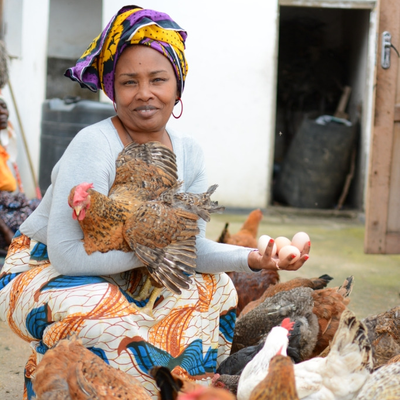
By Kilimokwanza.org Team · Dodoma — 22 May 2026
DODOMA — As this article goes to press, something unusual is unfolding on the floor of Mesuma Hall. Six of Tanzania’s leading financial institutions are sitting in the same room, under the same banner, around the same value chain — and they are not here to talk about risk in the abstract. They are here to share it.
AKM Glitters Company Limited, in partnership with Rikolto Tanzania and empowered by IDH’s Growing Together initiative, is convening the High-Level Stakeholder Dialogue on Contract Farming, Agricultural Financing and Farmer Organisation Development — a deliberately structured conversation aimed at one of the most stubborn knots in East African agriculture: how to wire smallholder maize producers into a reliable, financed, year-round market without the model collapsing under side-selling, default and mistrust within eighteen months.
The dialogue’s framing is unambiguous. In the official invitation circulated last week AKM Glitters set out the need to address “structural barriers affecting smallholder farmers and agribusiness SMEs,” organising the day around three pillars: policy and regulatory frameworks for contract farming and structured market systems; public-private collaboration in agricultural financing and risk-sharing mechanisms; and the strengthening of farmer organisations to build inclusive, competitive value chains.
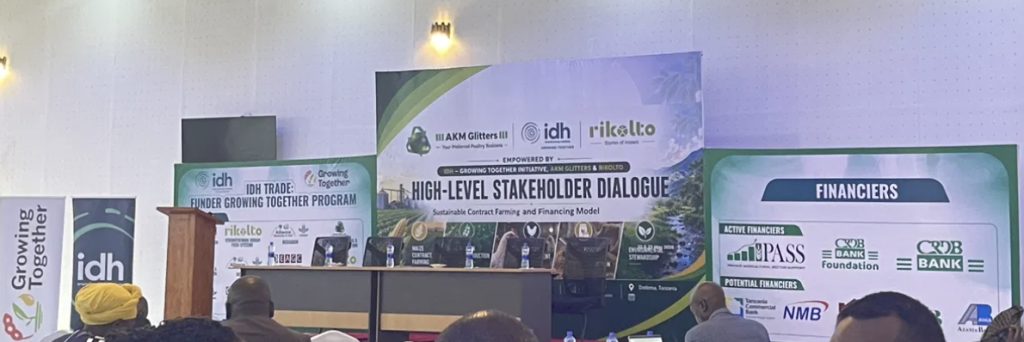
The financier line-up that made the room
If the agenda sets the intellectual frame, the financier wall behind the stage delivers the headline. Listed as active financiers are the Private Agricultural Sector Support Trust (PASS), the CRDB Bank Foundation, and CRDB Bank itself — three of the most experienced institutional players in Tanzanian agricultural lending. Listed as potential financiers are Tanzania Commercial Bank, NMB Bank and Azania Bank: a public-sector commercial bank, the country’s largest retail bank by network, and a respected mid-tier private lender.
For a sector long accustomed to development finance arriving in trickles and commercial finance arriving not at all, the optics matter. Six Tanzanian financial institutions converging on a single rural value chain — maize-to-poultry — at the invitation of a private agribusiness and an international NGO is not a routine event in Dodoma. It is, in the language of the Growing Together programme, the beginnings of a market system rather than a project.
Why maize, why poultry, why now
The strategic logic behind the dialogue is quietly elegant. Tanzania’s poultry sector, in which AKM Glitters is one of the most visible integrated players, runs on maize-based feed. Smallholder maize producers, in turn, run on volatile open-market pricing, late-season buyers and informal aggregation. Bridging the two — a structured, contracted, financed flow of grain from registered farmer organisations into a verified industrial off-taker — converts an unstable rural market into something a bank can actually underwrite.
That is the proposition AKM Glitters, Rikolto and IDH are bringing into Mesuma Hall today. The backdrop displays the operational architecture: maize contract farming, production, environmental stewardship — the three columns of a programme that wants to be measured not only by tonnages procured but by soil health, water stewardship and household resilience along the corridor.
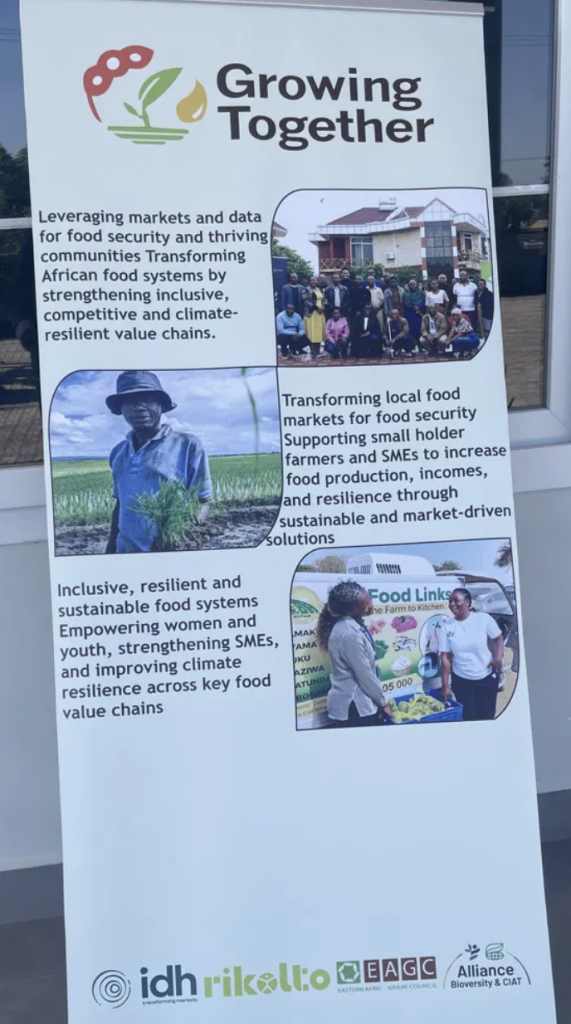
The presence of the Eastern Africa Grain Council (EAGC) and the Alliance of Bioversity & CIAT on the partner banner signals that the conversation is being placed in a regional grain trade frame and a climate-resilient food systems frame at the same time — a deliberate hedge against the historical tendency of contract farming pilots to be brilliant on commercial design and silent on agro-ecology.
“Structure is the missing ingredient”
Addressing the dialogue as it opens, AKM Glitters founder and Managing Director Elizabeth Swai is returning to a theme she has pressed in Tanzanian and continental forums for the better part of a decade: that the country’s smallholder economy is lucrative but unstructured, and that women and youth in particular cannot scale without finance written in a language that recognises rural risk.
“We have proven, with more than 300,000 farmers across 25 regions, that smallholders are bankable when the structure around them is sound — when there is an off-taker they can trust, inputs they can access on time, and a financier willing to look at the value chain rather than only the balance sheet,” Swai tells the gathering. “What we are doing in Dodoma today is putting that structure on the table — not as a pilot, but as a national conversation. Maize contract farming is not just about grain. It is about whether Tanzania’s rural women and youth get to participate in the industries that depend on them.”
Her intervention echoes a longer argument she has made since the Africa Food Systems Summit in Dar es Salaam in 2023: that the poultry value chain, properly structured, is one of the most efficient instruments Tanzania has for moving rural households up the income ladder — but only if financing follows production and not the other way around.
What the dialogue must deliver
The test of Mesuma Hall will not be the communiqué that emerges this evening. It will be whether the three pillars now under discussion translate into instruments. On policy, the question is whether Tanzania’s regulatory environment for contract farming and structured trade — currently a patchwork of warehouse receipts, EAGC standards and ministerial circulars — gets a coherent backbone. On financing, the question is whether the potential financiers listed on the backdrop today become active financiers by the next dialogue, with risk-sharing products that price smallholder default realistically rather than punitively. On farmer organisations, the question is whether the cooperatives and producer groups in the room can carry the contractual, agronomic and governance load that a serious off-take agreement demands.
Contract farming is not a new idea in this country. What is new — and what Dodoma may be remembered for — is the attempt to treat it as infrastructure rather than as a project. Banks, buyers, producers and regulators in one room is the architecture. The next eighteen months will tell us whether it holds.
This report is filed as the dialogue continues. Kilimokwanza.org will update with the closing communiqué and panel outcomes later today.
1 comment
Thank you, Madam Elizabeth Swai. You are truly exceptional. Your knowledge and talent in poultry farming are transforming people’s lives and improving their economic wellbeing. Very few can compare to you in this country. Stay blessed and continue inspiring others.
Massaba Jm