

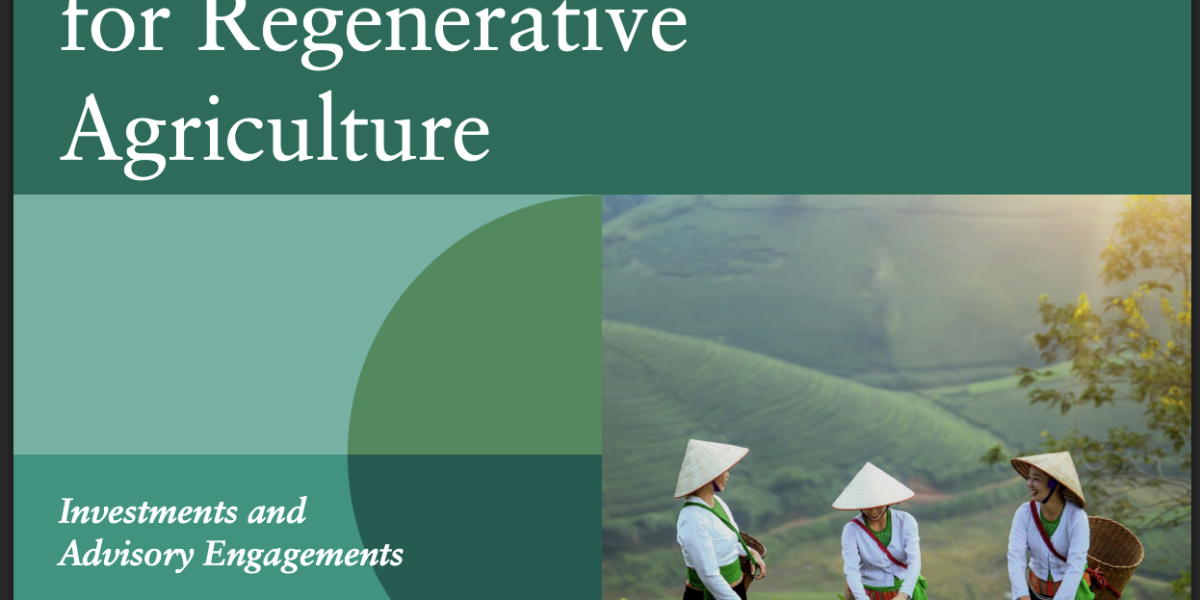
The International Finance Corporation has released what it describes as a first-of-its-kind framework to guide investments in regenerative farming — a move that could reshape how development finance flows to agribusinesses across emerging markets.
The document arrives at a moment of mounting urgency. One third of global soils are already degraded, agriculture is responsible for nearly one third of all global GHG emissions, and is the primary driver of biodiversity loss. Against this backdrop, the world’s largest development finance institution focused on the private sector has chosen to plant its flag firmly in regenerative agriculture territory.
The IFC’s Approach and Framework for Regenerative Agriculture, released in March 2026, is the result of an unusually deliberate gestation. The Framework is the product of more than two years of consultations with internal World Bank Group technical experts as well as external experts working at the forefront of regenerative agriculture implementation. That timeline matters: it signals this is not a hastily assembled communications document but a considered investment governance instrument.
The Problem It Seeks to Solve
At its core, the Framework addresses a gap that has hampered responsible investment in the sector. IFC is presenting the Approach and Framework to address a gap in the market for specific criteria or guardrails to be utilized by financial institutions in determining which investment or advisory engagements “count” as regenerative agriculture.
That question — what actually counts — is not trivial. Regenerative agriculture is an umbrella term for a broad range of practices and desired outcomes, and while common elements of regenerative systems are widely accepted, there is no governing body determining what practices are permitted or prohibited, as in organic production systems. This has left the field wide open to greenwashing, a risk the document openly acknowledges.
The trigger for the Framework’s design came partly from an external audit of corporate commitments. In 2023, the Farm Animal Investment Risk and Return Initiative (FAIRR) published The Four Labours of Regenerative Agriculture, an assessment of the commitments of the biggest agri-food companies towards regenerative agriculture. It was clear from FAIRR’s analysis that commitments varied widely — only 36% had quantified targets, 8% had targets to financially support farmers, 16% disclosed details on measurements and tracked impact, and 24% aligned regenerative agriculture with Scope 3 targets.
The “Three Rs” Architecture
The Framework is organized around what IFC calls three core impact areas. IFC views regenerative agriculture as a holistic ecosystem approach to agricultural production to protect farmers’ livelihoods and address biodiversity loss and climate change by building Resilience of farmer livelihoods, Restoring natural resources and cycles, and Reducing farm GHG emissions intensity.
What sets this framework apart from many peer efforts is the primacy it gives to the farmer’s economic reality. While some interpretations of regenerative agriculture focus on soil health as the primary driver for change and position farmer livelihood resilience as an intended result of the transition, IFC’s approach considers farm and farmer resilience as a central tenet for regenerative program implementation. The document is candid about why: a farmer is unlikely to prioritize reducing farm emissions and restoring natural resources unless it makes financial sense in the near-term, even though those impacts are likely to also positively improve farm resilience in the medium and long-term.
Minimum Criteria: Drawing the Line
The Framework establishes two tiers of minimum criteria — required and recommended — across both program-level principles and farm-level strategies. Required program principles include compliance with IFC Performance Standards, contribution to all three core impact areas, explicit strategies for improving farm financial success, multi-year engagement with farmers, inclusive capacity building, and a monitoring and reporting system with regular public disclosure.
At the farm level, required strategies include animal management with rotational grazing where livestock are present, a diversified cropping strategy — at least two crops in rotation for annuals, or diversification of species or varieties for perennials, soil protection and erosion management, and an input management strategy that progressively shifts toward biological and natural sources.
Recommended additions — the framework’s aspirational tier — include landscape approaches that bring in other off-takers, outcome-based KPIs, farmer access to finance, participatory design, independently verified impact, and soil management strategies including soil testing. The document notes that the Recommended Program Principles and Recommended Farm Strategies can be viewed as a plus for those agribusinesses that wish to deepen their commitments to the regenerative transition.
The Finance Gap and IFC’s Role
The scale of the challenge IFC is wading into is enormous. The Rockefeller Foundation estimates that the funding gap to shift conventional global food systems to regenerative is about $250–430 billion annually, for 10 years — while transitioning to regenerative agriculture could save $5.7 trillion in damages to people and the planet.
IFC’s toolkit to bridge that gap is multifaceted. In countries where donor resources are available, IFC can provide blended finance to lower the cost of capital for early-stage or higher-risk regenerative investments, structure incentive-linked loans and supply chain finance where interest rates or payment terms improve as farmers adopt verified practices, and expand risk-sharing facilities with local banks so they can lend to smallholders and agri SMEs for regenerative transitions.
The business case for agribusiness clients is also framed compellingly. According to the World Bank Group report Reboot Development: The Economics of a Livable Planet, a meta-analysis found that farmers’ profits increased by an average of 19 percent as a result of implementing nature-based solutions, and a separate meta-analysis showed that some common regenerative strategies increase gross revenues more than costs, resulting in stronger profit margins at the farm level.
Africa’s Particular Stakes
For readers in the East African development corridor, the document carries specific resonance. In Africa alone, increased uptake of regenerative agriculture could support nearly 5 million jobs by 2040. Meanwhile, extreme weather events impact small-scale farmers more immediately as they struggle to deal with water stress in crops and livestock, coastal erosion from rising sea levels, and unpredictable pest infestations — and these risks are often inequitably distributed, with women more vulnerable to climate-related disasters and 4 out of 5 people displaced by climate impacts being women and girls.
Guardrails and Caveats
The IFC is careful to frame this as a governance instrument, not a certification regime. This Approach and Framework is a work in progress intended to guide support to agribusiness clients implementing regenerative agriculture strategies, but is not intended to become a global standard or certification system, nor is it intended to be the sole avenue through which IFC supports agribusiness clients.
The Framework will be piloted, learned from, and revised. IFC will be preparing technical guidance to support the implementation of the Framework and will pilot this in investment and advisory engagements with clients, with the Framework subject to modification in the coming years to reflect lessons learned and further feedback from both internal and external stakeholders.
For agricultural development practitioners, agribusiness investors, and policymakers working across Sub-Saharan Africa, this document represents a significant shift in how a major multilateral financier operationalizes sustainability commitments — moving from aspiration to minimum criteria, and from rhetoric to measurable roadmaps. Whether it succeeds will depend on how rigorously IFC applies its own guardrails — and whether the smallholder farmers at the end of the value chain actually feel the difference.
The IFC Approach and Framework for Regenerative Agriculture is available at ifc.org. Questions may be directed to Julia Bolton at jbolton@ifc.org.