

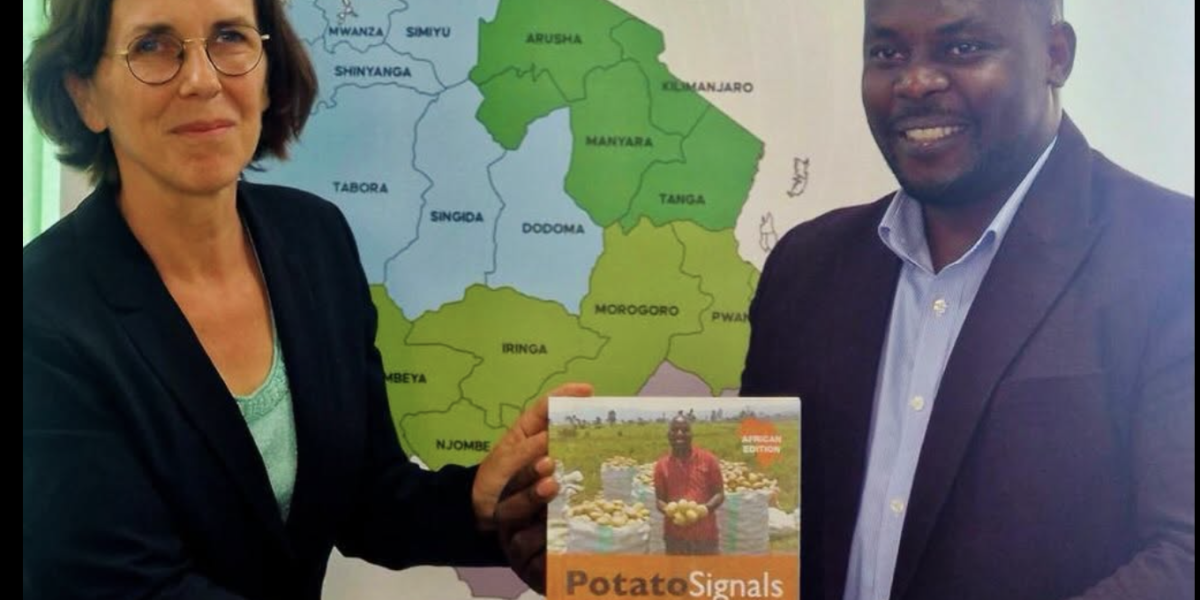
DAR ES SALAAM, 30 September 2026 — When potato farmers in Tanzania’s Southern Highlands planted recycled seed, they harvested fewer than 8 tonnes a hectare. Today, with certified seed and Dutch varieties, yields in farmers’ fields reach 30 tonnes. That result, and the partnership behind it, was on the table on Wednesday when the Ambassador of the Kingdom of the Netherlands, H.E. Marjo Crompvoets, led an Embassy delegation to the Agricultural Growth Corridors of Tanzania (AGCOT) Centre.
An introduction with a long history
The Ambassador was accompanied by Ms Yvonne van Laarhoven, the Embassy’s new Agricultural Counsellor for Kenya and Tanzania, and Ms Theonestina Mutabingwa, Agricultural Advisor. The delegation met the AGCOT team from 11:00 to 12:30 at the Centre’s offices on the 7th Floor of the Ministry of Home Affairs Building, Ohio Street.
The Embassy described the meeting as “a cordial introduction discussion to better understand ongoing work in the agriculture sector, and explore opportunities for the future collaboration.” In a statement on its Facebook page on 1 October 2026, it added: “AGCOT is one of the Embassy’s strategic agriculture partners, and we look forward to continued cooperation that supports sustainable agricultural development and shared impact.”
For AGCOT, the introduction came with a decade of shared work behind it. The Embassy officially joined the SAGCOT partnership in 2016. The Netherlands is one of several development partners, notably Norway, that have supported the SAGCOT initiative and now AGCOT.
“The Netherlands is one of our longest-standing partners,” said Abdallah S. Msambachi, Manager of the Tanzania Sustainable Soybean Initiative (TSSI) at AGCOT. “Over the years we have worked together to bring better potato seed and varieties to farmers, open the poultry and animal feed sectors to investment, strengthen feed ingredients supply, support poultry curriculum development and support spice agroforestry and local processing in Morogoro.”
The session, titled Growing together: AGCOT and the Netherlands, opened with a greeting in three languages — Karibu, Van harte welkom, Welcome. It moved from AGCOT’s model and results, through the history of Dutch engagement value chain by value chain, to ongoing work and the outlook for future collaboration.
Why agriculture, and why corridors
AGCOT opened with the stakes. Agriculture accounts for 26% of Tanzania’s GDP, 62% of employment, 65% of industrial raw materials and 30% of foreign-exchange earnings. Across Africa, the food import bill stands at about USD 80 billion and is projected to reach USD 110 billion by 2030, much of it wheat, edible oil, sugar, dairy and meat. Tanzania sits at the gateway to more than 300 million consumers in East, Central and Southern Africa, in an agribusiness market expected to reach USD 1 trillion by 2030.
The corridor model began in the Southern Highlands in 2010 as SAGCOT. On 17 March 2023, President Samia Suluhu Hassan directed that its lessons be taken to the rest of the country. The AGCOT Strategy was ready by August 2024, and AGCOT was launched in Dodoma on 27 April 2025, covering four corridors: Southern (SAGCOT), Northern, Central and Mtwara.
The Centre’s role is that of a neutral broker. It convenes government, business, farmer organisations and development partners, facilitates commodity and cluster compacts, tracks results and promotes investment. Msambachi summed up the pitch: “The central message was simple. AGCOT is a neutral and trusted platform that already delivers impact to scale, and the Netherlands remains a valued partner as we scale this work across all the corridors.” Land, commercial farmers and investment have already passed their 2030 marks.
Potato: fixing the seed system first
The potato story, centred on the Ihemi (Iringa, Njombe) and Mbarali (Mbeya, Songwe) clusters, shows how the partnership works. The barrier was not the soil or the farmer. It was the seed system.
Tanzania revised its Seed Act of 2003 to allow seed marketing and joined UPOV, the international convention on plant variety protection. Under a bilateral agreement between the Embassy and the Ministry of Agriculture, more than 30 high-yielding Dutch seed varieties were registered. The Embassy co-launched the Tanzania Potato Variety Catalogue with the regulator, TOSCI, whose staff were trained to certify seed potato. Dutch company HZPC brought professional seed production, and a centre of excellence for potato training was established at Uyole, Mbeya.
A potato strategic partnership then linked land preparation, fertiliser, seed, crop protection and storage firms. The Tanzania Horticulture and Potato Seed Platform (THPSP) brings together TAHA, World Vegetable Center, TASTA and TOSCI.
The results: yields of up to 30 tonnes per hectare in farmers’ fields, up from fewer than 8. Four new seed companies have entered the market, and demand for clean seed still outstrips supply. Investment has followed downstream into potato processing at Mapinga, Bagamoyo.
Lusitu: from 40 farmers to about 2,000
Lusitu Agri-Business shows what that means for a farmer group. When it was formalised in 2016, its smallholders faced high service costs, little access to quality seed, machinery or storage, weak business skills and poor market information. Partners worked with the group on practices, seed, markets and Kilimo Biashara business skills, and reformed the Rumbesa trade in overfilled sacks so that sales became standardised and transparent.
Membership has grown from 40 to about 2,000 farmers. Yields rose three- to four-fold, from 5 to 15–20 tonnes per acre, and farm revenue now stands at about TZS 14 million per hectare. Members have better access to finance, and the Potato Council of Tanzania (PCT) has been established, with its secretariat funded by the Netherlands Embassy.
The job is not finished. Tanzania still imports potatoes, which leaves room for local growers and processors to take a bigger share of the market.
Poultry and feed: the 70% problem
Poultry followed a similar route, starting with policy. A 2019 government MoU on poultry and aquaculture created working groups and impact clusters, and in 2022 SAGCOT joined the Poultry Working Group launched at an Embassy seminar. Most policy barriers have since been removed and regulators are being streamlined. VAT on processed animal feed and additives has been scrapped, a poultry stakeholders’ compact has been developed, and poultry curricula have been introduced at NTA levels 4 and 5.
Demand for day-old chicks and feed has risen, and modern breeds, many from the Netherlands, are reaching rural communities. Feed, however, remains the pressure point. It makes up 70% of poultry production costs and 60% in aquaculture.
Tanzania’s 279 registered feed manufacturers produce 897,750 tonnes a year, 56% of a 1.6 million-tonne target. Demand is forecast to reach 3 million tonnes by 2030, and soybean protein demand alone stands at 130,000–150,000 tonnes. A September 2023 Embassy–SAGCOT workshop focused on feed costs, soybean supply and alternative proteins.
That gap is the business of the Tanzania Sustainable Soybean Initiative, which builds seed systems and links farmers to off-takers. AGCOT pointed investors to openings in feed ingredients, premix and additive blending, mobile processing units, storage, portable quality scanners and digital feed formulation. Alternative sources, from cashew by-products to black soldier fly larvae, are creating new markets.
Spice trees for soil and income in Morogoro
The newest strand of the partnership joins nature and livelihoods. The Netherlands Embassy contracted AGCOT to implement a biodiversity and nature-based solutions project, using spice agroforestry to restore landscapes and conserve soil across three wards in Morogoro District, around the Uluguru Mountains. Supported by the Netherlands Ministry of Agriculture (LVVN), the pilot has trained 1,211 participants, procured 20,000 spice seedlings and identified 580 farmers for planting.
Tawa’s processing facility has received a solar dryer, an oil extractor and a slicer, so more of the value stays with local producers. A next phase would track seedling survival, market links with Get Aroma and Trianon B.V., and farmer income. A SPICE biodiversity proposal for 2027–2029 is being drafted.
TADAA: what 41 Dutch-linked firms say
Since October 2024, AGCOT has led the Tanzania–Dutch Agribusiness Accelerator (TADAA, 2024–2026) with support from the Embassy and RVO, the Netherlands Enterprise Agency. Its method is simple: find business needs, technologies and credible firms; connect partners, authorities and service providers; and take recurring policy and regulatory issues into dialogue. Priority value chains are horticulture, potatoes, seed, poultry, aquaculture, dairy, inputs and agricultural services.
Between May and September 2025, TADAA mapped 41 Dutch-linked SMEs in the Southern Highlands and profiled 17 of them in depth. Those 17 alone report more than USD 20 million in Dutch investment. An Animal Feed Investment Guide, prepared with the Ministry of Livestock, is in draft. The Digital Agribusiness Directory at digital.agcot.co.tz is live, with company verification and onboarding to follow.
The mapping is frank about what holds firms back. Of the 17 profiled:
- 15 already have local partners, and 14 apply climate-smart or sustainable practices.
- 10 want more partners.
- 10 face tax, permit or regulatory burdens.
- 5 are constrained by finance or slow loan approval.
- 4 are delayed by title-deed processing.
AGCOT takes these issues to its Policy Network, the Presidential Food and Agriculture Delivery Council (PFADC) and the Green Reference Group, a public–private sustainability platform.
Know-how is also reaching the field. In 2026, RVO-sponsored training brought Dutch and Tanzanian partners together for potato and vegetable farmers. HZPC covered certified seed potato, disease control and crop husbandry; East-West Seed, which serves more than two million growers in Tanzania, brought improved vegetable seed; Agriterra strengthened farmer organisations; and Mapinga Premium Foods provided structured market outlets. In Lukinga village, Gairo District, seed, training and market links were combined in one place.
“The real value of partnership is what it creates on the ground,” Msambachi said, “connecting businesses with farmers, traders and communities, and turning opportunities into something that can benefit everyone.”
Where the priorities meet
The Ambassador has been clear about what the Netherlands looks for in economic partnerships. Speaking to The Guardian (Tanzania) on 6 August 2026, she called for “trade, responsible investment and local value creation”, adding that “more processing must take place locally.”
AGCOT matched that agenda with four shared priorities:
- Strategic partnerships — extend and verify the Dutch-linked firm mapping across all four corridors.
- Feed, poultry and aquaculture — use sector platforms and the feed guide to identify investable cases.
- Seed and potato systems — match Dutch seed firms with Tanzanian partners that have clear demand.
- Spice agroforestry and processing — assess a next phase for planting, field results, processing and markets.
It also proposed joint answers to the constraints firms keep raising: verified profiles and targeted introductions for those seeking partners, bankable cases for lenders and investors, convening the responsible authorities on regulatory issues, and linking processing and cold-chain investors to corridor clusters to cut post-harvest losses.
The partnership has also invested in people. Through the Orange Knowledge Programme, with the Maastricht School of Management, it has supported youth capacity building and TVET curriculum development in horticulture.
Closing the session, the Ambassador said: “I would like to thank you very much for the detailed and comprehensive presentation. I look forward to further discussions on the opportunities we have seen and the important steps being taken to enable investment in the agricultural sector. I look forward to coming together again to explore the possibilities for working together.”
For the 2,000 farmers of Lusitu, and for the feed mills short of soybean, the measure of that next meeting will be practical: more certified seed, cheaper feed, fairer markets and more of the value kept at home. As AGCOT takes the corridor model across all four corridors under Tanzania Development Vision 2050 and Agriculture Master Plan 2050, the Dutch partnership offers a tested template for getting there.