

By Kilimokwanza
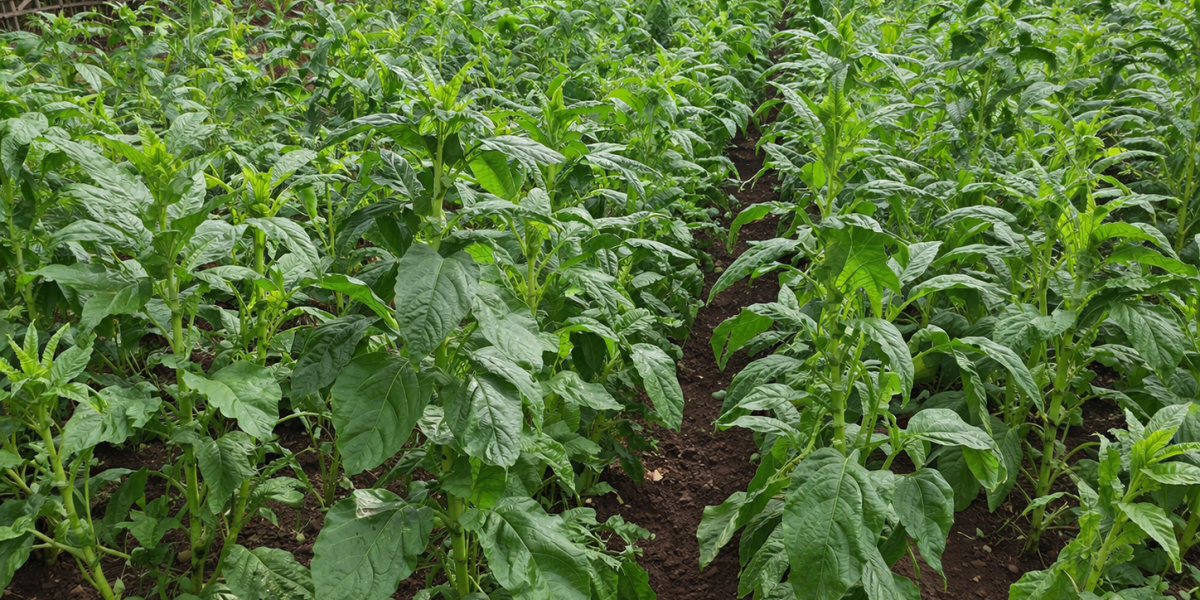
Amaranth, known in Kiswahili as mchicha, is one of the most nutritionally dense leafy vegetables grown in East Africa. Rich in iron, calcium, protein, and vitamins A and C, it is among the greens most frequently mentioned in discussions of food-based approaches to addressing micronutrient deficiencies in the region. It is widely cultivated, widely consumed, and deeply embedded in the food culture of Arusha and Kilimanjaro.
It is also, according to the July 2025 research brief titled Vegetable, Fruit, and Staple Crop Production and Input Use: Baseline Findings from the FRESH End-to-End Evaluation (Tanzania Evaluation, Research Brief 3, July 2025), being produced at yields that are a remarkable fraction of what the same crop achieves in controlled field trials conducted in the same regions. The brief records average amaranth yields of 4.5 tons per hectare across vegetable-farming households in the study area. Published field trial results from research conducted in Tanzania demonstrate yields ranging from 18.8 tons per hectare in the wet-cool season to 27.7 tons per hectare in the hot-dry season.
The gap between 4.5 and 27.7 tons per hectare is not a rounding error. It is a sixfold difference. And it carries significant implications for how the nutrition and food systems community thinks about supply-side interventions in northern Tanzania.
What the Baseline Found
Amaranth was the fourth most commonly cultivated vegetable in the study, grown by 182 of the 815 vegetable-farming households surveyed, representing 22% of vegetable farmers. This makes it a crop with meaningful reach across the farming population, not an exotic or marginal variety.
The land dedicated to amaranth averaged 0.4 acres per farming household, with the crop occupying approximately 33% of the cultivated plot area, consistent with intercropping practices. Average production per household was 20.8 kilograms, and average yield across the sample was 2.8 tons per hectare in the overall dataset, with the brief’s key messages section citing 4.5 tons per hectare as the summary yield figure.
The brief explicitly flags the gap as surprising, noting that field trials in the study regions have demonstrated substantially higher yields and citing the published Horttechnology research from 2019 by Dinssa and colleagues. The researchers did not attempt to fully explain the discrepancy in this baseline brief, but the data provides the starting point for understanding it.
The Seed Problem
One clue lies in seed use. Only 24% of amaranth-farming households reported using improved variety or hybrid seeds, compared to 69% for tomatoes, 89% for green cabbage, and 63% for collard greens. The great majority of amaranth farmers in the study area are planting local, traditional, or recycled seed.
The field trials that achieved 18 to 27 tons per hectare were conducted using improved amaranth breeding lines developed by the World Vegetable Center and partners. These varieties are selected for fast growth, high biomass, disease resistance, and climate resilience. The yield gap between improved varieties in trials and local varieties in farmers’ fields is, in part, a seed access and seed adoption gap.
The FRESH initiative has already begun to address this. The companion brief on promoting vegetable varieties reports that 23 amaranth breeding lines are currently being evaluated for vegetable and seed yields in two locations in Tanzania, and that seed kits including amaranth were distributed to 1,889 beneficiaries including 770 farmers. But the baseline data makes clear that these efforts need to scale considerably to move the aggregate yield numbers.
The Extension and Practice Gap
Seed alone does not explain the full yield gap. Input use for amaranth farming households was notably lower than for high-value commercial vegetables. While 73% of amaranth farmers used any fertiliser, only 10% used inorganic fertiliser. Only 31% used any pesticide, and just 10% used chemical pesticides.
Fertiliser and pest management practices are significant yield determinants for leafy vegetables. Amaranth responds strongly to nitrogen availability and can be severely set back by aphid and caterpillar pressure if not managed. The low input use rates suggest that amaranth is being farmed as a low-investment subsistence crop rather than as the high-yield commercial vegetable it is capable of being under the right management conditions.
Regional differences reinforce this picture. Fertiliser use for amaranth was 83% in Arusha but only 64% in Kilimanjaro. Use of improved seeds was 35% in Arusha but only 14% in Kilimanjaro. The extension and input supply systems are reaching farmers unevenly, and Kilimanjaro amaranth farmers are farming with less support.
Why It Matters
Amaranth is not a peripheral crop. It is cultivated by more than one in five vegetable-farming households in the study area. It is consumed regularly across both regions. It is nutritionally superior to most other leafy greens commonly eaten in Tanzania. And it is a crop for which the technology to achieve dramatically higher yields already exists and has been demonstrated in the study regions themselves.
Closing even half the gap between current farmer yields and demonstrated trial yields, from 4.5 to 15 tons per hectare, would represent a transformative increase in the local supply of one of the most nutritious foods available to households in Arusha and Kilimanjaro. The question the FRESH evaluation now needs to answer is whether the combination of improved varieties, targeted extension support, and better input access can bring that potential from the field trial to the smallholder farm.