April 2025 marked a defining moment of the decade for Tanzania’s agricultural sector.
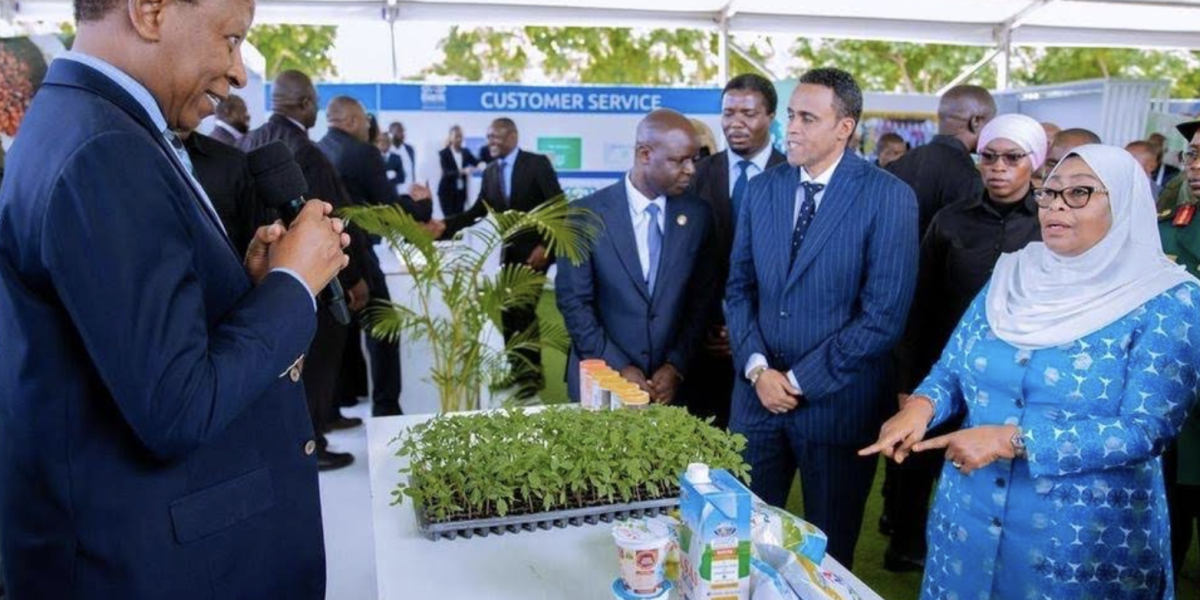
Dodoma, April 28, 2025 — Her Excellency President Dr Samia Suluhu Hassan, President of the United Republic of Tanzania, visited the AGCOT Pavilion during her tour of the National Exhibition at the Coops Bank launch in Dodoma, where she received a formal briefing on the rollout of the Agricultural Growth Corridors of Tanzania (AGCOT) framework, launched the previous day by Prime Minister Kassim Majaliwa.
During the visit, the President was briefed on the expansion of the former Southern Agricultural Growth Corridor of Tanzania (SAGCOT) into a nationwide agricultural transformation model.
“You have grown step by step, and now you have reached this level,” President Samia said, acknowledging the transition from a single corridor to a national framework, addressing the AGCOT CEO. Turning to young agripreneurs present at the pavilion, she added, “You are doing well, young people.”
AGCOT CEO Reports on Implementation of Presidential Instructions
The briefing was delivered by Mr Geoffrey Kirenga, Chief Executive Officer of AGCOT, who explained that the rollout of AGCOT is a direct implementation of the President’s earlier instructions to scale up proven agricultural models nationwide.
“We are implementing your instructions,” Kirenga said.
He explained that AGCOT now operates across four strategic corridors.
“We now have the Mtwara Corridor, the SAGCOT Corridor, the Central Corridor, and the Northern Corridor,” he said. “This expansion is guided by planning—so that we produce the right crops in the right areas, according to each corridor.”
Evidence from the SAGCOT Corridor
Kirenga outlined the performance of the SAGCOT Corridor as the foundation for national scale-up.
“Within the SAGCOT Corridor, private sector investment alone has exceeded USD 1.3 billion,” he said. “Government investment has been even higher—about USD 2.5 billion, mainly in roads, electricity, and related infrastructure.”
He emphasised that the most critical success factor was coordination rather than capital alone.
“The most important achievement has been the close working relationship between government and the private sector,” Kirenga said. “That private investment was made possible through collaboration—from regional and district leadership down to village level.”
Enterprise Transformation Across the Value Chain
The President was shown examples of enterprises at different stages of growth, demonstrating the effectiveness of the corridor approach.
In the dairy sector, Kirenga noted that one processor had grown from handling 12 litres of milk per day to over 400,000 litres, enabling Tanzania’s first-ever local production of powdered milk.
Youth-Led Agribusiness and BBT Impact
The briefing also highlighted youth transformation under the Building a Better Tomorrow (BBT) initiative.
Kirenga cited the example of Raha Aloyce, a young agripreneur from Morogoro.
“You personally supported her with twenty million shillings through the Ministry of Agriculture,” he said. “Today she employs nearly thirty young people and has repaid her loan in full.”
Adding to the update, Minister for Agriculture Hussein Bashe said that the same entrepreneur had now applied for one hundred million shillings to scale up her operations further.
Scaling What Works
Kirenga explained that the success of SAGCOT had informed the national rollout of AGCOT.
“This experience is what we are now taking to other parts of the country,” he said.
He noted that AGCOT is designed to institutionalise public-private collaboration and deliver measurable results across Tanzania’s diverse agro-ecological zones.
A National Framework for Agricultural Transformation
The visit concluded with the President commending the progress made and encouraging continued focus on results, particularly in empowering youth and building sustainable agricultural enterprises.
The AGCOT framework positions Tanzania’s agricultural transformation on a national footing—building on evidence, institutional coordination, and a results-driven corridor approach.