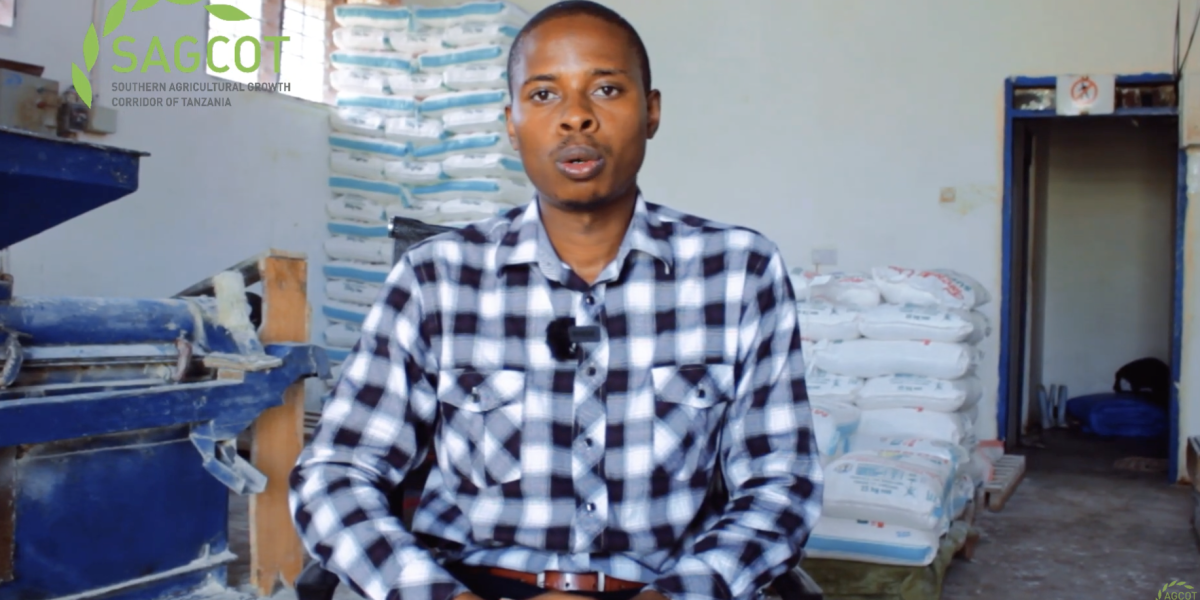
Every week, 90 tonnes of maize flows through Nassib Said’s factory in Morogoro. What arrives as humble kernels leaves as fortified flour—a transformation that has quietly positioned the 26-year-old entrepreneur at the center of Tanzania’s agricultural future. But Said’s real legacy isn’t measured in tonnage. It’s measured in the 25 young people now earning wages, in farmers across Iringa and Mbeya who have found a reliable buyer, and in urban Tanzanians discovering that locally processed grain can be as nutritious as it is affordable.
Said didn’t set out to disrupt anything. He simply noticed a gap that nobody else seemed willing to fill.
The Observation That Started It All
“Tanzania produces massive amounts of maize,” Said explains, his voice carrying the practical confidence of someone who has already solved what others still see as problems. “But in the cities, people don’t grow it. So they need it. That’s the gap.”
It’s a deceptively simple insight, but one that reveals the structural inefficiencies still embedded in East African agriculture. Tanzania’s rural heartland—Iringa, Mbeya, Njombe, Songea, Sumbawanga—produces more maize than it can consume. Yet in urban centers like Morogoro and Dar es Salaam, the demand for quality processed grain outpaces supply. Middlemen and importers fill the void, but often with products of uncertain provenance and dubious nutritional value.
Said decided he would be the bridge.
The Harder Part: Actually Building It
Walking into MOAFRICAN GROUP’s facility, the complexity of that bridge becomes apparent. It’s not simply about owning a mill. Every stage demands precision, discipline, and problem-solving that begins well before grain ever touches equipment.
It starts with sourcing. Said purchases maize directly from farmers in Tanzania’s major producing regions—a deliberate choice that distinguishes his operation from competitors who buy from urban middlemen. “When I source directly from farmers, I see the quality at the source,” he says. “I can reject what’s degraded before it becomes my problem.”
This matters because poor storage at the farm level is endemic. Farmers lack proper facilities. Maize sits exposed to moisture, heat, and pests. By the time it reaches Morogoro’s urban markets, quality has already deteriorated. Said’s model eliminates that decay by shortening the journey from harvest to processing.
Once maize arrives at his facility, the real work begins. The grain must be cleaned—dust, debris, and contaminants removed. Then it’s carefully conditioned with measured moisture to roast evenly. After roasting comes milling. But here’s where MOAFRICAN GROUP diverges from countless other small processors: before the flour is even bagged, Said’s operation adds fortification. Essential nutrients—vitamins and minerals that address Tanzania’s persistent malnutrition challenges—are incorporated directly into the product.
Packaging and distribution complete the chain.
On paper, it sounds straightforward. In practice, it’s an exercise in continuous problem-solving.
Where the System Fails
“The biggest challenge is raw material quality,” Said acknowledges. Despite his direct sourcing, some maize still arrives compromised. Farmers, lacking proper storage infrastructure, sometimes can’t deliver the quality they promise. When Said’s team inspects incoming grain, they occasionally must reject entire loads. It’s a loss—the farmer loses a sale, Said loses a processing opportunity—and it reveals a deeper problem: farmer training in post-harvest handling remains inadequate across Tanzania.
Beyond raw materials, infrastructure failures plague his operation. Tanzania’s electricity supply is notoriously unstable. Power surges and outages damage equipment and halt production. In a business with tight margins and time-sensitive orders, every hour without power translates into customers disappointed and competitors winning their business.
Then there’s the market education challenge. Fortified maize costs more than basic flour. Consumers accustomed to commodity pricing often don’t understand why. “Customer awareness about fortification is limited,” Said notes. “Many don’t realize the nutritional difference. I have to educate every customer about why the price reflects the value.”
Quality certification—a credential that would unlock doors to institutional buyers and larger supply chains—remains elusive. Said is pursuing it, but the pathway is bureaucratic and expensive, another obstacle that smaller processors must navigate alone.
The Education That Changed Everything
Recognizing that entrepreneurship requires more than vision and persistence, Said invested in formal training. In 2024, he completed SIDO’s (Small Industries Development Organization) entrepreneurship program in Dar es Salaam. He followed this with technical training from TBS (Tanzania Bureau of Standards) in Morogoro. He has participated in entrepreneurship courses across multiple institutions.
These programs proved transformative. SIDO training revealed something counterintuitive: that even a small factory—a modest operation like his—could achieve quality certification. “That training showed me it’s possible,” he says. “You don’t need to be massive. You just need to do things right.”
The entrepreneurship courses equipped him with business fundamentals—costing, pricing, market strategy, operational management—that transformed MOAFRICAN GROUP from a processing operation into a genuine business.
The Competitive Advantage
In a crowded market, Said has built a defensible position through three overlapping advantages. First, his direct sourcing from farmers provides cost savings unavailable to competitors dependent on urban middlemen. Second, his fortified product addresses a genuine health need in a way generic flour does not. Third, his direct engagement with customers—educating them about quality, explaining the fortification process, building relationships—transforms transactions into trust-based relationships.
“People come to understand that they’re not just buying flour,” he explains. “They’re buying health. They’re buying the fact that we worked directly with farmers. That story has value.”
The Human Equation
The 25 young people employed at MOAFRICAN GROUP aren’t abstractions in a business plan. They’re fellow Tanzanians who, before Said hired them, faced the chronic unemployment that plagues East African youth. Some work production jobs. Others handle packaging, quality control, or distribution.
The wages Said pays are modest by global standards but transformative locally—money that supports families, pays school fees, enables young people to imagine futures beyond casual labor.
Said is conscious of this impact. “This business has been able to help farmers in regions where we source get reliable markets,” he reflects. “And it’s helped young people who we’ve employed get income that supports their daily needs. And we pay taxes, which contributes to the national economy.”
The Bigger Picture
Said’s success is not isolated. He benefited from AGRA and MasterCard’s YEFFA program (Youth Entrepreneurship for the Future of Food and Agriculture), implemented through SAGCOT, which specifically identifies and supports young agripreneurs driving agricultural innovation across Tanzania. Said represents a growing cohort of youth refusing the false choice between agriculture and prosperity—proving that the sector can generate both.
Looking Outward
Said’s ambition extends beyond Morogoro. “My long-term goal is to reach more customers and increase production—expanding to Dar es Salaam and other regions.”
To realize this vision, he needs infrastructure support—particularly reliable electricity—and acceleration toward quality certification. With those investments, institutional buyers would open their doors. Supply chains currently beyond reach would become accessible. The 90 tonnes per week could become 200.
A Message to the Next Generation
For young Tanzanians considering agriculture, Said offers wisdom earned through struggle: “Agriculture pays, but you must have clear goals and good management. Startup costs are low. There are many opportunities in the value chain. The government and stakeholders support those doing things right.”
His words carry particular weight because he’s living them. He’s not romanticizing agriculture or minimizing its challenges. He’s demonstrating, quietly and methodically, that the real opportunities don’t end when the crop is harvested. They begin there.
They begin in processing. In innovation. In connecting rural producers to urban consumers. In transforming commodity grain into nutritious food. In creating jobs and opportunity where systems have traditionally created neither.
Nassib Said is proof that Tanzania’s agricultural future won’t be written by government policy alone or by foreign investors swooping in with capital. It will be written by young people like him—people willing to notice gaps, build bridges, and persist through the very real obstacles standing between ambition and reality.
One tonne of fortified maize at a time.