
Dar es Salaam — Strategic investment in market promotion is delivering tangible gains for Tanzania’s horticulture sector, boosting exports, job creation, and global visibility, according to a new academic study released at the end of 2025.
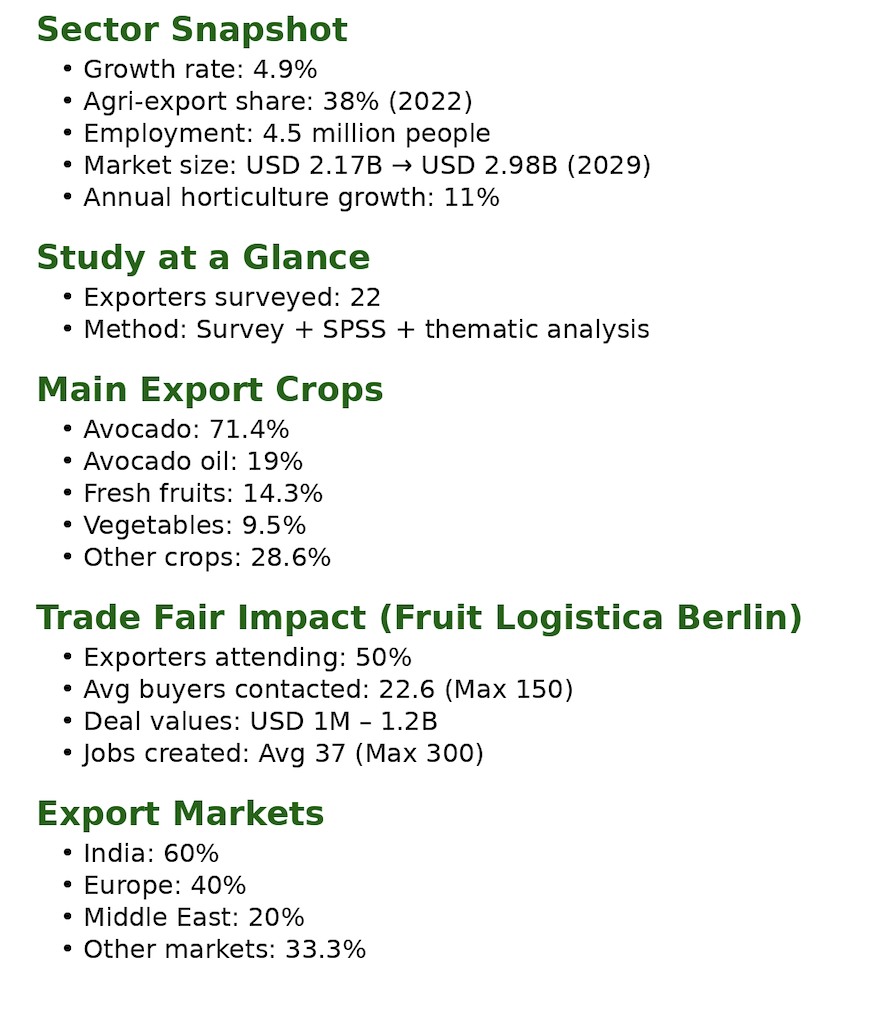
The paper, The Influence of Market Promotion on the Performance of the Tanzania Horticulture Sector, authored by Steven Tumaini and published in the Advanced Research in Economics and Business Strategy Journal, examines how trade fairs and exhibition-led promotion are shaping export performance across the country’s fast-growing horticulture industry.
Drawing on data from 22 Tanzanian exporters who participated in national, regional, and international exhibitions, the study finds that avocado exports dominate the sector, with more than 70 percent of surveyed exporters engaged in the crop. Value addition is also emerging, as nearly one-fifth of exporters now process avocado oil, signaling a gradual shift from raw produce exports to higher-value agro-processing.
The research highlights international trade fairs—particularly global platforms such as Fruit Logistica in Berlin—as powerful catalysts for market access. Exporters who attended these events reported new buyer contacts ranging from just a handful to as many as 150, with some securing business linkages valued at up to USD 1.2 billion. Beyond revenues, participation translated into employment gains, with firms hiring up to 300 additional workers following successful exhibitions.
“These findings show that market promotion is not a cosmetic activity—it directly influences export volumes, income generation, and employment,” the study notes, adding that horticulture is increasingly contributing foreign exchange earnings and livelihoods, especially for women and youth.
However, the paper also points to persistent challenges. Export market diversification remains shallow, with most firms supplying no more than three destinations, primarily India, Europe, and the Middle East. Heavy reliance on a single crop and limited markets exposes exporters to price volatility, phytosanitary barriers, and policy shocks. Smaller and emerging firms, in particular, struggle with the high costs of certification, logistics, and participation in international fairs.
Exporters surveyed called for stronger financial support, improved exhibition infrastructure, better national branding, and more inclusive participation for small and medium enterprises. Concerns were also raised about trade barriers and unresolved phytosanitary protocols that continue to constrain competitiveness for certain crops.
The study concludes that while Tanzania has made notable progress in positioning itself as a global horticulture player, sustained impact will require coordinated action. Recommended priorities include targeted financing for exporters, expanded capacity building on standards and certification, investment in cold-chain and logistics infrastructure, and a more deliberate strategy to diversify both crops and markets.
As global demand for high-value horticultural products continues to rise, the research underscores that effective market promotion—backed by policy support and private-sector readiness—could be a decisive factor in transforming Tanzania’s horticulture sector from an avocado-led exporter into a resilient, diversified engine of growth.
https://revue.univ-oran2.dz/Revue/AREBUS/index.php/AREBUS/article/view/110/84