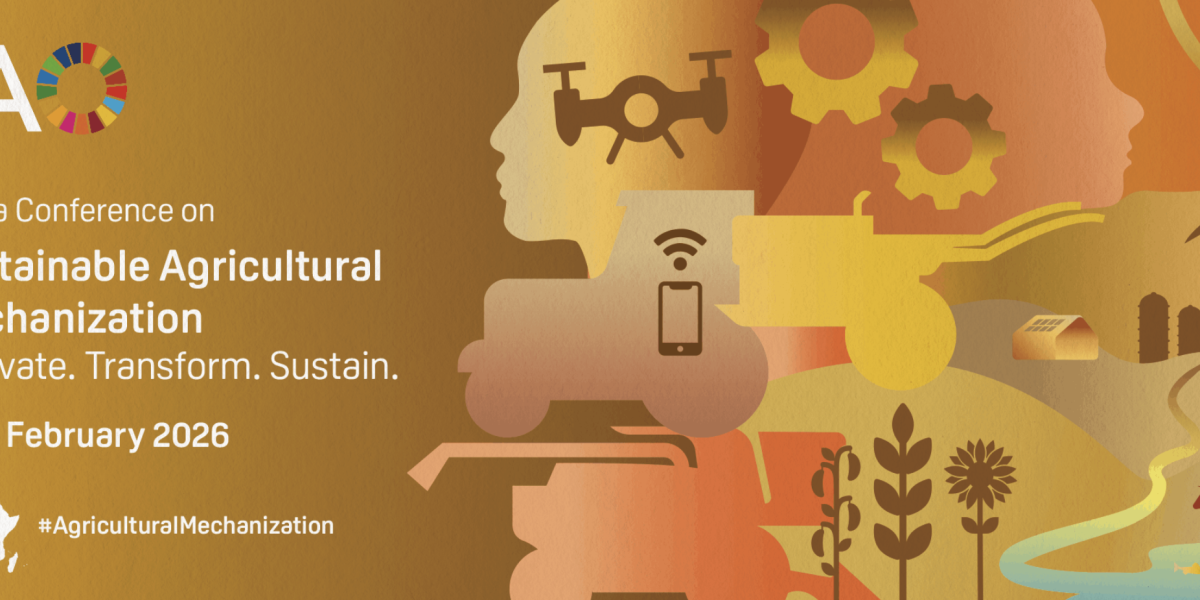
DAR ES SALAAM, Tanzania — When Prime Minister Mwigulu L. Nchemba takes the stage at the Almasi Ballroom on February 3rd to launch Tanzania’s Agricultural Mechanization Strategy, he will be setting in motion a continent-wide conversation that could reshape the future of African agriculture.
The Africa Conference on Sustainable Agricultural Mechanization, running from February 3-6, 2026, represents more than just another gathering of agricultural experts. It is a critical inflection point for a continent where over 307 million people struggle with hunger, where childhood malnutrition affects nearly one in three children, and where farming systems face mounting pressures from climate variability, labor shortages, and rising production costs.
Beyond Tools: A New Way of Working
“Agricultural mechanization offers more than just tools,” the conference organizers emphasize. “It opens up new ways of working that can help farmers tackle long-standing challenges.”
This philosophy permeates every session of the four-day event, organized by the Food and Agriculture Organization (FAO) in collaboration with the Government of Tanzania. From precision agriculture demonstrations to youth entrepreneurship masterclasses, the conference acknowledges that sustainable agricultural mechanization is not about imposing a one-size-fits-all technological solution, but about creating pathways that respect Africa’s diverse farming systems while addressing urgent productivity needs.
The numbers tell a sobering story. Food insecurity is rising across the continent, with stunting affecting roughly 31 percent of African children—well above the global average. Meanwhile, smallholder farmers continue to struggle with manual labor that is both physically demanding and increasingly insufficient to meet production demands.
A Neutral Space for Honest Dialogue
What distinguishes this conference from countless other agricultural forums is its deliberate positioning as “a neutral space” where farmers, mechanization service providers, research institutions, development agencies, policymakers, extension specialists, civil society, opinion leaders, and the private sector can engage in open dialogue.
The speaker list reads like a who’s who of African agricultural transformation: from FAO Deputy Director-General Beth Bechdol to African Union Commissioner Moses Vilakati, from grassroots innovators like Jerry Mallo of Bennie Agro Nigeria to academic leaders like Professor Linus Opara of Stellenbosch University.
But perhaps most telling is the deliberate inclusion of voices often marginalized in high-level agricultural policy discussions. Chef and FAO Goodwill Ambassador for Africa Fatmata Binta will share regional perspectives alongside government ministers. Youth entrepreneurs like Femi Adekoya, founder of Integrated Aerial Precision, and Yakub Kamal Yakub, CEO of TroTro Tractor, will present alongside senior World Bank and African Development Bank officials.
The Youth Question
The conference’s organizing committee has carved out substantial space for youth engagement—not as token participants, but as central actors in mechanization’s future. A special youth event on mechanization services as job opportunities features what organizers call “elevator speeches” from young trailblazers, followed by a World Café format for intimate dialogue.
The Thursday morning youth masterclass, “Mechanization Hire Services as a Business,” goes further, moving from theory to practical implementation. With Tanzania’s Minister of State for Youth Development in attendance, the session signals governmental recognition that mechanization must create employment, not just increase productivity.
“We’re not just talking about mechanization for mechanization’s sake,” explains one organizer. “We’re exploring how these technologies can open up new livelihood opportunities for a generation of young Africans who need viable economic pathways.”
From Local Artisans to Digital Platforms
The parallel sessions reveal the conference’s commitment to exploring mechanization across multiple scales and contexts. On Wednesday morning, attendees can choose between sessions on supply chain dynamics featuring presentations from Senegal on the role of local artisans, or research innovations showcasing everything from semi-integrated rice processing plants in Nigeria to precision agriculture applications in Kenya’s food basket regions.
One presentation, “Mechanising Diversification: Agronomic, Nutritional, and Labour Productivity of Maize–Legume Intercropping Systems in Zambia,” exemplifies the conference’s nuanced approach—recognizing that mechanization must serve nutritional diversity, not just monocrop efficiency.
Digital transformation sessions explore how drone technology, renewable energy systems, and platform-based models like TroTro Tractor and Hello Tractor are democratizing access to mechanization services. These innovations address a persistent challenge: how smallholder farmers can access expensive equipment without individual ownership.
The Money Question
Wednesday afternoon’s session on “Enhancing Investment and Financing of Mechanization” confronts the elephant in the room. Representatives from the African Development Bank, World Bank, and International Fund for Agricultural Development will join government officials and private sector leaders to discuss how to move mechanization financing from aspiration to reality.
Ernest Ruzindaza from the World Bank and Seth S. Meng from IFAD will share perspectives on multilateral financing, while Chinso Chipopola, Head of Field Operations at AGLEASCO Zambia, brings practical experience from leasing operations on the ground.
Conservation Meets Innovation
A critical thread running through the conference is the integration of conservation agriculture principles with mechanization. Sessions feature presentations from the African Conservation Tillage Network and CIMMYT on technological choices for sustainable mechanization of smallholder systems in Southern Africa.
This represents a significant evolution from earlier mechanization paradigms that sometimes prioritized productivity at the expense of soil health and environmental sustainability. The Framework for Sustainable Agricultural Mechanization in Africa (F-SAMA), subject of its own dedicated session, provides guidelines for implementation that balance efficiency with ecological resilience.
South-South Cooperation and Knowledge Exchange
Perhaps recognizing that Africa need not reinvent every wheel, the conference dedicates substantial attention to South-South cooperation. Presentations explore lessons from Asia’s mechanization journey, with contributions from the Philippines, Vietnam, India, and China.
The Tanzania-Philippines South-South and Triangular Cooperation Initiative on Capacity Development offers a case study in how knowledge transfer can be adapted to local contexts rather than imposed from above.
An Institutional Home for SAM
Thursday morning’s session may prove the conference’s most consequential. Delegates will discuss the establishment of a Centre for Sustainable Agricultural Mechanization (CSAM) for Africa—a permanent institutional home that could provide ongoing coordination, research, and support for mechanization efforts across the continent.
Saidi Mkomwa from the African Conservation Tillage Network will present a proposal outlining the rationale, scope, and institutional options, while Marco Silvestri from UNESCAP’s CSAM will share Asia’s experience. The question of ownership—whether the center should be housed within the African Union, hosted by a member state, or structured as an independent pan-African institution—promises robust debate.
From Talk to Action
The conference closes with a “Readiness for Action” panel that brings together African Union representatives, ministers, development partners including JICA, the World Bank, the African Development Bank, China Agricultural University, UNIDO, and Norway’s development agency.
This session’s composition suggests an understanding that sustainable mechanization at scale requires coordination among African governments, continental institutions, bilateral partners, multilateral organizations, and technical expertise from both within and outside the continent.
The Friday field visit to the IITA Youth Incubation Centre in Dar es Salaam and the Chauru Ruvu Rice Mechanization Cooperative offers participants a chance to see implementation on the ground—where policy meets practice, where investment translates into actual machinery in farmers’ fields.
The Path Forward
As delegates gather in Dar es Salaam, they carry with them the weight of continental expectations. Africa’s agricultural transformation cannot wait for perfect conditions or ideal solutions. Climate change is already disrupting growing seasons. Urban populations are expanding, demanding more food. Young people are looking for viable livelihoods.
The Africa Conference on Sustainable Agricultural Mechanization offers no silver bullets. But in creating space for honest dialogue among diverse stakeholders, in centering youth voices alongside traditional power brokers, in exploring financing mechanisms alongside conservation principles, and in considering permanent institutional structures for ongoing coordination, it charts a course that acknowledges complexity while insisting on action.
The question is not whether Africa can mechanize sustainably, but whether the continent can marshal the political will, financial resources, technical capacity, and institutional coordination to make it happen at the scale and speed required.
Over four days in Dar es Salaam, delegates will begin writing that answer.
The Africa Conference on Sustainable Agricultural Mechanization runs February 3-6, 2026, at the Almasi Ballroom in Dar es Salaam, Tanzania. Online participation is available via registration link on the conference website.