

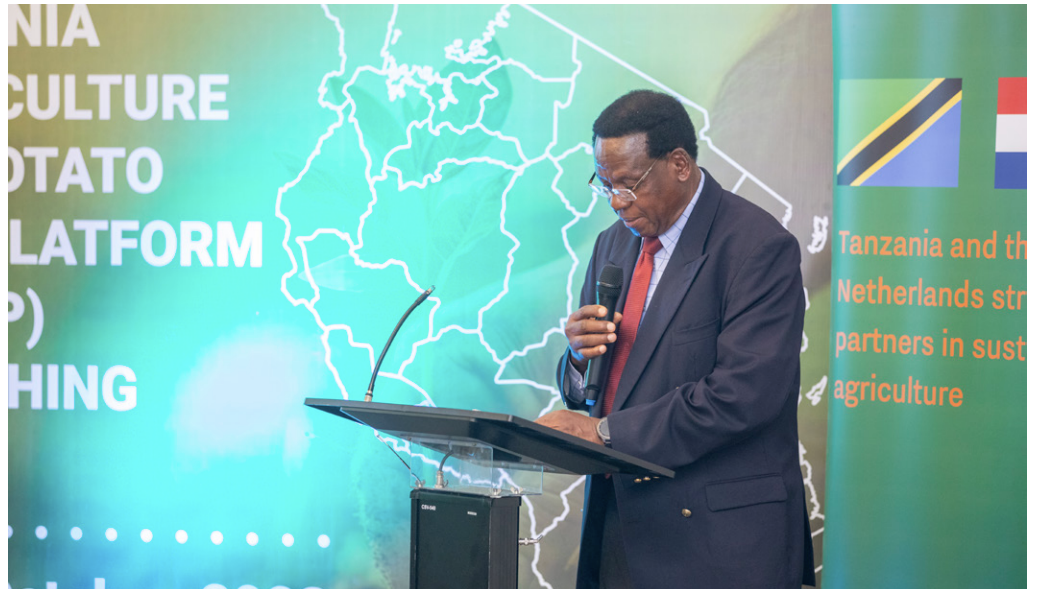
For nearly a quarter of a century, the Tanzania Seed Trade Association’s Executive Director has argued that food security starts in the seed -and that the country’s long dependence on imported seed is a standing bill paid in foreign exchange and lost jobs. On 9 September 2026 in Arusha, he watched part of that argument become a factory.
ARUSHA, September 2026 – Baldwin “Bob” Shuma spoke for the private sector as Agriculture Minister Hon. Daniel Chongolo (MP) opened Seed Co Tanzania’s TZS 18 billion seed-processing and warehousing plant in Engorora village, Kisongo Ward. He kept his message short. Every kilogramme of seed Tanzania imports, he told farmers, company officials and government leaders, is in effect a job sent abroad. The industry’s task is to bring that job, and its value, back home.
Shuma had already used that line. He had watched this site for three years. On 18 August 2023, Arusha Regional Commissioner Hon. John Mongella officiated the start of construction on the same Seed Co factory. Shuma kept a photograph of that day in his presentation slides, captioned with the hope that the plant would create jobs and cut seed imports. Three years on, Seed Co says it produces more than half of its Tanzania seed requirement locally, on a site covering about 7,100 square metres.
A parastatal’s rise and collapse
The system Shuma would spend his career reforming was built in a different Tanzania. After the 1967 Arusha Declaration, President Julius Nyerere’s Ujamaa policy placed agricultural inputs under state control, and mass campaigns such as Siasa ni Kilimo (“Politics is Agriculture”) put cereal production at the centre of national politics. The Seed Act of 1973 consolidated seed supply under the state, and the following year the government formed the Tanzania Seed Company (TANSEED) as a monopoly producer and distributor, working through state research stations and the National Milling Corporation.
TANSEED’s uniform, pan-territorial pricing left it unable to cover the real cost of transport to remote areas, and by multiple accounts certified seed often reached cooperative depots months after the rains had started, pushing farmers back onto unimproved grain. When Tanzania’s structural adjustment reforms of the late 1980s and early 1990s dismantled input subsidies and opened seed trade to private companies -authorised in 1990 and formalised in 1995 -TANSEED could not compete on commercial terms and slid toward insolvency. Early private entrants, for their part, gravitated to low-risk importing rather than local multiplication, and researchers who have studied the period describe smallholder use of certified seed falling sharply in the years that followed, with the great majority of rural households reverting to farm-saved seed.
Building TASTA
Private seed companies registered the Tanzania Seed Trade Association (TASTA) in 2002 -the association’s own records, the Ministry of Agriculture and Seed Co Tanzania all date its founding to that year -and brought in Shuma, an agronomist, to lead it. His arrival coincided with the Seed Act of 2003, which split the sector’s old combined role in two: the Tanzania Official Seed Certification Institute (TOSCI) took on quality assurance, and the Agricultural Seed Agency (ASA) took over public multiplication farms.
By 2020, TASTA’s membership had grown from its original six to 52 companies. By late 2023, it stood at 47: 26 local and 21 international. In 2021, the African Seed Access Index (TASAI) ranked TASTA second only to South Africa’s SANSOR as the most effective seed trade association among the African countries it assessed.
His favourite description of the work is the one he gave editors and journalists in Bagamoyo on 3–4 November 2023: seed business is the unfinished business of yesterday. The same slides listed his other rules:
- The farmer is the main client.
- The trade demands integrity and transparency.
- It is high-risk but profitable, so careful planning matters.
- “No trial and error with farmers.”
Seed, he argues, is not grain. It is a living product that needs careful research, handling and promotion, and it must be sown in the right season and the right ecology.
What partnership has already won
At the Agricultural Research Forum and Seed Stakeholder Meeting on 19 August 2020 at Mt. Meru Hotel, Arusha, Shuma listed what two decades of public–private partnership had won:
- Legal framework: the Seed Act 2003 and its 2007 regulations, plus the plant health and plant breeders’ rights frameworks.
- International standards: alignment with UPOV, OECD and ISTA.
- Lower costs: reviewed certification charges at TOSCI, removed levies, and revised taxes on packaging materials.
- Access to public varieties: the most practical gain. With support from AGRA, TASTA coordinated reforms letting private companies obtain early-generation seed of publicly bred varieties, ending the old requirement that a local company run its own breeding programme before it could go into business.
That reform has since produced its own success stories. Dr. Mary Mgonja, a Tanzanian plant breeder previously with AGRA and ICRISAT, licensed publicly bred maize and sorghum varieties to found Namburi Agricultural Company. Namburi now produces about 300 tonnes of certified maize seed annually, reaching some 15,000 farmers, alongside 50 tonnes of sorghum seed reaching a further 23,000 -the kind of domestic multiplication of public breeding that Shuma’s access reforms were designed to unlock.
Counterfeit seed was the other front. For years, fake and substandard seed had discouraged smallholders from adopting new technology, leading to poor harvests and heavy losses. TASTA worked with TOSCI, under Director General Patrick Ngwediagi, and with AGRA to roll out T-Hakiki, a verification service that lets a farmer check a seed lot by phone. By 2021, all 47 TASTA members were packaging seed under TOSCI labels, verifiable by USSD *148*52#. “Since 2017, policy and developmental actions have turned around the situation,” Shuma said. “Smallholder farmers have gained confidence with improved seeds, as there are ways of verifying them.” He also credits the retail network: “Unlike in the past, we have agro-dealers even at the village level selling certified seeds to smallholder farmers.”
The nineteen-year odyssey to international standing
Domestic reform was only half the task. Without enforceable plant breeders’ rights, international breeders were reluctant to license elite varieties into Tanzania for fear they would be multiplied without compensation; without international laboratory accreditation, seed certified in Tanzania had to be re-tested at foreign ports before it could be traded. Closing that gap took, in Shuma’s own reckoning, nineteen years of legislative and institutional work.
TASTA and the Ministry of Agriculture drafted the Plant Breeders’ Rights Act, which entered into force in 2013; Zanzibar passed matching legislation in 2014, giving the United Republic a single legal framework. On that foundation, Tanzania deposited its instrument of accession to the 1991 Act of UPOV in October 2015, becoming the 74th member of the Geneva-based body -and, notably, the first Least Developed Country to join under the stricter 1991 Convention. TASTA then worked to align domestic field-inspection protocols with OECD Seed Schemes.
The arc closed in September 2018, when Minister for Agriculture Charles Tizeba announced TOSCI’s laboratory accreditation under the International Seed Testing Association (ISTA) at a meeting in Arusha. “This completes the circle,” Shuma told the assembly. “Now Tanzania has UPOV, OECD, and ISTA membership and welcomes investors in agriculture and seed production for the local and the export market.” Seed tested and certified by TOSCI would now carry automatic scientific and legal standing in export markets, without re-testing at the border.
The dollar problem
Shuma’s case for local production is about foreign exchange as much as patriotism. In October 2023, when Tanzania was short of US dollars, he spelled out the risk in a Kiswahili interview. Imported hybrid seed, he said, is neither free nor aid. It is bought with foreign currency in markets such as Zimbabwe or Zambia, then taxed again on arrival. “If we run short of dollars, seed will run short,” he said. “If we do not produce enough seed ourselves, there is danger.”
His solution was specific. Tanzania should take its best irrigable valleys under government control and allocate them for irrigated hybrid seed production. Seed fields need isolation from ordinary maize, and the countries Tanzania buys hybrids from have already done this. “If we don’t do the same, we will keep buying from them,” he said.
Land, cess, and the evidence behind the advocacy
TASTA’s two policy briefs set out the gap in numbers, drawing on a survey of 25 members in Arusha, Kilimanjaro, Morogoro and Mbeya:
- Tanzania imports up to 40 percent of the certified seed used for food crops.
- Only 22 percent of cultivated land is planted with improved seed, and only 37.3 percent of households use improved seed.
- To meet national demand, TASTA estimates the seed sector needs about 105,000 additional hectares, which could create roughly 10,378 full-time jobs and 77,163 casual jobs, counting indirect employment.
- Without that land, companies leave: one member, Field Masters, moved most of its operations to Senegal and Mozambique after failing to secure land in Tanzania.
Shuma has made the land argument publicly and pointedly, including in front of Minister for Agriculture Adolf Mkenda during an inspection of Seed Co’s Arusha operations: “We have land for industrial parks for construction of shopping malls and skyscrapers but not for seed production.” His proposed remedy is a formal land-banking system -large parcels of state land set aside on long-term lease specifically for seed multiplication.
Seed cess told a similar story of policy outrunning practice. Seed was administratively exempted from local crop cess in 2017, yet three of the five districts TASTA studied were still charging it, at TZS 1,000 to TZS 6,000 per 100 kg bag. More than 70 percent of producers knew seed was exempt; many paid anyway to avoid roadside delays, seed deterioration and being labelled troublemakers. The Finance Act 2022 formally exempted seed. TASTA’s recommendation now is enforcement and awareness, backed by TOSCI transport orders that let district officials tell seed from grain.
Diversifying beyond maize
By the 2020s, TASTA’s convening role had widened beyond cereals. In June 2025, it co-hosted the Vegetable Breeders Innovation and Exchange Session with TOSCI, the World Vegetable Center, the Tanzania Horticultural Association (TAHA) and AGCOT, with the Netherlands Ambassador to Tanzania, H.E. Wiebe de Boer, as guest of honour. A parallel Netherlands-backed platform bringing together TASTA, TAHA, TOSCI, the World Vegetable Center and SAGCOT has pushed the same diversification into potatoes: Dutch breeders including HZPC, Agrico and Europlant have registered disease-resistant potato varieties yielding 25 to 50 tonnes per hectare, well above the 7 to 10 tonnes typical of the degenerated, virus-infected tubers Southern Highlands farmers relied on for generations. Shuma has been associated with that platform’s leadership, though the precise date of his appointment could not be independently confirmed and should be checked against TASTA’s own records before publication.
Fifteen years alongside the Corridor: TASTA and SAGCOT/AGCOT
TASTA’s push for land, policy coherence and diversification has run in parallel with a second institution: the Southern Agricultural Growth Corridor of Tanzania (SAGCOT), a public-private partnership launched at the World Economic Forum on Africa in Dar es Salaam in 2010 and formally unveiled the following year, when its Investment Blueprint set a target of bringing 350,000 hectares into commercial production. TASTA has been counted among SAGCOT’s private-sector partners since close to the beginning, and the seed sector’s land and regulatory problems -the same ones Shuma raised with Minister Mkenda -have repeatedly surfaced in the Corridor’s own work.
One well-documented strand of that collaboration is legal reform. The New Markets Lab, working with the SAGCOT Centre and funded by AGRA, produced a legal and regulatory mapping of Tanzania’s seed sector -published in April 2016 -that fed into the same push for streamlined variety registration and clearer seed law that TASTA was independently pursuing through its own policy briefs. TASTA and AGRA also worked with the Ministry of Agriculture, TOSCI and Sokoine University of Agriculture in subsequent years on multi-stakeholder seed platforms at the local government level, aimed at giving district officials and seed companies a standing forum to resolve exactly the kind of land-access and cess disputes described above.
The Corridor model itself has since scaled up. On 27 April 2025, Prime Minister Kassim Majaliwa launched the Agricultural Growth Corridors of Tanzania (AGCOT) in Dodoma, extending the SAGCOT approach nationwide through three additional corridors -Central, Northern and Mtwara -and folding the SAGCOT Centre into the new AGCOT Centre. The expansion sits inside the government’s Agriculture Master Plan 2050, which envisions the corridor model, backed by seed companies leasing public multiplication land under irrigation, as one route to closing the seed-supply gap described below. Some of the more granular figures associated with this expansion -specific hectare and tonnage targets for 2030, the number of local seed platforms established, and farmer counts under individual soybean and potato programmes -come from secondary reporting that could not be independently confirmed here and should be checked against TASTA’s and AGCOT Centre’s own records before publication.
Where the numbers stand today
The gap Shuma has spent two decades arguing about is still visible in this year’s figures. According to the Ministry of Agriculture’s 2026/27 budget presentation, national demand for quality seed stands at 127,650 tonnes a year, against available supply of 79,214.48 tonnes in 2025/26. The government’s target is to lift domestic production from 47,702.45 tonnes to 105,000 tonnes in 2026/27, and to raise overall availability to meet the full 127,650-tonne demand figure the following season. Those figures, current as of the Kisongo opening, are the ones to cite going forward rather than earlier production targets that have since been superseded.
What comes next
The Kisongo opening showed what Shuma has been pushing for: a private investor building locally; a public agency, the Agricultural Seed Agency, leasing irrigable land at Dabaga Farm in Iringa; and a minister promising sanctions against counterfeiters. Seed Co has signalled a second processing plant and a research station in southern Tanzania. Chongolo wants seed companies contracted to the new national extension agency rather than each running parallel field networks.
For Shuma, the measure is still the gap between what Tanzania grows and what it needs. Arusha narrowed it. It did not close it. In his own words, it is still unfinished business.
Sources: remarks at the Seed Co Tanzania plant opening, Kisongo, 9 September 2026; TASTA presentations of 19 August 2020 (Arusha) and 3–4 November 2023 (Bagamoyo); TASTA Policy Briefs No. 1 (Access to Land) and No. 2 (Seed Cess); interviews published 2021 and October 2023; Seed World, “Challenges and Opportunities for Seed Trade Between Africa and Europe” (Nov. 2018); UPOV, “Braving the Odds: Dr. Mary Mgonja’s Journey” (2024); Daily News, “Seed industry anchors agricultural productivity drive” (Sept. 2026); TanzaniaInvest and Ecofin Agency reporting on Ministry of Agriculture 2025/26–2026/27 budget figures; TASTA, Ministry of Agriculture, and Seed Co Tanzania on TASTA’s 2002 founding; SAGCOT Centre and Devex on SAGCOT’s 2010–2011 founding; New Markets Lab legal guides on the SAGCOT/AGRA seed regulatory mapping project (2016); The Citizen, Kilimo Kwanza and AGCOT Centre on the 27 April 2025 AGCOT launch.