

KILIMOKWANZA SPECIAL SERIES: ON AGCOT • WHAT TRANSFORMATION ACTUALLY LOOKS LIKE
Eighteen portraits from Tanzania’s agricultural corridor • Batch 4: The AGCOT Leadership • kilimokwanza.org
The Board Chairman Who Walked the Fields First
Dr. Ally Hussein Laay has chaired the AGCOT Centre board since 2018 – through a pandemic, an institutional rebrand, a USD 6.34 billion investment milestone, and the expansion of the corridor model from one region to the whole of Tanzania. In March 2026, he walked every farm on the Ihemi Cluster field visit himself, took his own notes, and arrived in Dodoma four days later carrying personal witness rather than a briefing document.
By Kilimokwanza Correspondent • Ihemi Cluster, Iringa and Njombe Regions • March 2026
DR. ALLY H. LAAY — AT A GLANCE
- Board Chairman, AGCOT Centre (formerly SAGCOT) – 2018 to present
- Led Ihemi Cluster field visit delegation, 9–12 March 2026
- Present: all six farm sites, both RC courtesy calls, board meeting, Dodoma briefing
- Co-presented field evidence to Minister Chongolo, 13 March 2026
- Presided over SAGCOT → AGCOT rebrand (2023)
IHEMI CLUSTER • The Board Chairman of the Agricultural Growth Corridors of Tanzania arrived in Lusitu Village, Njombe, on the morning of 9 March 2026, and walked into a ten-acre avocado orchard. He spent an hour listening to Beno Mgaya explain yield variation between tree rows, export rejection rates, and why Ruvuma’s soil drainage profile is superior to Njombe’s for Hass avocado. He asked questions that were not in any briefing document. He took notes himself.
That morning set the register for the four days that followed. Dr. Laay was not inspecting. He was learning. The distinction mattered to everyone who accompanied him, because a Board Chairman who is learning asks different questions from one who is confirming – and different questions produce different evidence.
“You can read all the investment reports. Then you meet Beno, and you understand what the model actually does to a person’s life. That is why we walk the farms. Not to confirm what we already know. To understand what we do not yet know.”
– Dr. Ally H. Laay, AGCOT Board Chairman
What makes the walk more significant is the distance Dr. Laay has travelled to be standing in that orchard. He has been Board Chairman since 2018. He has presided over eight years of the corridor’s most consequential period: a global pandemic, a change of government, an institutional rebrand, and the expansion of a model that began in southern Tanzania into a national programme covering four corridors and seventeen regions. He has seen what the evidence looks like in a ministerial report. He also knows that a ministerial report and a conversation with a farmer in his own field are not the same thing.
Eight Years in the Chair: A Chairmanship Record
| DR. ALLY H. LAAY — CHAIRMANSHIP RECORD: 2018–2026 | |
|---|---|
| 2018 | Laay’s first year as Chairman. He steered the Centre into its next five-year strategic phase and celebrated the launch of the Kilombero Cluster – pushing the initiative to the halfway mark of its projected six operational clusters. He pressed hard on research into gender inclusivity and extension services, insisting that the corridor model could not claim success if women and youth remained marginal to it. |
| 2019 | He described 2019 as a critical “bridging year” – the link between the 2014–2018 strategy and the 2020–2024 strategy. His priority was aligning the Centre’s work with Tanzania’s Agricultural Sector Development Programme II (ASDP II) and embedding the Inclusive Green Growth agenda into the corridor’s planning framework. The year was about laying the architecture, not the headlines. |
| 2020 | COVID-19 arrived. Laay described 2020 as the year the partnership learned “the true essence of resilience.” The Centre collaborated with the government to mitigate major disruptions to health, economic activity, and agribusinesses across the corridor zones. Supply chains were threatened. Farmer access to inputs broke down in some areas. The institutional coordination role of the corridor became, briefly, a crisis management role. |
| 2021 | Recovery and reflection. Laay centred his annual message on the power of Public-Private Partnerships – and pointed to specific policy advocacy wins: in dairy, sunflower, and horticulture. An independent End of Project Review commissioned by the Royal Norwegian Embassy confirmed the institution’s ongoing relevance to both the Tanzanian government and the private sector. For a Chairman who had just led the organisation through a pandemic year, that independent confirmation carried particular weight. |
| 2022 | The sector continued its recovery. Laay applauded the SAGCOT team’s perseverance and pledged the organisation’s full support to the government’s flagship Agenda 10/30 initiative and the Building a Better Tomorrow programme, which targeted bringing more youth into agricultural investment. Youth in agriculture was a theme he had pressed since 2018. By 2022, it had become government policy. |
| 2023 | A monumental year. Laay announced the most significant institutional shift in the organisation’s history: taking the SAGCOT model beyond the southern corridor to the rest of the country. The expansion to the Mtwara, Central (Great Lakes), and Northern Corridors required a new identity. He presided over the official rebrand from SAGCOT to AGCOT – the Agricultural Growth Corridors of Tanzania. Annual farming revenues from the corridor surpassed targets to reach USD 160 million. |
| 2024–25 | In his most recent annual messages, Laay presented the finalised 2025–2030 AGCOT strategy – the roadmap for the nationwide expansion. Cumulative corridor investments reached USD 6.34 billion – 111 percent of the original target, achieved five years ahead of schedule. He extended deep gratitude to the Royal Norwegian Embassy and the Government of Tanzania for signing the funding agreements that will facilitate the expansion. He was, at this point, stewarding an institution that had outgrown its original mandate and was beginning the work of becoming something larger. |
The March 2026 Ihemi Cluster field visit, in this context, is not a routine board activity. It is the act of a Chairman who has spent eight years reading reports about what the corridor does and who has decided, at the beginning of the next strategic cycle, to go and see it for himself. Not through a video call. Not through a site visit managed by staff. Through four days, on foot, in the rain, asking questions of farmers who do not know his title and do not need to.
Four Days, Six Sites
Day 1 in Lusitu gave him Beno Mgaya – the burial group turned avocado movement, the TZS 450 million annual income, the 1,000 farmers trained across five regions, the two percent rejection rate. The Tanzanice packhouse showed him what GLOBALG.A.P. certification actually requires at operational scale, and what the gap between current certification infrastructure and the 2030 avocado production surge actually means in practical terms.
Day 2 in Mtwango Village gave him ISOWELU AMCOS – Phokasi Ndikwege in a field in flower, Raymond Nyagawa with his hundred avocado trees and his retirement plan, Abdalla Kajogoo describing a TZS 1 billion loan with zero defaults in normal seasons. Then Tamu Tamu in Ifunda – Peter Schuurs, twenty-five years across Africa, who eliminated countries one by one and found Iringa; Lulu Maguru and her ten numbered cider varieties and the eleventh that is not yet excellent enough to release.
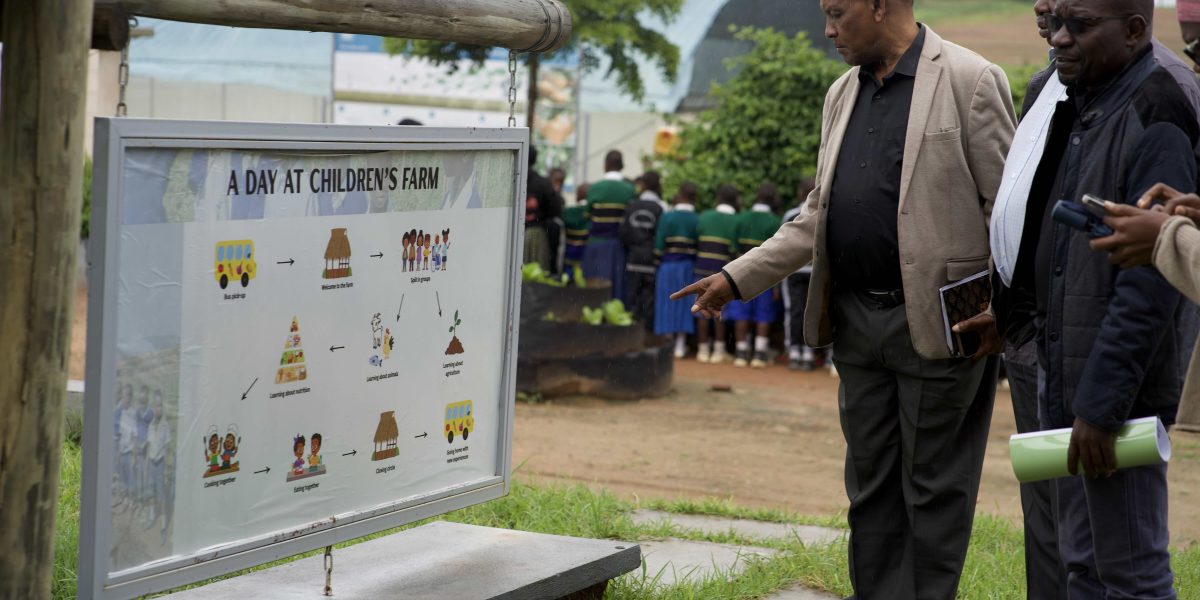
Day 3 was Farm for the Future in Ilula – 193 hectares of certified seed maize, 69 hectares of macadamia, forty schools in the children’s farm programme, twenty-five women in the third phase of Women for the Future, and two Norwegian exchange volunteers running a nutrition class for primary school children. And Fair Agro in Igumbilo – Suleman Farej’s propagation house, 3.3 million transplants per month, and a national franchise proposal that the board carried to Dodoma the following morning.
Day 4 was the board meeting and Dodoma.
The Farm for the Future Moment
The exchange that colleagues who accompanied the visit describe most often did not happen in a field. It happened in a classroom at Farm for the Future in Ilula, where two young Norwegian volunteers – nutrition specialists on a NOREC exchange programme – were running a lesson for local schoolchildren. Dr. Laay introduced himself. He introduced AGCOT. He explained, to two people who had come from Norway to work in Iringa and who may not have known what they were in the middle of, what the corridor is, what the partnership has built since 2011, and why Farm for the Future is one of the most important investments in the current portfolio.
“In Tanzania, we’ve got a collaboration between the government and the private sector to work in agriculture transformation. But that collaboration also works with your government in Norway through the Embassy of Norway in Tanzania. And we have been collaborating since 2011. All what you see here is a microcosm of that collaboration.”
– Dr. Ally H. Laay, AGCOT Board Chairman – Farm for the Future, Ilula, 11 March 2026
He was not speaking for the record. He was speaking to two young people who deserved to understand what they had come to be part of. The children’s farm programme they were helping to run – forty schools, twice a year, planting and harvesting and learning to cook with what they grew – was solving a problem that agricultural investment conferences discuss in abstract terms: how do you make farming attractive to the generation that will have to do it? You make it interesting when they are ten years old. You give them a reason to associate food production with something other than hard labour and uncertain income. You plant the idea before you ask them to plant the seed.
For a Chairman who had pressed gender and youth inclusion as a strategic priority since his first year in the chair, the classroom at Farm for the Future was not a soft side visit. It was a demonstration that the corridor’s investment thesis extends beyond the current season’s harvest to the people who will be farming in 2040.
The Specific Questions at Fair Agro
At Fair Agro, Dr. Laay spent more time at the propagation facility than at any other single engagement of the four-day visit. He asked Suleman Farej about the minimum viable franchise point size – what volume of transplant throughput was needed before a cooperative-based franchise point became self-sustaining without subsidy. He asked about the cost differential between a Fair Miche transplant and farm-gate direct-seeded production, and how that differential compared with the yield improvement it delivered. He asked about the AMCOS franchise agreement terms – the cooperative’s obligations, Fair Agro’s obligations, and what happened when a season was bad.
These were due diligence questions, not courtesy questions. They were the questions of a Board Chairman who had already decided the proposal was worth pursuing and was testing whether the model was structurally sound enough to recommend to the Ministry. The answers satisfied him. The Fair Agro national partnership proposal was the first item on the six-point agenda the board carried to Dodoma.
What the Chairmanship Has Prepared Him to Say
When the delegation arrived at the Ministry of Agriculture on 13 March, Dr. Laay presented not a policy brief but a field account – a sequential description of what the board had personally witnessed, cross-referenced with the data those witnesses generated. Beno Mgaya’s 600 trees at TZS 450 million per year. ISOWELU’s billion-shilling loan. Tamu Tamu’s five-country export footprint. Fair Agro’s 3.3 million transplants per month. The specific soil drainage advantage in Ruvuma that he had heard about from a farmer in an orchard on a cold morning in Lusitu.
But behind the field account was something only eight years in the chair can provide: the institutional memory to know which of these numbers represent genuine structural progress and which represent fragile gains that the wrong policy decision could reverse. He knows that sunflower oil processors built their investment on duty structures that were later changed. He knows that the certified seed potato supply is at under three percent of national need. He knows that the avocado certification pipeline is running behind the production surge. He has read eight years of annual reports. He has now also walked the farms.
“Tanzania’s agricultural transformation window is open now. The infrastructure exists, the private sector is investing, the cooperative models are proven, and the farmers are ready. What is required from Government is not funding alone, but political commitment and policy predictability across election cycles.”
– Dr. Ally H. Laay, AGCOT Board Chairman – Ihemi Cluster Board Meeting, 11 March 2026
The Board Chairman who walked into a ten-acre avocado orchard on 9 March walked out of a Ministerial meeting on 13 March with commitments on Ruvuma, seed potato supply, and youth land access that had not been on any agenda before the field visit began. He has been building toward that kind of evidence-to-commitment meeting since 2018. Eight years of chairmanship produced the institution, the investment record, and the 2025–2030 strategy. Four days in the field produced the specific commitments that the new strategic cycle needs to begin with. The walk was the work.
• • •
Kilimokwanza Special Series: What Transformation Actually Looks Like • Batch 4: The AGCOT Leadership • kilimokwanza.org • March 2026