

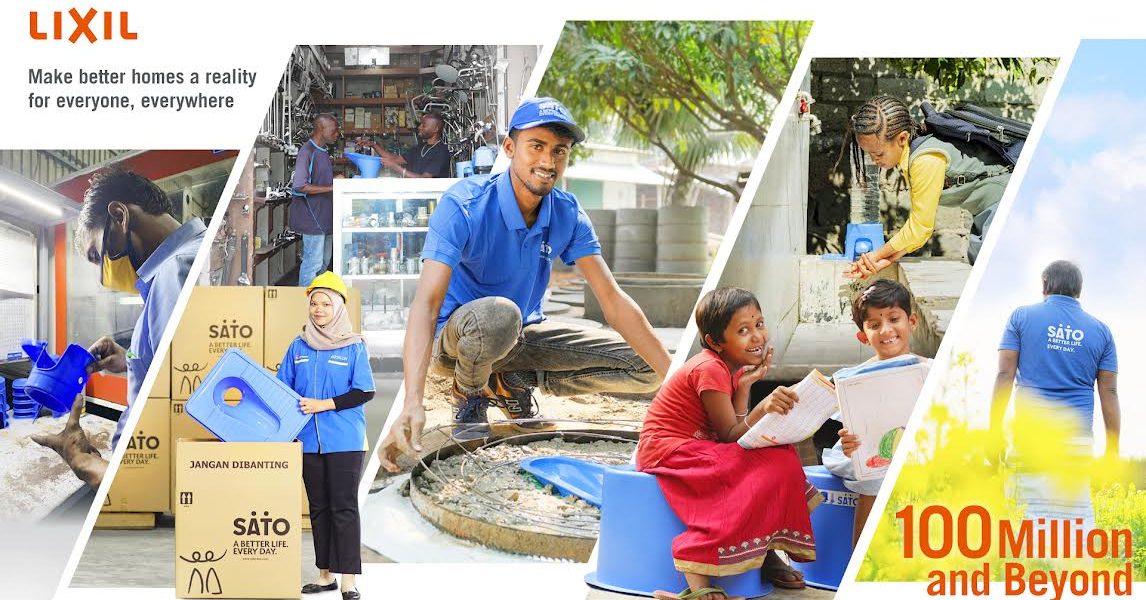
In rural Kenya, where nearly 40% of the population still lacks improved sanitation, an affordable Japanese-designed toilet solution is quietly transforming communities — one pit latrine at a time.
For millions of families across rural Kenya, the daily reality of sanitation is anything but dignified. Open pit latrines attract flies and disease. Handwashing stations are scarce. Children fall sick from preventable waterborne illnesses. In a country where more than 23 million people in rural areas have limited or no access to improved sanitation, the consequences are devastating — and deeply personal.
But a shift is underway, driven not by charity, but by a market-based model that is proving sanitation can be both affordable and sustainable.
LIXIL Corporation, the Japanese manufacturer of water and housing products, has announced that its social business arm, SATO, has now reached 103 million people globally with its sanitation and hygiene solutions. Kenya is one of the programme’s flagship markets — and a proving ground for what scaled, private sector-led sanitation can look like in Africa.
The Product: Deceptively Simple, Remarkably Effective
At the centre of SATO’s approach are two products that solve big problems with elegant simplicity.
The SATO Pan is a plastic toilet pan designed to seal open pit latrines. A weighted flap closes automatically after each use, blocking flies, odours, and the spread of disease — turning a basic pit into a more hygienic facility. The SATO Tap, meanwhile, is a portable handwashing device that delivers an effective handwash using just 100 millilitres of water — a critical innovation in water-scarce communities.
Neither product requires plumbing, electricity, or expensive infrastructure. They are designed for the realities of rural life — durable, intuitive, and priced within reach.
Kenya: Building Local Supply Chains, Not Aid Dependency
What distinguishes SATO from conventional development interventions is its insistence on working through markets rather than around them.
In Kenya, SATO has established local manufacturing and distribution networks, creating jobs and building supply chains that can sustain themselves beyond donor funding cycles. Working alongside UNICEF Kenya and the Ministry of Health, the programme has introduced and scaled its solutions in counties including Kitui and Siaya — two regions where open defecation rates have historically been among the highest in the country.
The approach addresses the full chain of barriers that keep rural families trapped in poor sanitation: awareness, product availability, local entrepreneurship, and access to microfinancing. Rather than distributing free products, SATO cultivates demand and builds the commercial infrastructure to meet it.
The Numbers Behind the Milestone
The 103-million figure is not just a headline. It represents over a decade of work since LIXIL launched its Global Sanitation and Hygiene strategy in 2013. The milestone encompasses families across multiple countries in Africa and Asia who now have access to improved sanitation — and with it, reduced disease burden, greater school attendance for girls, and new economic opportunities in the communities where SATO operates.
Globally, the stakes remain staggering. More than 1,000 children under the age of five die every day from diseases linked to unsafe water, poor sanitation, and inadequate hygiene. The economic toll runs into hundreds of billions of dollars annually in lost productivity and healthcare costs.
“Reaching 103 million people is not a finish line, but powerful proof that the private sector plays a critical role in addressing an urgent global issue,” said Kinya Seto, CEO of LIXIL.
The Road to 2030 — and the Acceleration Gap
Despite the progress, the global goal of universal access to safe sanitation by 2030 remains far off track. With fewer than five years to the deadline, the pace of progress needs to accelerate dramatically.
Erin McCusker, who leads SATO, described the 103-million milestone as “a vital transition point” rather than a destination. LIXIL has signalled that its upcoming 2030 targets will double down on private-sector innovation and market-driven models — an approach that, if Kenya is any indication, could offer a replicable blueprint for the continent.
For the millions of rural Kenyans still waiting for a safer, more dignified sanitation experience, the question is no longer whether affordable solutions exist. It is how fast they can reach the communities that need them most.
Data source: WHO/UNICEF Joint Monitoring Programme for Water Supply, Sanitation and Hygiene (2024)