

Seed Takes Centre Stage as Africa Hosts the World Potato Congress for the First Time
Day One of the 13th World Potato Congress in Naivasha put clean planting material at the heart of the agenda. Across the border, the Potato Council of Tanzania is preparing to sign a cooperation pact with its Kenyan counterpart on Wednesday. NAIVASHA, Kenya, 26 October 2026 — The 13th World Potato Congress (WPC 2026) opened on Monday, 26 October 2026, at the Sawela Lodges and Convention Centre on the shores of Lake Naivasha. It is the first time in the Congress's history that it has been held in Sub-Saharan Africa. The five-day meeting runs until Friday, 30 October, under the theme "Global Potato Partnership for Enhanced Food Systems, Nutrition Security and Trade". Delegates from 62 countries had registered by 9 October, according to the National Potato Council of Kenya (NPCK), which is co-hosting the Congress with FreshCrop Limited. For East Africa, the timing matters. Potato is a staple and a cash crop for hundreds of thousands of smallholder households in Kenya and Tanzania. Yet most farmers still plant seed saved from their last harvest, carrying disease forward season after season and keeping yields well below what the crop can deliver.Day One: three routes to clean seed
Monday was given over to six technical workshops before the formal opening. Three of them dealt directly with the problem that holds back African potato farming more than any other: the shortage of clean, certified seed. The Rooted Apical Cuttings (RAC) workshop ran from 09:00 to 14:00 and included a field visit from 11:30. Rooted cuttings are taken from disease-free mother plants raised from tissue culture, then grown on in nurseries. Because they can be produced close to farmers, they offer a faster and cheaper way to put clean starting material into the field. The Hybrid True Potato Seed (HTPS) workshop, from 09:00 to 12:00, looked at planting potatoes from botanical seed rather than tubers. Seed tubers are bulky, perishable and costly to move on rural roads. The session examined how new business models and partnerships could cut seed costs and widen access to quality planting material in lower-income countries. The Aeroponics workshop, from 14:00 to 16:30, covered soil-less production of mini-tubers in mist chambers, a method that keeps early-generation seed away from soil-borne disease. The other three workshops covered international potato marketing, a framework for international research collaboration on shared priorities and biosecurity, and global potato sustainability.A Congress built to last beyond Friday
The official opening was scheduled for 17:30, followed by a welcome reception from 19:00 to 21:00. The organisers have also launched the WPC 2026 Youth Engagement and 4K Club Programme. It links school agricultural clubs to potato production, with training in land preparation, certified seed production, soil health, integrated pest management, record-keeping and good agricultural practices. Selected participants will take part in the Congress and the Farmers Field Day, and the organisers hope the programme will continue at future Congresses. A structured platform of international working groups has been set up to keep collaboration going during and between Congresses. The local organising committee is chaired by Wachira Kaguongo, Chief Executive Officer of NPCK. Speaking when the Congress was launched in July 2025, he said: "It's time for Africa to take its rightful place in global food discussions."Tanzania at the table
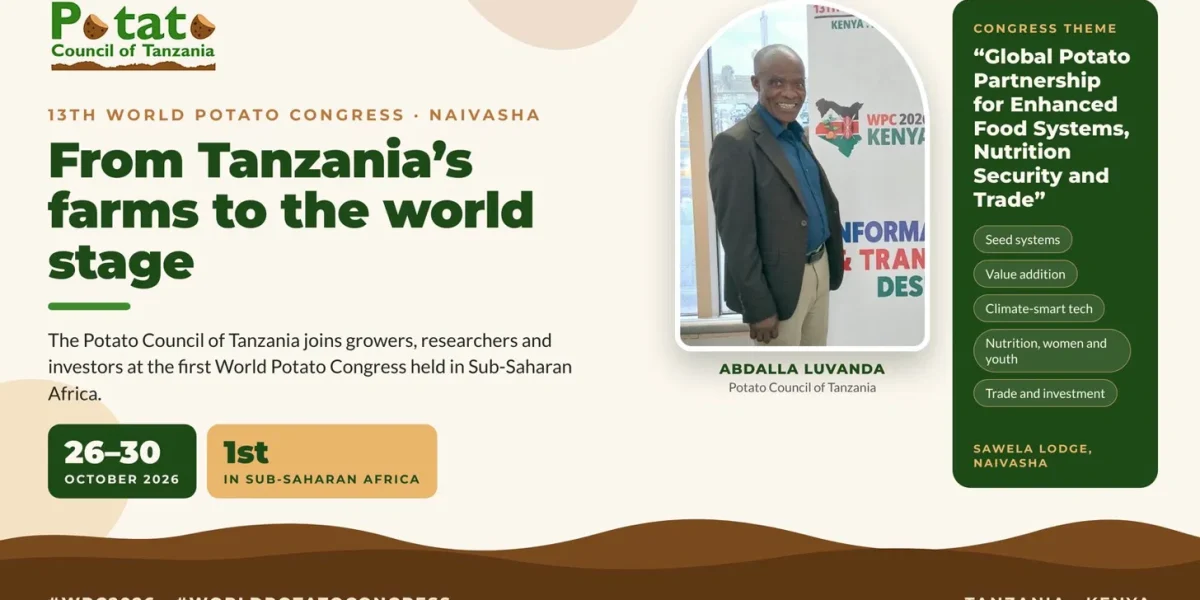
The Potato Council of Tanzania (PCT) is in Naivasha to represent Tanzania's potato sector, led by PCT Board Member Abdalla Luvanda. PCT is a young institution. It was registered in 2024 with the Business Registrations and Licensing Agency (BRELA). Its founding subscribers were the Avocado Society of Tanzania (ASTA), the then SAGCOT Centre (now AGCOT Centre ) and the Agricultural Council of Tanzania (ACT). The council speaks for a sector that has already shown what clean seed can do. In the Southern Highlands, farmers working with certified seed and good agricultural practices have raised average yields from about 7 tonnes per hectare to 28 tonnes per hectare. The constraint now is supply: certified seed remains scarce, and most Tanzanian growers still recycle their own.A pact for Wednesday
On Wednesday, 28 October 2026, PCT and NPCK will sign a Memorandum of Understanding at the official Congress dinner. The MoU sets out a framework for cooperation between the two countries' potato industries in four areas:- knowledge and technology exchange in production, post-harvest handling, storage and marketing
- information sharing on standards, quality assurance and regulatory frameworks
- trade linkages and market access between Kenya and Tanzania
- joint capacity building, research and exchange visits for farmers, seed producers and processors
"Monday was a day full of technology, from rooted cuttings to true potato seed and aeroponics," said Luvanda. "We are here to learn how to bring these innovations home and take Tanzania's potato sector to a new level for our farmers. Clean seed is where that starts, and Wednesday's agreement gives us a partner across the border to build it with."
The week ahead
| Date | What happens |
|---|---|
| Tuesday, 27 October | Session on processing growth in the Global South, with Sereni Fries (Kenya), HyFun Group (India) and SnowValley Agricultural Group (China) |
| Wednesday, 28 October | PCT–NPCK MoU signing at the official Congress dinner |
| Thursday, 29 October | Farmers Field Day at FreshCrop, Mau Narok; more than 1,500 Kenyan growers expected |
| Friday, 30 October | Congress closes |